
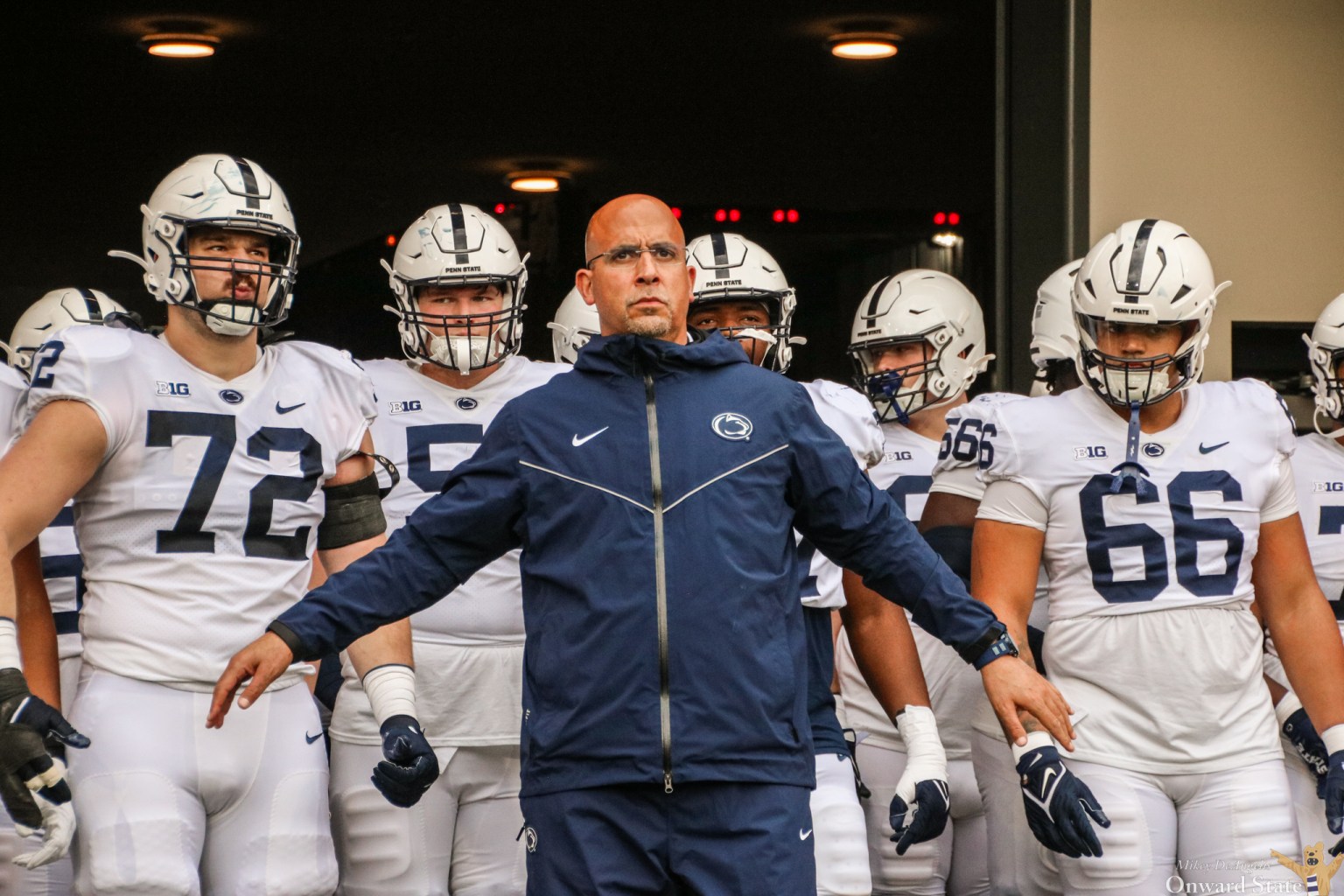
When James Franklin took the Vanderbilt job in 2011, he clocked in at the ripe young age of 39. He was, in every sense of the word, the young head coach, tackling whatever he could get his hands on, even if it meant the auspicious history of Vanderbilt football in the SEC. A few years later, Franklin would be the quintessential “hot name,” the up-and-coming coach talked about around coaching circles when new jobs would open. Eventually that next job came to fruition and Franklin was off to Penn State.
Now 51, Franklin is in many ways the same person he has always been, but also a bit wiser and a bit older. His age is not especially noticeable until you start looking at pictures from his introductory press conference. That’s when the passage of time hits you, maybe more noticeable in his children than anything else as the trio walked down the Beaver Stadium tunnel.
“There were some there was some advantages of being 39 and not knowing what I didn’t know. …” Franklin told StateCollege.com in a recent one-on-one interview. “You hear all the things that people say you can and can’t do and why and the history of the place and all those types of things. And we were just naive enough and confident enough to go in there and have some success. So I think that’s probably the biggest difference. Coming to a place like Penn State, it’s interesting, [I was] at a much different point in my career, but it was probably similar in some ways, where for different reasons I didn’t completely know what I was walking into, with all the, you know, specifics and details of the sanctions and so on and so forth.
“I’m still an emotional guy, but I’m probably less emotional than I was at 39. I’ll take a deep breath from time to time now where I didn’t before. So that’s probably the biggest difference — just more willing to kind of take it all in, willing to take a deep breath and making sure I’m not being driven by my emotions. That’s still a factor for me, but not, you know, not such a driving factor. It was when I was younger.”
In and of itself, 51 is not old by any means, but heading into the 2022 college football season CBS reported that the average age of all FBS Division I head coaches was 50. Franklin spent most of his career on one side of the slope; now he heads down the other. Ten years on the books at Penn State is a surprise — right? Especially for a coach who had bounced around the lower reaches of the profession for the opening stages of his career on a near annual basis.
“Yes, but that’s more because of the profession, right?” Franklin said. “It just doesn’t happen. And now you’re talking about the possibility of 20 years, so it’s unusual in the profession. It’s unusual in today’s college football.
“I did say that this was my dream job, but in a lot of ways it really wasn’t because I didn’t really see this. I thought it would always stay kind of within the family. And when I say within the family, somebody with strong Penn State ties, you know? …When I’m at Vanderbilt, and I saw I saw [Bill O’Brien] got the job, I think that kind of changed that a little bit. But I would also say I’m not wired like a lot of people were, a lot of people in this industry. They get a job and then a couple of years in, or even right away, sometimes they’re already thinking about the next job. And I’m really just not wired like that. So no, to sit here and say, I think I’d be here 10-plus years, no because I’ve never done that if you look at my career. I’ve never done that and been able to do that.”
Franklin will be 52 not long after the bowl season ends this upcoming year, and as the recruiting schedule increases and with the transfer portal changing the landscape of the game even more, it does beg the question if Franklin has a number in mind. If there is a finish line in sight one day down the road. All things being equal, he could retire tomorrow and never have to work another day in his life. At some point that prospect must become appealing, especially as the demands of the support slowly begin to outpace him.
“I don’t have a number, but me and my wife kind of go back and forth on this all the time,” Franklin said. “I don’t really know what I would do. I don’t have a whole lot of other hobbies. So I worry a little bit about that. She always talks to me about going on TV. I’ve done a little bit of that, some of that broadcasting stuff. But I’m not really sure — I don’t have a number in my mind. I think a lot of it’s going to be just how I feel, you know, those types of things. It’s not just how I feel but do I feel like I have the energy to give what college football takes nowadays and what Penn State needs. So it’s more of that; it’s not a number it’s kind of a feel.
“It’s funny that you say that though. We’re not an early offer team for the most part and we offered to a rising eighth grader in my office yesterday. I remember I’m sitting there meeting with the parents and the kid. I’m like holy shit, like am I really about to do this? Like I don’t believe in this; what am I doing? Well, thank God I got a 10-year contract. That’s the only chance I’ve got, you know, with this young man to kind of see it through with him.”
There are certain changes to college football that Franklin likes. The early signing period has become Penn State’s default signing day. It gets a lot of the heavy lifting out of the way early. But summer camp season is nearly endless, evaluation periods seemingly longer than the months they encompass. Managing a roster with the transfer portal looming is an endless player management challenge. There are truly no days off. However well Franklin and his staff might be compensated, there is a reality that, underneath the facade of endless energy and resources, Franklin and his staff are people. And people get tired. People want to see their families. People want to take breath.
But when, exactly?
“It’s not good for college football. It’s not good for coaches. I don’t think it’s good for the student-athletes. I don’t think it’s in really anyone’s best interest,” Franklin said. “I think, in theory, maybe it’s in the student-athletes best interest [but] I don’t think in reality it is. I just think I’m trying to be better. Can staff meet later and let everybody [rest]? Like we never had official visits in the summer. So you don’t have any weekends off. We’re now where you used to have weekends off in the summer. So what can we do? OK, now we’ll take Mondays off after an official visit weekend. It’s still not the whole weekend. But at least it’s that Monday and then later in the week have a staff meeting a little bit later than we normally do. Where can I throw bones?
“In the years past, we’ve had X number of days off. How can we get back to that same number in the in the current calendar? And we’ve done a good job of doing that and just kind of being aware of that, but they may not come in the same clusters. It may be a day here, a day there, so it’s hard to kind of get away if you want to or need to, but I think that’s where it just kind of wears on you is there’s not really any time of the year where it backs down. You get July, but that’s really the only thing that’s left.”
“I think the other thing that coaches struggle with is it’s a third of your time with your family, you’d like it to be a third of the time is with your current team and a third of the time is in recruiting. Well, as this recruiting thing continues to grow what does that take away from? You don’t want it to take away from your family. But you also don’t want it to take away from your current team. It makes no sense to spend all this time recruiting these guys that you bring into campus [and then can’t spend time with them]. That’s the challenge. I want to make sure I’m doing right by my family. I want to make sure I’m doing right by my current team. And then also doing what I have to do to build the program and sustain the program through recruiting. So that’s the hard part and it’s just there’s only so many hours in a day and so many days in a week, so something’s gonna have to change. And what really probably bothers me is how many coaches I know now that are trying to go to the NFL when they’ve probably would have been lifelong college coaches.”
Facing down nearly all of his 10-year contract, it’s hard to gauge how much the contract length really matters in today’s age of buyouts and negotiation. Nevertheless, it is very friendly to Franklin, whose buyout drops to $2 million in 2024 and just $1 million each following year. If anyone wants to hire him, that money will be no object. Meanwhile, if Penn State were to want to move on from Franklin without cause they will owe him his remaining salary on the deal. Firing Franklin halfway through his deal would still cost Penn State around $40 million.
For whatever it’s worth, Penn State AD Pat Kraft told StateCollege.com that he has never actually read Franklin’s new contract (which was negotiated under old AD Sandy Barbour), but with no real reason to move on from Franklin, this all may simply be a formality.
Does Franklin have the energy for 10 more years? Perhaps that’s a bigger question than the terms of the deal itself.
“I’ve never really lacked for energy. I’ve just always been that guy,” Franklin said. “I’ve just always been wired that way. … I would also say another big part of it is [Penn State Board of Trustees chair] Matt Schuyler, [university president] Neeli Bendapudi and Pat Kraft. I think they are a big part of that, because I really feel like me and my staff have been rejuvenated when I didn’t even realize I needed that. In the past, there were a lot of little no’s that I didn’t understand why they were no’s and some of them weren’t even financial ones. They were just philosophical or just things were more difficult than they needed to be. And in the last nine months we’ve had so many more little yes’s. Those little no’s, they add up and they wear on you.”
It’s practically a matter of public record that Franklin had become frustrated with Barbour and her administration toward the later stages of her tenure at Penn State. While Franklin is not entitled to get everything he wants just because he wants it, it’s fair to say the partnership had strained his enthusiasm for staying in State College.
But as things change, Kraft about as chummy and accommodating as Franklin could possibly ask for, the prospect of Franklin staying out the entirety of his deal seems less and less unlikely. A lot will change each and every year in college football, but there are a limited number of jobs Franklin would be suited for, probably even fewer he would be willing to take on. The futures of Clemson, Georgia and Alabama are all interesting, but Franklin’s passing interest in such a program might not be matched by an interest in hiring him. Any hopes of USC being a new start are likely well out the window as the Trojans begin their stint in the Big Ten under the watch of — fittingly — 39-year-old Lincoln Riley.
All told, if you drop the obligatory cynicism of taking long-term commitment in college athletics at something less than face value, it’s not totally unreasonable to foresee a situation in which Franklin really does coach out the remaining years on his deal.
Especially if he’s getting told “yes” more often than “no.”
“That’s where those things wear you down, because you’re fighting battles and you’re seeing what it could be. So you’re fighting all these battles constantly to try to get it where you know it can be. And I think that’s where… I don’t think most coaches want to leave,” Franklin said. “I think what happens is you get frustrated because the commitment level does not match the expectations. So that’s where the frustration comes. It’s great to have high expectations and that’s why you come to a place like Penn State. But does the commitment level truly match what the expectations are? And if they’re not, then somebody should be willing to come out and say, ‘hey, we’re not willing to do what these other places will do to win’ and make sure everybody knows that.”
For a coach that began to really make a name for himself at 39 and now looks to potentially coach his entire 50s at the same school, there is a potential for the embrace of settling down. Barring the unforeseen, Franklin could very well retire at Penn State. For the hyper ambitious it’s a strange feeling to finally say “this will do” although Franklin doesn’t see it as settling. And in truth he’s not wrong — most schools aren’t equipped to win a national title on Day 1 or even Day 5,000. Starting over somewhere else doesn’t make it any easier to do the same endless grind back to where you just were. If anything fighting the same battles in the same place might be the only way to really make progress.
“For me, it’s not settling,” Franklin said. “It’s waking up every single morning to fight the battles that I think need to be fought to allow us to reach our potential and get back to who I think we can be and who we have been in our past but a very long time ago,” Franklin said. “And that’s where having teammates having partners that are with you on that journey —Matt Schuyler, Neeli Bendapudi and Pat Kraft – now you’re not fighting those battles alone. You go in you and say we need to do these things and then you don’t even need to sell anymore. So that that has been very helpful, you’re not settling. You’re fighting those battles and now you’re in a position where you got people fighting with you.”
The deal runs until 2031. Check back then.



