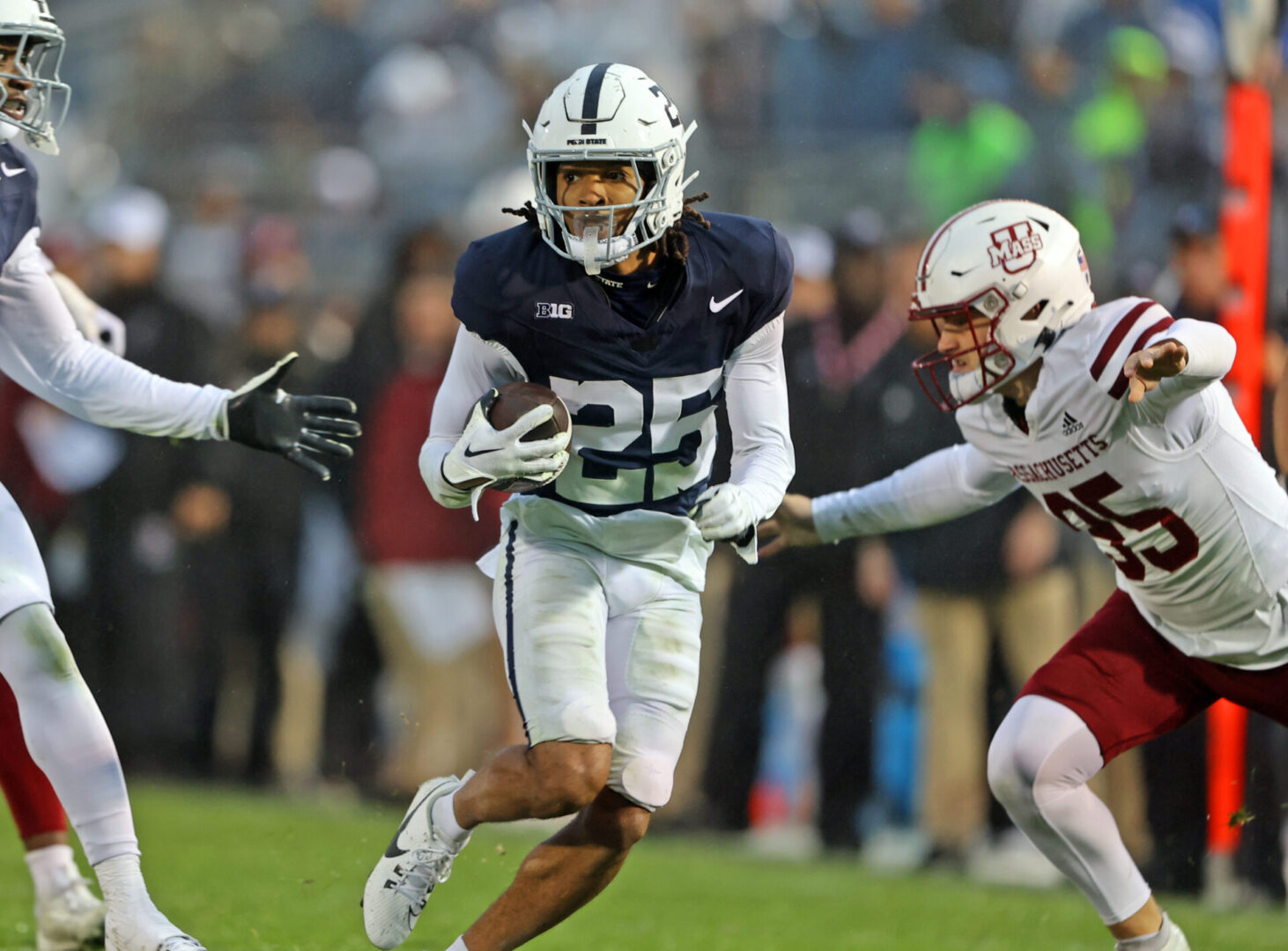
Penn State football introduced its third and final coordinator hire of the offseason as special teams coordinator Justin Lustig spoke to the media on Tuesday afternoon. Lustig comes to State College by way of Nashville, having spent time at Vanderbilt in the same role since 2021.
“My wife grew up in Erie,” Lustig, an Erie native as well, said a few hours after early morning snowfall ended in State College. “So that’s like snow capital of the world. I don’t think you can show us anything snow wise that we haven’t seen growing up.”
For the well-respected special teams guru, who was named a Broyles Award nominee in 2018, Lustig will have plenty on his plate this offseason as the Nittany Lions look to reload following the departures of placekicker Alex Felkins and primary punt returner Daequan Hardy. Former special teams coordinator Stacy Collins, who returned to Boise State this offseason, had done a good job of solidifying a special teams unit in 2023 that entered the season with plenty of question marks. Now Lustig will look to maintain, and build on, that success.
Which begs the question, what can Penn State’s special teams improve on? The answer is more what the Nittany Lions can do with the ball than when kicking it. When it comes to returning kicks, Penn State’s average ranking over the past eight seasons was 61st in the nation on punt return average and 52nd nationally in kickoff return average. The Nittany Lions have done better in both areas in recent years but have been ranked outside the top 50 in at least one of those two categories five times since 2016.
Flip over to the other side of the coin and Penn State has finished 38th and 32nd respectively in opponent punt return and opponent kick off return averages over the past eight seasons. End of the day, Penn State does a better job defending kicks than it does returning them but given the ever increasing strength of kickers and accuracy of punters that’s maybe not a huge surprise. Since 2016 Penn State’s punting average has been – on average – 39th best in the nation with this past year actually marking the highest punt yardage average of Penn State’s previous eight seasons, 12th-best nationally. Of course punting the ball far isn’t the only thing that matters. Good punts on short fields can be more valuable than bombs that go out the back of the end zone, so yardage isn’t the only thing that matters.
To that point, ESPN’s efficiency ratings saw Penn State finish the year at No. 21 nationally in special teams efficiency. ESPN defines efficiency as “a unit’s per-play contribution to a team’s scoring margin, adjusted for the opposing unit faced, expressed on a 0-to-100 scale.”
For context, here are the last eight seasons of Penn State’s rankings within this ESPN efficiency system:
- 2023: 21st
- 2022: 61st
- 2021: 61st
- 2020: 44th
- 2019: 3rd
- 2018: 23rd
- 2017: 15th
- 2016: 29th
So does Lustig need to improve things? Well, yes and no. Penn State has managed to be a decent special teams program, but with a roster that is constantly changing so too are a team’s strengths. The good news for fans is Lustig has a track record of getting the most out of hit unit and improving in it: During the 2023 and 2022 seasons Vanderbilt post two special teams units inside the Top 45 of the ESPN efficiency rankings after having been outside the Top 100 the year prior to his arrival. As a team in 2023, Vanderbilt was one of 20 programs in the country to block multiple punts – Penn State has had multiple blocked kicks just three times in past eight seasons.
“I think as as a coach, and as my growth has happened over the years, you learn to be accountable for your areas,” Lustig said of accountability. “I’m responsible for the special teams and it’s all gonna run through me and I know that when good things happen, I know that when bad things happen.”
And if Lustig’s resume is any indication, there should be a lot more good than the bad.