
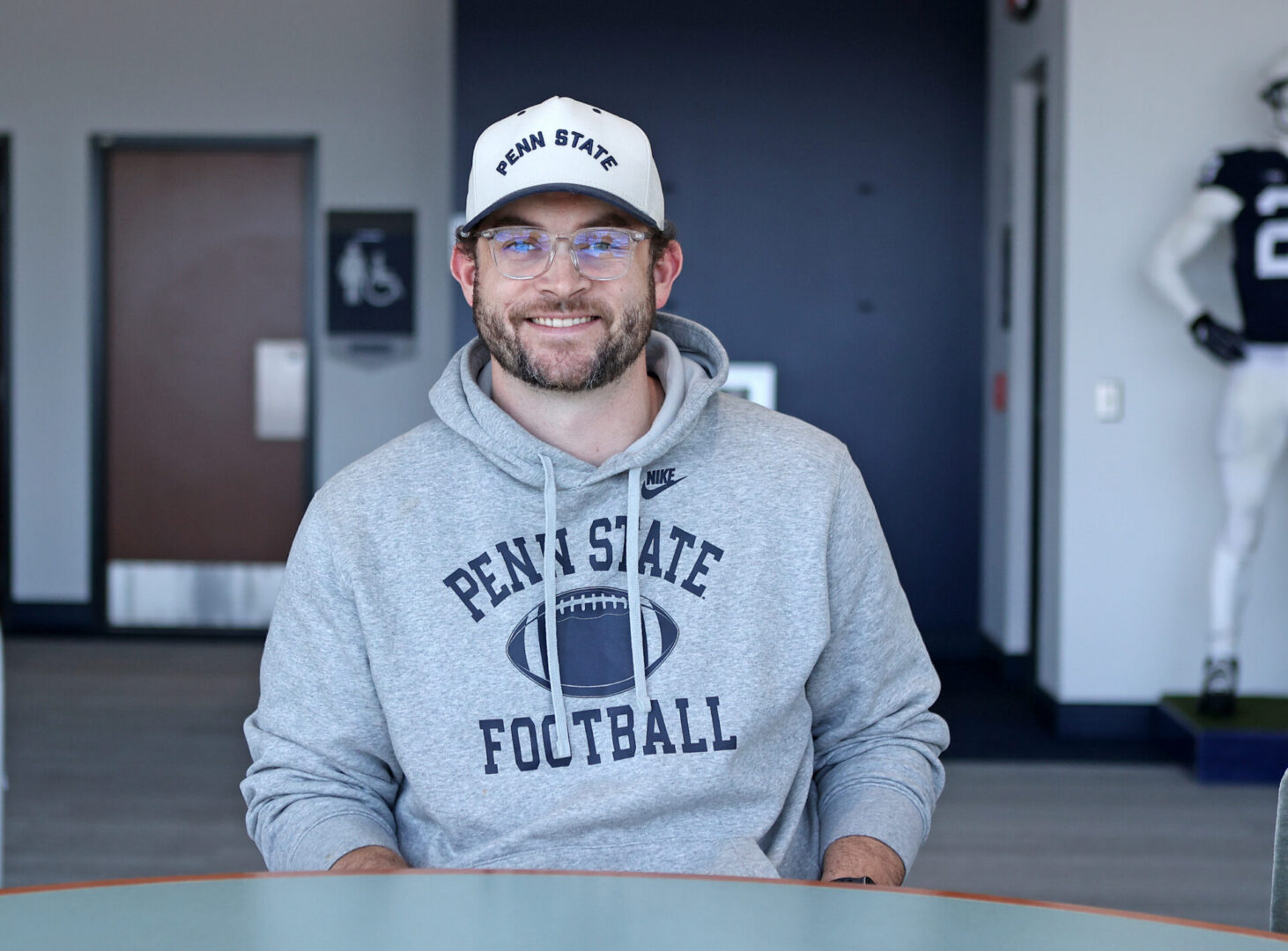
Under James Franklin, Penn State often opted for splashy hires at the coordinator positions, bringing in coaches with a proven track record at other stops. Head coach Matt Campbell took a different approach, bringing Taylor Mouser with him from Iowa State, with just two seasons of offensive coordinator experience under his belt.
It wasn’t long ago Mouser was flipping pizzas at Little Caesar’s, calling every coach he could get a number for and desperately looking for his first break into coaching. Voicemails became the norm, and only one head coach actually responded — Campbell, who was the head coach at Toledo at the time.
“He’s the only person that hit me back, and I’ll never forget that and the loyalty that he’s given to me to be able to promote me to a spot where I got to be the offensive coordinator,” Mouser said Wednesday.
That’s why following Campbell to Penn State was a no-brainer; Mouser said he’d go to Division III Mount Union (Campbell’s alma mater) if his head coach asked him to.
The young coach capitalized on the opportunity, rising from a graduate assistant to a director of scouting to a quality control coach and a tight ends coach, before landing the OC gig in 2024. That year, the Cyclones set a program record with 11 wins, their first time in double digits.
But what exactly does Mouser’s offense look like?
“We want to be, what I call is like a spread pro offense. If you’re watching NFL, we want to be similar to what the Los Angeles Rams are and probably what the Colts are from a bare bones structure of what the offense is; we want to be able to play multi personnel, multi tempo,” Mouser said.
Those comparisons make a lot of sense — Mouser cited Colts’ tight ends coach Tom Manning and Rams’ passing game coordinator Nate Scheelhaase as some of his biggest mentors, and both spent time at Iowa State while Mouser was there.
Another mentor is Washington State special teams coordinator and wide receivers coach Derek Sage, who was Toledo’s wide receivers coach during Mouser’s first year coaching.
But Mouser draws inspiration from a wide range of sources. He said every offensive coach on the staff has an NFL team and college team that they’re tasked with studying, constantly looking for new wrinkles to incorporate into their own offense. They even watch high school tape and talk to high school coaches for inspiration.
Mouser understands that constant evolution is a requirement in college football, and his Penn State offense won’t be the same as his Iowa State unit.
“I’d be naive to tell you we’re going to come here and do exactly what we did at Iowa State,” Mouser said. “We game players, we scheme everything up for the defenses that we’re going to see. There’s going to be a level of physicality and a level of effort that everybody here is going to recognize from the get-go, and I don’t know how pretty it’ll be to start, but these guys are going to play hard, and they’re going to play fast, and they’re going to play nasty.”
Mouser also said he plans to coach from up in the box rather than on the field, because he likes having a work station away from cameras and distractions.
In terms of personnel, effort level is one of the things Mouser is most impressed by from quarterback Rocco Becht, who transferred in from Ames with his final season of eligibility. He described Becht’s resiliency against UCF in 2024, leading a game-winning drive in the fourth quarter after throwing two pick-sixes earlier in the game.
“If you’re going to be a quarterback for us here, like you better have relationships with everybody on the team,” Mouser said. “I’m not really into putting a guy out there that is interested in just getting his. You got to be an unselfish guy that wants to go out there and be connected to the coaches, the players and the community, because we’re going to get more out of you like that.”
To hone that sense of togetherness, Mouser’s entire offense does up-downs at the end of practice for every drop by a wide receiver that day. He wants every practice rep to feel like “fourth-and-five with 110,000 people out there.”
“The drop affects all of us,” Mouser said. “It affects you guys, it affects me.”
Mouser also holds the title of tight ends coach, and he often incorporated 12- and 13-personnel looks with the Cyclones. He wants his tight ends to be versatile and well-rounded, which is similar to the previous regime.
“I always felt like a tight ends are kind of like the Swiss Army knife, like they give you size mismatches in the pass game, they add gaps in the run game,” Mouser said.
While some of his ideals sound familiar to recent blue-and-white offensive coordinators, one core tenant differed. Mouser said his biggest regrets after losses are usually related to conservative play-calling, and he wants to be aggressive because of the impact it can have on players’ mentality.
“I want to be fearless in the moment and give our guys the chance to go out there and make plays to win it, because that’ll trickle into our guys if they know I’m tiptoeing in the game plan and what we’re calling,” he said. “Being able to put our foot on the gas pedal and have our guys sprint to those explosive plays is how they work, in my opinion.”



