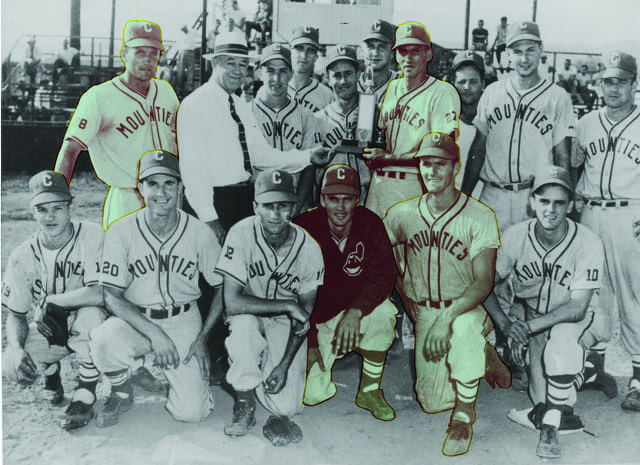
Across the Centre County Baseball League’s 96-year history, no name has been more closely associated with a town and a team than Chambers.
You say Chambers, I say Clarence. You say Clarence, I say Chambers.
Even today, nearly 50 years after the last of the four Chambers brothers hung up his Mounties jersey, if you talk to anyone who played in the league in the 1950s and ‘60s, and you mention perennial power Clarence, the response is overwhelmingly — “Oh, yeah, the Chambers boys.’’
There were five of them, and four of them — Howard, Roy, Phil and Dave — formed the core of the Clarence teams of their time. The fifth brother, Cordes, played sparingly and sometimes served as the team manager.
They were talented and tough in a time when no quarter was asked or given. You need to be wearing your big-boy cleats when you crossed the foul line to take the field against them. ‘Intense’ might be the best way to describe them.
The prevailing attitude around the league was that if you beat the Chambers, you could beat Clarence. It didn’t happen often. Dave was a 6-foot-3 pitcher. Roy was talented enough to play anywhere. Howard was primarily a first baseman. Phil was usually in center field.
“When you went to Clarence, you’d better be ready to play ball or you’d get beat,’’ said Phil. He and Dave, who are twins, are the surviving brothers. They’re 83 now.
“They were rough and tough and they played the game the way it was supposed to be played,’’ said Don Robinson, who played against the brothers for Port Matilda and a couple of other league teams and also went with Clarence to the Midland Tournament in 1962.
“I always looked forward to playing them,” Robinson said. When I was a bat boy at Port, I would hear about them. You’d watch them play and you wanted to be close to as good as they were.”
And they were good. Good enough that at one time in 1951, Phil, Dave and Roy were all playing in the minors. Think about that: Three brothers from a small town in central Pennsylvania in the minors at the same time. Howard also spent some time in the minors. In fact, in addition to the Chambers brothers, two other Clarence natives — Ed Drapcho and Sonny Kolasa — also were in the minors at one point. Drapcho, a left-hander, pitched Penn State to the final game of the 1957 College World Series.
None of them made it to the big leagues. Roy came closest, playing four years and reaching Class A where, for two summers, his roommate was Roger Maris. Phil was of the opinion that Dave had the most potential of the brothers.
“Of all of us, Dave was the one who could have made it,’’ he said, “as hard as he threw.’’
How hard?
“I think in the high 90s,’’ Dave said.
It was said that he was once clocked at 103 mph on a radar gun, but he wouldn’t acknowledge that.
“I didn’t see it (the reading)’’ he said.
How was it that these brothers came to be as good as they were? It’s not a mystery.
“There was no television, no iPads,’’ Phil said. “We were on the field playing ball all the time.‘’
For a time in the ‘50s , right there with them, was a youngster who lived just past the right-field fence.
“They were instrumental in my knowledge of the game,’’ said Alex Murnyack, who went on to play at Bald Eagle Area and Clarion and then coached at BEA. “They helped me tremendously. I’d go over to the field and shag fly balls, or whatever, and then when they were done they’d let me take a few swings. They’d hit some balls in the creek and when I couldn’t quite hit them that far, they’d tease me. But they’d encourage me to do the best I could do.
“I was probably the closest to Dave since I was a catcher. He was an amazing pitcher and it really helped me to catch a guy who threw as hard as he did. I used to go to practice in my bare feet and those guys would call me Indian. Even today, when I see him in church or wherever, Dave still calls me Indian.’’
Around the league the brothers were respected for their ability on the field but also carried the reputation of being brawlers. The reputation wasn’t accurate, Phil said.
“We weren’t fighters, we were ball players,’’ Phil said. “We didn’t want to fight. We wanted to win.’’
“The other teams always said that because we’d beat them and they’d use that as an excuse,’’ added Dave.
“You know how it is, teams always want to get the top team,’’ Phil said. “They would play their hardest to beat you. Our biggest rivalry was with the team that was right behind us in the standings. That was usually Pleasant Gap. Teams knew they had to beat David and he was hard to beat.’
He was. And so were the Mounties.