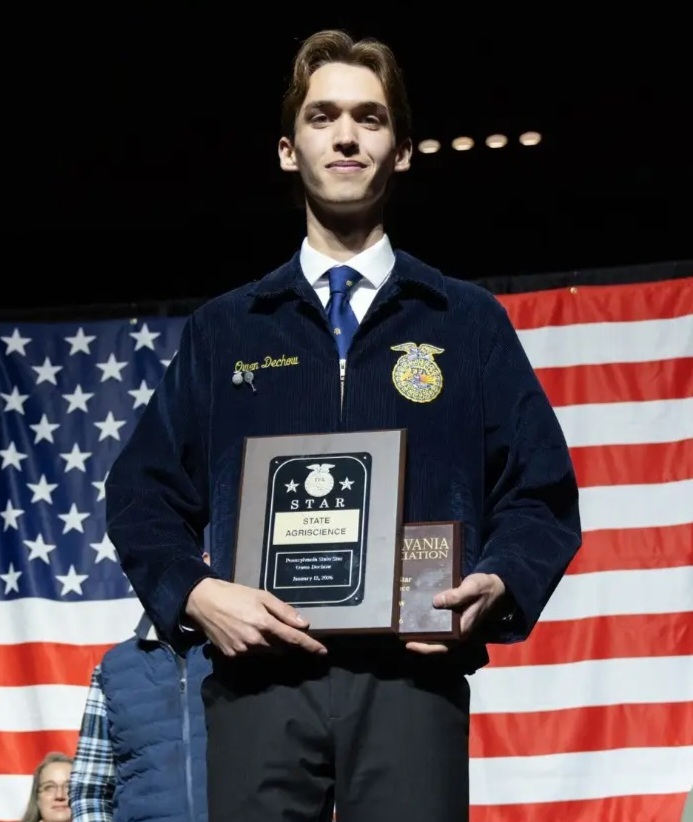
BALD EAGLE — When Owen Dechow talks about agriculture, he doesn’t start with tractors or barns. He starts with data, genetics and a laptop.
The Bald Eagle Area High School senior was recently named the Pennsylvania FFA Star in Agriscience, one of the organization’s highest honors, recognizing exceptional work in research-based agricultural projects. The award places Dechow among the top FFA students in the state and highlights a project that blends agriculture, computer science and real-world problem solving.
The Star Award recognizes students who excel in Supervised Agricultural Experience projects, known as SAEs, which are hands-on, in-depth projects that apply classroom learning to real agricultural challenges. At the state level, the award reflects years of work, leadership and academic commitment, with winners advancing through a competitive review process.
Dechow’s project focused on something few people expect to hear about in high school agriculture: building a full-scale genetic simulation for livestock.
“I created a simulation of a population of cattle,” Dechow said. “It tracks genetics, phenotypes, predicted transmitting abilities, inbreeding coefficients, as well as recessives, both the positive and the negative ones.
The idea was to create a realistic, classroom-ready system that allows students to study how genetics influence livestock performance without needing years of real-world breeding data. In agriculture classes, understanding genetic progress is essential, but tracking it in real time is nearly impossible.
“The issue is that over a couple months long semester, you’re not going to realistically raise a bunch of animals and breed them together and track genetic progress,” Dechow said. “And this is where this entire simulation falls in. It’s simply a way to make that progress or to give some form of hands-on experience.”
The program assigns each student a virtual herd. From there, they make breeding decisions based on genetic traits, monitor results and see how their choices affect future generations. The goal might be increasing milk yield, improving fat content or avoiding inbreeding. These are problems, Dechow said, faced by real farmers.
What makes the project even more impressive is that Dechow built it entirely himself.
“Every single line of code was written by me,” he said. “Most of it was written before I even really knew what AI was.”
The project began when Dechow’s father, a professor at Penn State, asked if he could create a tool to replace time-consuming spreadsheets used in genetics courses. What started as a high-school challenge grew into a fully functional web-based platform now used in college-level instruction.
The system even solves a problem many professionals struggle with calculating inbreeding coefficients. Dechow wrote his own software library to analyze animal pedigrees and determine genetic risk. He said the process took significant trial and error.
“There wasn’t an existing tool that did what I needed,” he said. “So I had to build one.”
That tool is now part of his website, HerdGenetics.com, which serves as the front end for the simulation. Students log in, manage herds and track outcomes through an interface designed to feel natural rather than technical.
The work caught attention not only for its technical complexity, but for its real-world application. In modern agriculture, genetics plays a major role, particularly in dairy and livestock operations that rely on artificial insemination and genetic analysis.
“Because genetics can now be shared across the country, it’s easier than ever to accidentally create inbreeding,” Dechow explained. “That’s why understanding pedigrees and genetic data is so important.”
Beyond the technical achievement, Dechow said FFA played a major role in shaping his growth as a leader and mentor. As a senior, he now helps younger students interested in coding and agriculture, offering guidance he didn’t always have himself.
“When I made this, there wasn’t really anybody at my school who was really there to help me,” he said. “I had one computer science teacher who was very helpful and did show me how to write a couple things. But as I got deeper into this project, I kind of lost that ability to find help.”
“So being able to help younger people in 10th grade and the freshmen and the juniors and everyone else in school has actually been fun. I really enjoyed it,” Dechow said.
He also credits FFA with connecting him to students from across the state who share different interests within agriculture.
“One student was working with deer genetics, another with hydroponic systems,” he said. “That’s the best part of FFA. Meeting people who care about different parts of agriculture and learning from them.”
Dechow hopes his project also helps change perceptions about what FFA represents.
“FFA isn’t just farming,” he said. “If you eat food, wear clothes or live in a house, agriculture affects you. There’s a place in FFA for scientists, engineers and researchers, not just farmers.”
Looking ahead, Dechow plans to major in software engineering, with an interest in agriculture-based technology. He also hopes to pursue ministry studies, with the long-term goal of combining a professional career with service to rural communities.
“I’d like to work in software, ideally something related to agriculture,” he said. “And also serve as a pastor in a small community someday.”
For now, he’s focused on finishing high school and continuing to develop the project that earned him statewide recognition. The Star Award, he said, is meaningful not just for the honor itself, but for what it represents.
“The one thing I love to tell people about FFA, and I wish everybody would understand, is that it’s for everybody,” he said. “There’s going to be opportunities for brilliant scientists to come out of FFA as well as hard workers and hard farm workers.”
And for Dechow, that path has already taken him from a classroom idea to a statewide honor, and toward a future where technology and agriculture grow together.