UNIVERSITY PARK — The Penn State Department of Classics and Ancient Mediterranean Studies hosted an Ancient Writing Workshop on Saturday, March 16, open to both the campus community and the public.
At the workshop, presentations were paired with demonstrations and activities focusing on a variety of ancient scripts including Egyptian, cuneiform (Akkadian and Ugaritic) and Coptic magic texts and the transition from Phoenician to Greek.
Attendees were transported back in time to practice these scripts with hands-on activities featuring clay, papyrus and wax tablets. From the beauty of Egyptian hieroglyphs to the intricate wedge-shaped characters of cuneiform, participants were exposed to a diverse array of writing systems, such as Akkadian, Ugaritic and more.
“Cuneiform was originally designed to write Sumerian, which is our oldest attested written human language from the end of the fourth millennium,” Michael J. Stahl explained during his presentation.
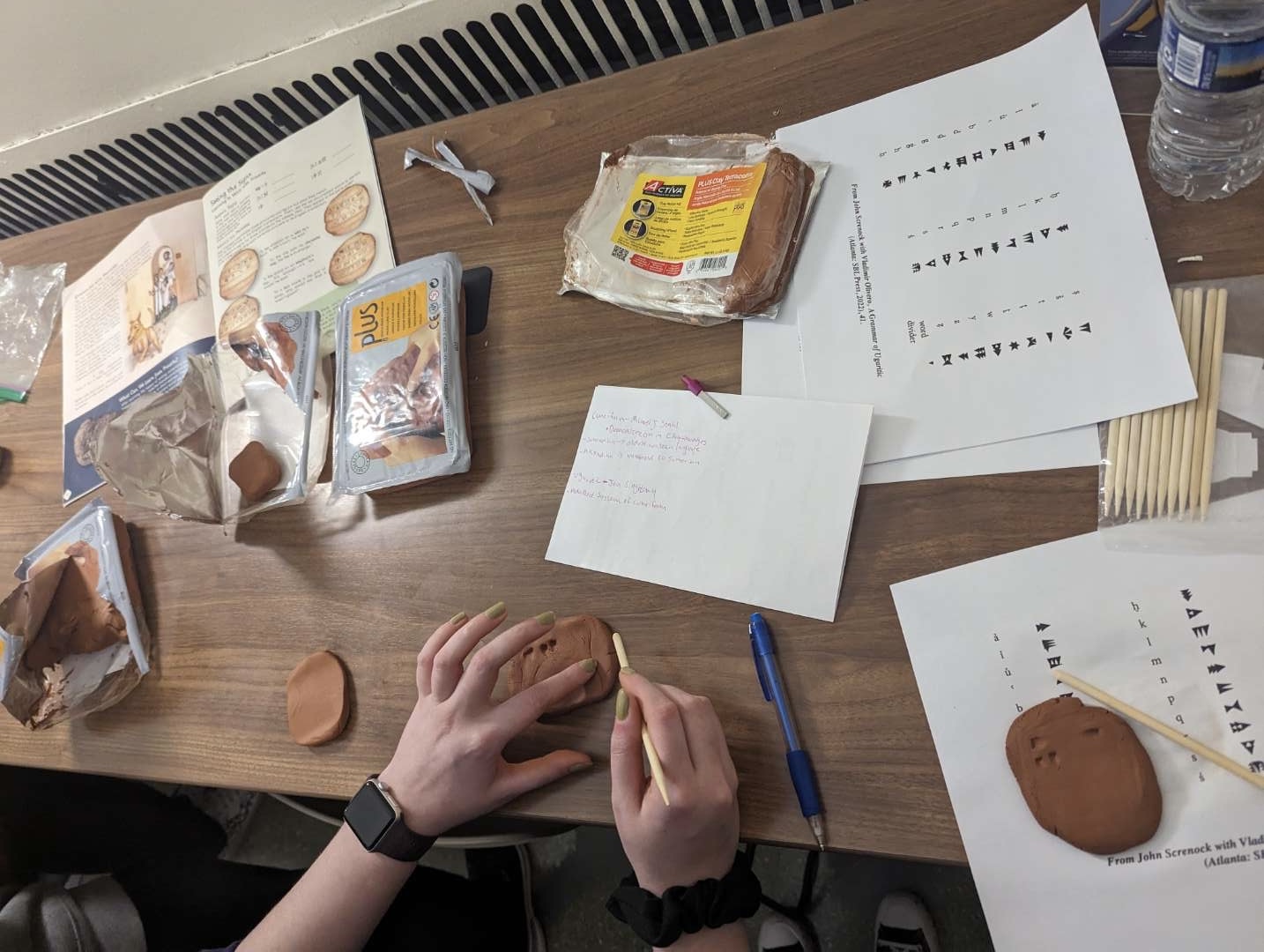
Guests were then able to try to recreate wedge-shaped characters of cuneiform on slabs of red clay using a stylus. The experimental learning provided by the Ancient Writing Workshop made it a unique experience as participants were able to actively participate and do more than observe.
“You can see that each sign is made of these little wedges, and you make the wedges with the edge of a wedge-shaped stylus made of reed that naturally makes this style triangular impression,” Jen Singletary, Department of Classics and Mediterranean Studies assistant research professor described.
Learning about these different types of ancient writing styles plays a role in understanding and preserving history and understanding culture and language. The presentation on the transition from Phoenician to Greek even showed a connection between some ancient writing systems using the linear alphabet and the alphabet we use today.
“We need to make a distinction between language and script,” Taylor Gray said in his presentation on Phoenician. “Language is a thing we use to communicate. It’s the vocal medium. The representation of language in writing is a script, and so we’re going to be talking about scripts. Scripts can change the language that they represent.”
Gray went on to explain how these scripts change and evolve over time, but understanding the writing systems offers experts a glimpse into the past and an understanding of why languages and scripts are the way they are in this day and age. Attendees at the workshop were able to try their hand at Phoenician and ancient Greek writing by creating cursed amulets on tinfoil, similar to real historical ones carved into silver.
The workshop even included a bit of magic as Michael Beshay presented a history of Coptic magic texts. According to Beshay, Coptic is the last stage of the Egyptian language. The texts signify the ancient interceptions of religion and magic.
“These magical texts like these happen to be some of the earliest materials that we have that register the cross in Christian tradition as a symbol of power and protection, as well as things that excerpt gospel traditions and therefore showcase the developing notion here that these are sacred texts,” Beshay explained.
The Ancient Writing Workshop, sponsored by the Department of Classics and Mediterranean Studies, provided a hands-on experience in ancient scripts, spanning from Egyptian to Phoenician and Greek alphabets and exploring Coptic magic texts as well as cuneiform. Through presentations and activities, attendees gained insights into the evolution of these scripts and their cultural significance.