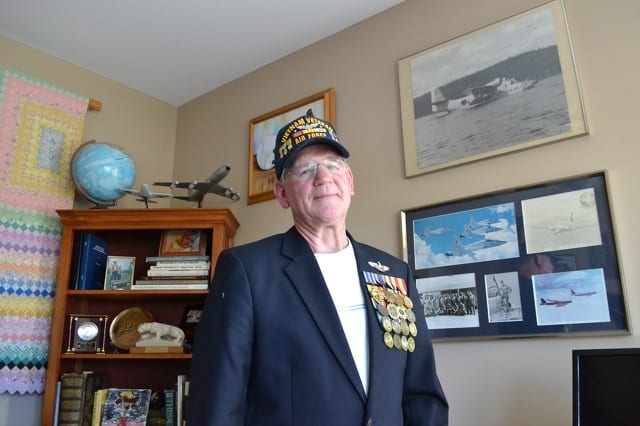
CENTRE HALL — Bob Booz has a reasonable assumption as to why he’s more open to talking about his tour of Vietnam from 1970 to 1971.
Booz piloted C-7 Caribous, which are transport planes capable of making short landings, mostly out in the jungle on small runways that were little more than patches of cleared of vegetation.
As the years came and went after his tour, he met those who had a very different experience in the Army or Marine Corps.
“Now I see what they mean, because I was in a war zone and we were shot at, but I was not on the ground out there like you see in these documentaries,” Booz
said.
For this reason, Booz thinks there will be veterans who choose to visit the Vietnam Traveling Wall at night when the display comes to State College.
The 80 percent replica of the Vietnam War Memorial from the American Veterans Traveling Tribute organization in Texas will open to the public starting at noon Thursday, Oct. 5, at Innovation Park. It will remain open to the public for 24 hours a day until after the closing ceremony at 3 p.m. Sunday, Oct. 8.
It’s during the late night or early morning, Booz said, when some veterans who lost friends in the war may come to be alone in the peace and quiet with the memorial.
Booz and the rest of the Traveling Wall committee have been working to bring the portable monument here for the last year and a half. He said they signed the contract with AVTT about a year ago, and have been working to fulfill the requirements of that contract and generate public interest.
The wall arrives in pieces on a 24-foot trailer, with a motorcycle honor escort in tow. The pieces of the replica memorial arrive on wheels, and it takes a minimum of 15 people to assemble and interlock the pieces and remove the wheels, all under the direction of the truck driver, who runs the show.
The 360-foot wall will be guarded at all times by at least two people as part of the contract, Booz said. It also will be lit throughout the night.
The names on the replica wall and the actual memorial itself are organized by the order in which American personnel were killed or declared missing in action, going day by day. If a person looking for a specific name doesn’t know an exact date, there are online databases to search to find the location of a name. It’s common practice to rub the names of loved ones on a piece of paper using a pencil.
Booz became involved with the traveling wall through Brian Querry, director of Centre County Veteran Affairs. Querry then introduced him to Frank Christopher, a WPSU producer and another driving force behind the effort to bring the wall to Centre County for four days.
Booz said the last year and a half of planning has brought out memories for him that he hasn’t dwelled on since the war itself.
The Air Force veterans of the tactical airlift wings flew critical supplies and personnel to forward bases and outposts. Among Booz’s decorations is a Distinguished Flying Cross, which is earned for heroism or extraordinary achievement during flight.
One day during his tour, it was all business as usual until he landed during one of his runs and was met by a sergeant who informed him and his crew they would be diverted.
“He said, ‘There’s an emergency. There’s an outpost that’s just about out of ammunition. You’re the first guys available, so we’re going to divert you and you’re going to take it.’”
They loaded up Booz’s Caribou with four pallets of howitzer shells and sent them out to the jungle to drop them off to a unit that had seen some heavy fighting.
On approach, they were told the site was “cold.” There currently wasn’t any fighting. Booz and his crew touched down just fine and got into position for offloading.
“And the forklift was just starting get under to get it (the first pallet) out, as I recall. All of a sudden, we heard this ‘boom’! I’m looking, and you can see in the distance dirt flying, so it was incoming. So, they were under attack. You listen to the radios, and you can hear the guy screaming on the radios, saying, ‘They’re trying to get that Caribou!’ We were the only plane there at the time.”
The forklift backed away, the loadmaster removed the restraints on the other three cargo pallets, Booz maneuvered the plane back and performed a speed-offload of the shells by accelerating the plane and letting the pallets fall out the rear hatch and down the loading ramp.
Meanwhile incoming fire was landing around the plane with more loud booms while American soldiers returned fire, Booz said.
“We got airborne and we just stared at the gauges” to see if something was wrong, such as losing gas or hydraulics.
Back at base, crews inspecting the plane told them it was riddled with bullet holes, but somehow no vital lines had been hit.
Before his deployment, Booz was in Army ROTC at a Penn State branch campus before he transferred to University Park and flipped to the Air Force. After college, it was on to flight school, designed to wash out the ones who couldn’t hack it. He said he was worried about making the cut, but in the end he did and became a bona fide pilot.
Then, he found out he was going to Vietnam and would be flying the C-7, a plane he wasn’t familiar with.
It was April 1970, Booz’s first days in-country. The 23-year-old landed in Cam Ranh Air Base, where air groups were running operations to a besieged outpost. Already, multiple C-7s had been shot down, Booz had been told, and the battle had been raging several days.
Military records show this was probably at Dak Saeng Camp, established years earlier for the Army’s 5th Special Forces Group to monitor the Ho Chi Minh Trail. Three C-7s from Cam Ranh and Phu Cat and two helicopters were shot down between April 2 and 15.
Throughout his tour, Booz and other air crew transported troops, ammunition, prisoners and food of all kinds, including beer and frozen steaks. Those steaks were always guarded, he said, but the crew could typically find a way to scam a case for their fellow flyers.
There were a few grim times that Booz recalls transporting the bodies of American soldiers back to a base. He said he wishes he would have more carefully documented those days, because somewhere on that traveling wall are their names.
Booz did nine years in the Air Force before he got his discharge papers and was hired by a defense contractor. He was later hired by HRB Systems in Centre County. He finished his career working for Penn State for 10 years. He now lives in Centre Hall.