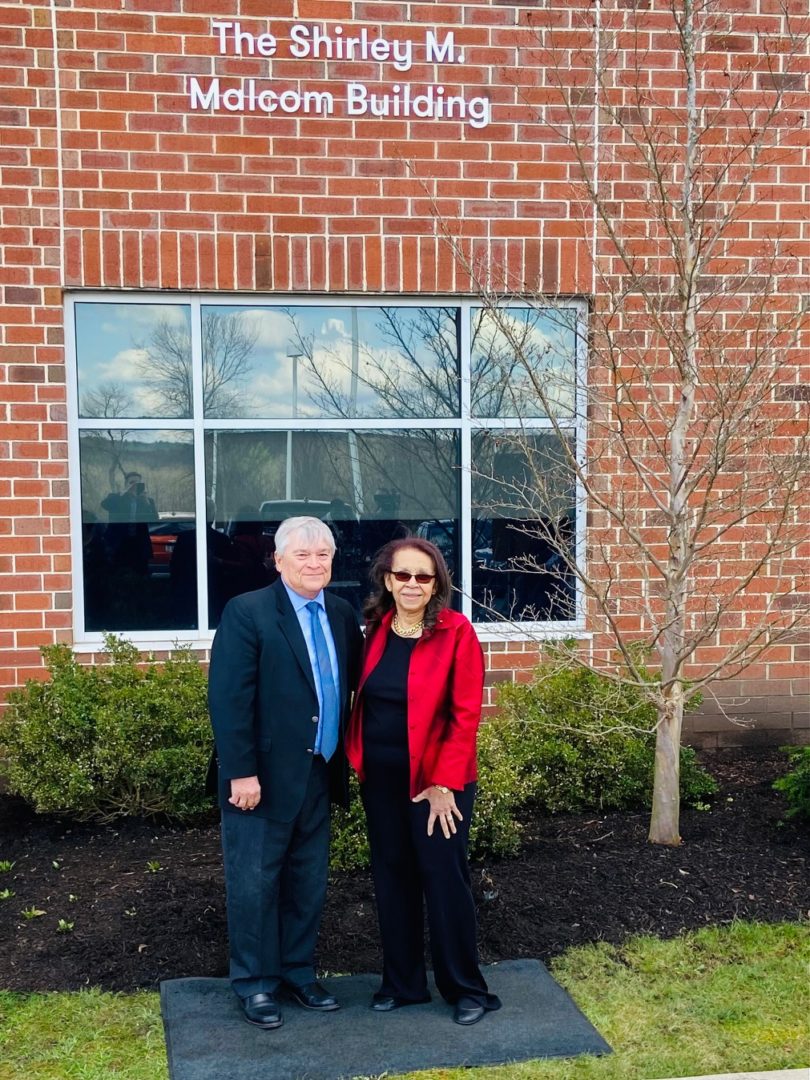
UNIVERSITY PARK — Shirley Malcom joined the ranks of venerated alumni whose names adorn campus structures when Penn State dedicated Innovation Park’s 329 building in honor of the pioneering ecology educator on April 8.
Penn State President Eric Barron led the dedication reception in the Outreach Innovation building and spoke about ongoing efforts to recognize alumni who have had a “significant, positive impact on this university.”
“It is important … to recognize those with the courage and conviction to open doors, break glass ceilings, to bring their unique perspectives to well-worn disciplines,” Barron said. “That is a reason to celebrate, and why we are here today.”
Born in 1946 in Birmingham, Alabama, Malcom graduated from George Washington Carver High School before earning her bachelor of science degree with distinction in zoology from the University of Washington, Seattle, and her masters in zoology from the University of California, Los Angeles.
Malcom left the west coast and came to State College as a Ph.D. candidate in the early 1970s and graduated in 1974 with the first doctorate in ecology to be awarded from the university.
Two years after receiving her doctorate, Malcom co-published the groundbreaking report, “The Double Bind: The Price of Being a Minority Woman in Science,” which highlighted the challenges of being a black woman in a white-male dominated field.
After a brief tenure at University of North Carolina, Wilmington, Malcom, and her husband Horace, whom she had met in line for registration in 1972, relocated to the Washington, D.C. area, and started searching for a tenure-track faculty position in her field.
Although her job hunt was initially unsuccessful, Malcom refocused and answered an ad for a research assistant position at the American Association for the Advancement of Science.
“It opened up a whole new world,” Malcom said.
Once at AAAS, Malcom “jumped on” on a project to bring more minority populations into STEM, and later joined a project to encourage women and girls in the sciences.
“In the following years I experienced first-hand systemic challenges to inclusion everywhere, at every level of education,” Malcom said.
Malcom rose through the ranks at AAAS, and now serves as senior advisor to the CEO of the American Association for the Advancement of Science, and helms its SEA Change program, which promotes diversity in STEM higher education.
Outside of AAAS, Malcom has also held leadership positions at the National Science Foundation and the National Science Board.
President Bill Clinton also appointed Malcom to his President’s Council of Advisors on Science and Technology, where she served from 1994 to 2001.
In recognition of her “extraordinary use of science for the public good,” Malcom was awarded the Public Welfare Medal by the National Academy of Sciences in 2003.
Malcom is also recognized as a Penn State Distinguished Alumna, the highest honor the university can bestow on an alumnus.
“It’s really different at Penn State from when I first set foot on campus,” Malcom said, “I had no idea where I was going, literally or figuratively.”
When Malcom first came to University Park, she stayed at the Nittany Lion Inn because she did not have housing on campus and had to fully support herself on her savings since she had no assistantship, fellowship or stipend.
She initially pursued a doctorate of honors in teaching, but was encouraged to return to the ecology program after a few weeks by her doctoral advisor H. B. Graves.
Despite her trepidation, Malcom knew she had to complete her degree — and did so in 1974.
“Penn State became the place where I once again found a place in science,” Malcom said.
Destiny Wright, a senior biology major in the Eberly College of Science and millennium scholar who spoke at the dedication, had a similar experience to Malcom when she arrived at Penn State.
“I’ve had crushing moments when I’ve walked into a lab … and didn’t see people who look like me, that led to me feeling unwelcome” Wright said.
Despite the stereotype that minorities cannot succeed in STEM, Wright said she has flourished in her field, and has published research in a national neuroscience journal, and completed summer research programs at Columbia University and Penn State.
“(Malcom) represents a beacon of hope on an unfamiliar path,” Wright said.
After Wright spoke, Malcom noted that the name Destiny seemed fitting.
“I want everyone to realize that I do not believe this to be about me, I believe it is much bigger,” Malcom said. “The need for women to be their authentic selves, to find their places in inclusive science communities, the opportunities for students of color who may need an existence proof to see their dreams realized.”