
STATE COLLEGE — The timing of the Aug. 28 ribbon-cutting on the Martin Luther King Jr. plaza in State College, unfortunately, could not be better.
A dedicated public space to King now stands along Fraser Street between West College and West Beaver avenues at a time of renewed racial tension and, at times, outright conflict in the nation, as speakers pointed out during ceremonial remarks.
The plan for the plaza has been years in the making, beginning with a State College Borough Council vote in April 2012 to change the name of Fraser Plaza to the Dr. Martin Luther King Jr. Plaza.
The area’s most prominent feature is now a sweeping wall depicting King’s visit to Penn State in Jan. 21, 1965, when 8,000 people packed into Rec Hall to listen to one of the best orators and fighters for justice of the 20th century.
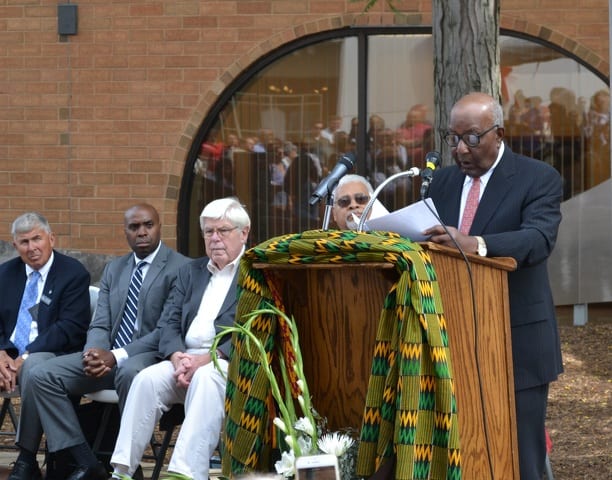
Dr. Marcus Whitehurst, vice provost for educational equity at Penn State, quoted King from his Rec Hall remarks.
“If we will only look, if we will only notice the developments in our own nation, we will be objective enough and realistic enough and honest enough to know that we have a long, long way to go,” Whitehurst recited.
He went on to say that recent events show the struggle of communication that persists in the present day.
“At Penn State and in State College, we do a lot of things right,” Whitehurst said. “But similar to Dr. King’s words, we know there is always more that we can and should do to foster inclusivity. To ensure that we recognize opportunities and benefits that diversity and inclusion bring, such as stronger relationships, increased creativity and a greater reach into our global communities.
“Let’s be honest, the recent events at Charlottesville have been an outgrowth of our collective inability to engage in meaningful, civil conversations for quite some time. Whether it’s within our nation’s capitol, or on our campus, or just in general conversations, we struggle to find ways to communicate our diverse experiences.”
Hate groups, including white supremacists, have been on the rise since 2015, increasing from 892 to 917 in 2016, according to the Southern Poverty Law Center.
The increased hum from white hate groups moved from insulated Internet chatrooms and lower-key incidents and into the public eye when a white supremacist rally turned violent in Charlottesville, Va., culminating in a man plowing into a group of counterprotesters with a car, killing one and injuring 19 on Aug. 12.
Dr. AnneMarie Mingo, an assistant professor at Penn State, said there are King memorials all over the world, but few go beyond a street name, a mural or a monument, unlike the plaza.
“This marks a space outside of one of the traditional areas of the civil rights movement where you might expect to see something,” Mingo said. “So, we might expect to see something where? In Memphis, Atlanta, Montgomery, even the one in D.C. because of today’s honoring of the March on Washington for jobs and freedom. But State College? We’re doing something big here.”
Aug. 28 also marked 54 years since King’s peerless 1963 “I Have a Dream” speech, delivered in the shadow of the Lincoln Memorial to approximately 250,000 people surrounding the Reflecting Pool on the National Mall in Washington. It was performed in full Aug. 28 by Dr. Charles Dumas, professor emeritus at Penn State, at the outset of the ceremonies.
Mingo said there would be more to add to the plaza. Six nearby pillars just to the north of Beaver Avenue will be adorned with plaques.
Dr. Preston Williams attended as the keynote speaker to the ceremonies. He is a renowned scholar and professor emeritus at the Harvard School of Divinity. He also was the second African-American professor to be hired at Penn State, teaching from 1956 to 1960.
He said King’s dream was one where people of all backgrounds and identities came together in a truly brotherly and sisterly relationship.
“King called for a worldwide fellowship that lists neighborly concerns beyond one’s race, class and nation. Differences and diversity were to be reconciled and redeemed in the creation of the beloved community. The goal and purpose of our living was not to attempt to establish supremacy of one group or individual over the other, but to create a win-win situation. For each contributed to — and benefited from — the other.
“King sought to create a community where personal and civic relationships were harmonious and mutually beneficial. A plaza is an appropriate symbol for king’s dream, because it brings people together for commerce, for friendship, for the performance of civic duty.”
The ribbon-cutting ceremony in front of the sweeping wall was led by Mayor Elizabeth Goreham, who was joined by speakers, borough council members and other who aided in the planning and development of the plaza.
Local police departments had a strong presence around the ceremony. Large concrete barriers were placed to the north and south of the covered canopy on Fraser Street. Officers from various departments secured corners around the perimeter and were seen on all levels of the parking garage.



