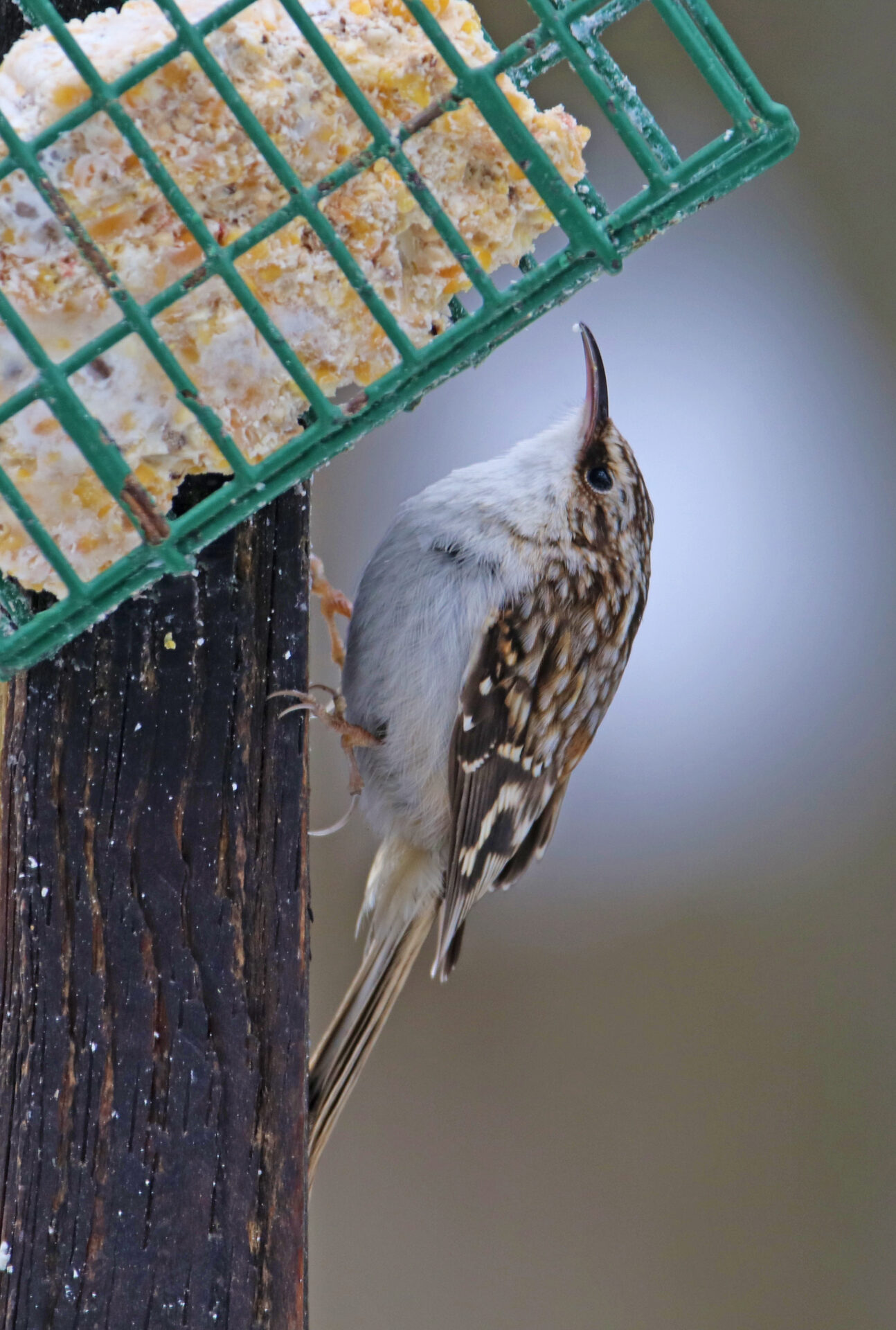
The brown creeper — camouflaged to perfection
BROWN CREEPERS are usually rare visitors to backyard feeding stations, but it is occurring more often this winter.
The brown creeper (Certhia americana) favors northern coniferous forests across North America. It is a year-round resident of the forested regions of Pennsylvania, least common in the western border counties and extreme southeast. It is the only member of the creeper family in North America.
According to “Second Atlas of Breeding Birds in Pennsylvania,” the number of brown creepers in the Keystone State has increased slightly during the past 20 years, but their range has contracted northward.
With a length of only five inches, and a weight less than one third of an ounce, the creeper is one of the smaller forest bird species. A buff-colored eye stripe, long curved beak, and mottled brown coloration help to distinguish the creeper, but to the untrained eye, it probably falls into the generic “little brown bird” category. It is the species’ feeding behavior that makes identification easy.
Brown creepers will land near the base of a large tree and spiral upward around the trunk as they look for insects, spiders or invertebrate eggs. They will fly down to the base of another nearby tree and start over, or sometimes repeatedly search the same tree trunk — covering new areas with each successive pass.
Creepers will also defy gravity and “creep” upside down, on the underside of large tree branches. They are always on the move except when threatened by a passing hawk. They react to such danger by freezing in place for five minutes or more.
“The brown creeper is perhaps the most camouflaged perching bird in Pennsylvania’s forests,” wrote Jerry Skinner in the breeding bird atlas.
Their mottled brown coloration provides a near-perfect camouflage against a tree bark background. Although they are fairly common, creepers are rarely seen because their camouflage plumage and small size makes them inconspicuous woodland residents. Their coloration allows them to blend perfectly with their habitat.
Creepers have special adaptations for foraging. Strong feet with long toes and long curved claws grasp the bark, and stout tail feathers serve as a brace. They use their thin curved bills like very fine tweezers to probe narrow crevices for food. It is believed that the creepers’ eyesight and long beaks allow them to locate tiny insects that other birds miss.
Brown creepers must be good foragers, for only occasionally do they visit feeding stations offered by humans. Although they eat a few seeds, they are most likely to be attracted to suet feeders or peanut butter.
State College birder Joe Gyekis analyzed eBird data for Pennsylvania and learned that creeper sightings are much more common this winter as compared to the past five years.
Their abundance helps to explain the many feeder sightings of brown creepers this winter. I have been feeding birds at the same location in Centre County for the past 42 years, and this is the first year that I have brown creepers as daily feeder visitors. Although not especially shy around people, at the feeder, they seem to be easily startled and/or displaced by other, larger birds.
Creepers are sometimes observed in the company of chickadees, titmice, kinglets, downy woodpeckers and nuthatches, as a part of mixed-species winter feeding flocks. Creepers are usually observed singly or in pairs. About the only time they gather in larger numbers is when small groups of up to 10 birds conserve body heat by spending a cold winter night huddled together in a tree cavity.
Nesting occurs during April and May and that is when their high-pitched “seet” (repeated four or five times) calls are most often heard. Once you recognize their call, you will likely hear the creeper before you see it.
For their small, well-hidden, hammock-style nests, brown creepers usually select a ledge on the side of a tree that is created by a large piece of peeling bark as a platform. Although the male might bring nesting materials, the nest is entirely constructed by the female. It is made from twigs, feathers, grass, spider webs and moss. Four to eight speckled white eggs are laid in this protected location. Little detail is known about brown creeper reproduction.
Budding naturalists should be cautioned that older books (and some Web sites) list the brown creeper with the same scientific name as the Eurasian treecreeper, Certhia familiaris, for they used to be considered the same species.
I enjoy watching the antics of the tiny brown creepers — you will, too, once you get to know them.