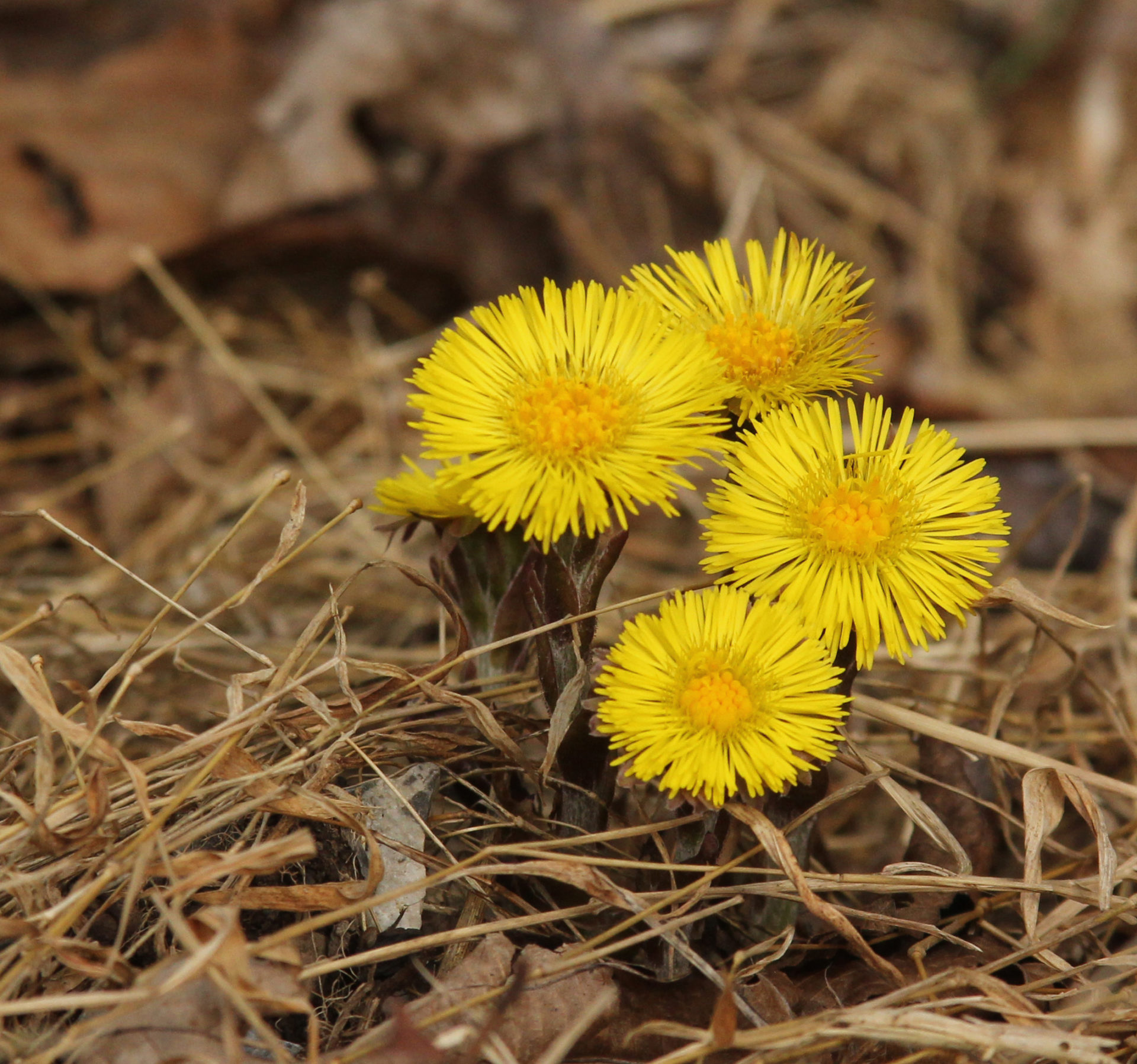
Coltsfoot — an early sign of spring
One of the earliest signs of spring in the world of wildflowers is a small yellow flower called coltsfoot. For as long as I can remember, I have noted the first coltsfoot flower that I have seen — often writing down in a notebook, or now, in my computer journal. The first-bloom dates vary from February through March and even into early April. This year, I saw my first bloom on March 15.
The plant gets its common name from its leaves, which are shaped like jagged-edged horses’ hooves. When fully developed, the leaves can be larger than a horse’s hoof.
However, only the flowers are visible at this time of year; its leaves appear later in the spring. An older Latin name for coltsfoot was Filius ante patrem — meaning “the son before the father” — because the flower blooms before the leaves appear.
Coltsfoot is often confused with dandelion, but aside from the fact that they both have similar-sized yellow flowers, a closer inspection reveals many differences. Coltsfoot flowers have a distinct circular center not found in dandelions. The flower stalk on coltsfoot is covered by numerous maroon and green scales while a dandelion’s is naked. The two plants’ leaves are also totally different.
The earliest coltsfoot flowers bloom very close to the ground. As the weeks go by, the later bloomers can be found on the ends of longer stems — one flower per stem.
A perennial wildflower, coltsfoot is native to Europe and parts of western and central Asia. It was introduced to North America by early colonists because of what was thought to be its medicinal value. Today, it is found growing in southern Canada and the northern United States. It grows throughout Pennsylvania and is common within Centre County.
Coltsfoot thrives in so-called “waste places” and areas with recently disturbed soil. Roadsides, railroad fill, old sawdust piles and construction sites are all home to coltsfoot. Wet clay, garden compost or relatively dry cinders along a railroad right-of-way provide equal opportunity since coltsfoot can grow in almost any soil type.
Many a gardener will be quick to challenge the label “wildflower” for their preferred term “weed.” Coltsfoot’s invasive nature makes it hard to eradicate from gardens, pastures or cultivated fields. The plant spreads by means of a white underground rhizome. Cultivation simply chops the root-like rhizome into smaller pieces, which can each grow into a new plant. Like dandelion, coltsfoot also produces large quantities of wind-blown seeds, which easily spread the plant to new areas.
The use of coltsfoot in herbal medicine dates to ancient Greece and Rome. Therefore, it should be no surprise to learn that its scientific genus name is Tussilago — from the Latin term for cough.
The leaves were dried and smoked, or a tonic was made by boiling them. It was a common treatment for coughs and asthma, one that has persisted to the present day.
Ingredients such as mucilage, acidic polysaccharides and steroids enable it to be used as an expectorant, a diuretic and to reduce inflammation.
Before you rush out and brew your own cough syrup, beware. Laboratory tests have shown that coltsfoot, taken in repeated small doses, caused cancer as well as liver damage in rodents. Some experts state that extracts from coltsfoot should never be taken internally while others warn that it should be used in moderation and avoided during pregnancy.
Supplements containing coltsfoot can be purchased online. However, since this column’s purpose is not to provide medical guidance, see where your own research leads you.
Watch for the bright yellow coltsfoot blossoms during your times afield. Coltsfoot is a true sign of spring.