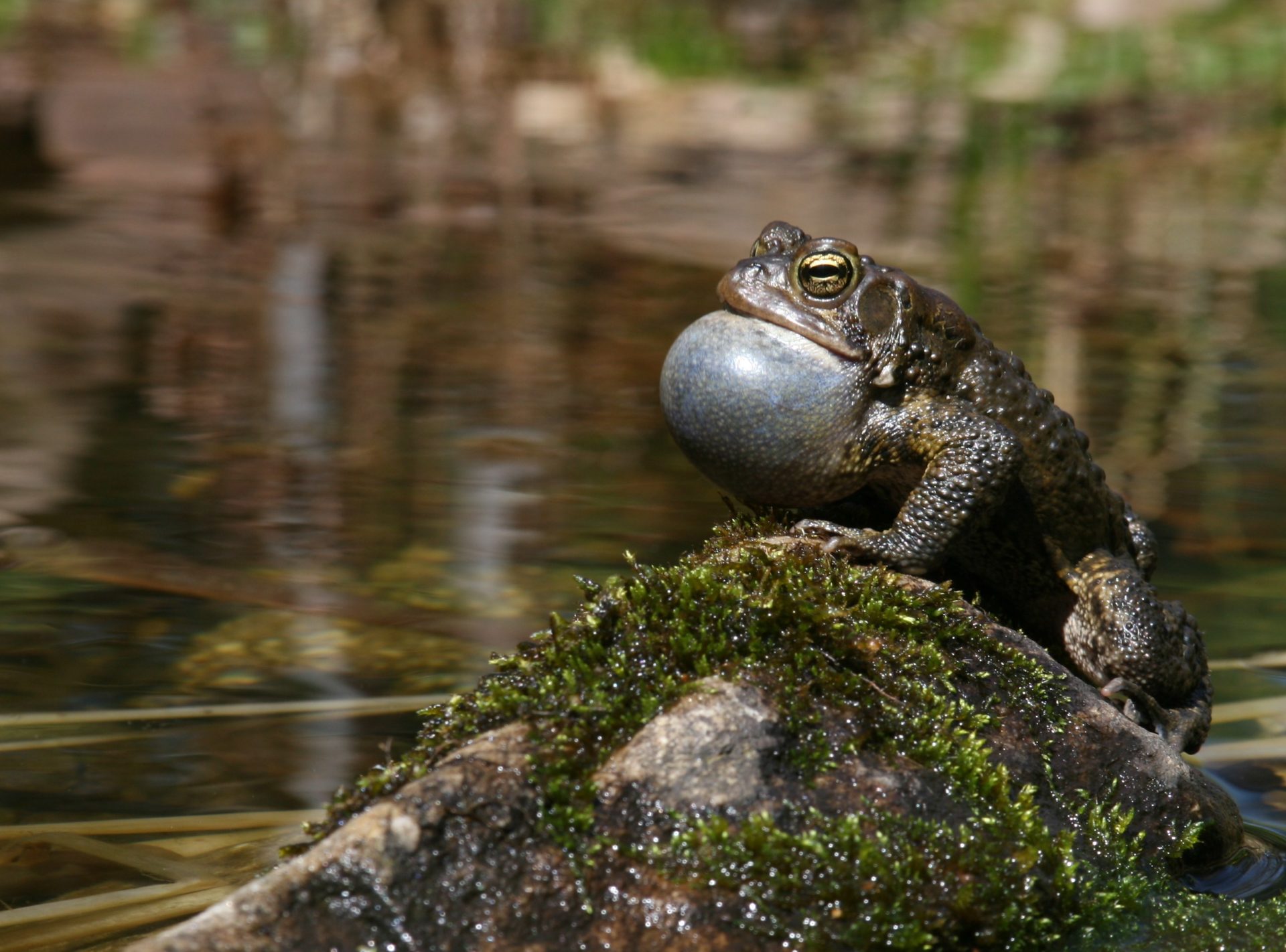
Nighttime visitor— the eastern American toad
THE EASTERN American toad is the most common of the three toad species that call Pennsylvania home.
Toads are rarely seen during the day, but they actively feed at night and might be spotted anywhere. If you happen to travel a country road on a warm, rainy, spring night, you might see hundreds. The sheer number of toads hopping about can make one scratch his head wondering where they all came from.
Three species of toads call the Keystone State home – the eastern American toad, Fowler’s toad and the eastern spadefoot toad. The eastern American toad (Bufo americanus americanus) is the most common and the most widely distributed of the three. It is found from Louisiana north into Canada, as well as in all 67 Pennsylvania counties.
Spadefoot toads have vertical pupils, while American and Fowler’s toads have horizontal pupils. All three could occur in Centre County, with spadefoots being less likely. I have seen one spadefoot toad in my lifetime.
Toads have a dryer, warty skin and can tolerate lessdamp environments than most species of frogs. They hop rather than leap as frogs do, because toads have smaller and less-powerful back legs.
American toads can live for up to 10 years in the wild, while growing to four inches in length — about the size of a man’s fist. Females typically grow larger than males. Toads are usually some shade of mottled brown or gray, but they can also have yellow, red and black highlights. They are very well camouflaged in their natural habitat.
The closely related Fowler’s toad lives in the southern two-thirds of the state and near Lake Erie. The Fowler’s toad can be distinguished from the American by its unmarked underbelly and the three warts on each dark spot, as opposed to one or two per spot on the American toad.
April and May are breeding months for American toads, when they move to ponds, swamps and vernal pools. The male’s mating call is a high-pitched trill that lasts for up to 30 seconds. The male’s vocal sac puffs up like a balloon when they are calling.
Mating occurs when the smaller males clasp females and swim around together in the shallow water. Sometimes several males court a fertile female toad at the same time. Females release long strings containing thousands of tiny black eggs as the males deposit clouds of sperm.
Eggs hatch into tiny black tadpoles in just a few days. Tadpoles eat bacteria and algae, gaining size and then losing their tails and growing legs within five to 10 weeks. Their speed of development depends on water temperature and available food.
Adult toads live on a diet of earthworms, spiders, beetles and other insects that they catch with their sticky tongues. Toads should be considered beneficial yard animals because of the quantities of mosquitoes and other insects that they consume. Predators that regularly take American toads include garter snakes, herons and a few hawks — including broad-winged hawks, red-shouldered hawks and American kestrels.
I once watched a large garter snake slowly moving through the forest floor. When I checked back, the snake seemed to be struggling, with its head stuck in a hole. Five minutes later, the garter snake moved on. Curiosity got the best of me, and I went over to check what had caused the disturbance. When I poked at the hole in the ground, a large toad hopped out. It had cuts on its face from its encounter with the snake. Apparently, the toad was large and strong enough that the garter snake could not pull it from its burrow, and the snake gave up.
Steroid secretions from a toad’s skin repel many predators and can cause eye or mouth irritation in humans — so don’t kiss any toads. While toads might have warty skin, contrary to popular folklore, they do not cause warts on human skin.
American toads usually burrow in the soil to hibernate, but they emerge in late April to breed — or after the temperature warms in early May. Watch for them on warm nights and listen for the male’s trilling call after dark.