Please, check the box
Every April, my family and close friends see me wearing a silver bracelet with a green ribbon on it. They know why I wear it; yet others who don’t know me may inquire the meaning of the green ribbon.
I then launch into my tale of how organ donation profoundly affected me and my family — and why organ donation awareness plays a big role in my life.
In 2010, my late husband was told he had a very rare — and terminal — genetic illness called Familial Amyloidosis. In plain terms, his liver produced abnormal “sticky” proteins that attached to other internal organs. In his case, they were attacking his peripheral and autonomic nervous system, his eyes and his heart.
There is no cure. He was only 40 years old, and we had three children who were 17, 14 and 9 at the time. I vividly recall sitting with a team of experts at Johns Hopkins in Baltimore, Md. who told us that there were very limited options. “We cannot save your life. But we can hopefully extend it.”
My husband, who was a funeral director, clung to those words. “I’m not afraid to die,” he said bravely. “But I want to see my kids graduate from high school, and hopefully from college. I want to see them grow up into adults.”
There was one treatment: Organ transplant. In his case, he not only needed a new heart, he also needed a new liver because his was producing those sticky proteins that were slowly killing him. Without transplant, he might have a year or two at most. His illness was so rare that it took two years for a diagnosis. So, his time was running out quickly. He was out of breath from cardiac involvement, and he was walking with a cane. His 6-foot-1-inch frame was gaunt from losing 70 pounds.
Long story short: He waited nine very long months for “the call” and on Feb. 21, 2011, I drove him from Clearfield County where we lived to the University of Maryland Medical Center in Baltimore where he received the gift of life in the form of a new heart and new liver from a 35-year-old woman who died from an asthma attack.
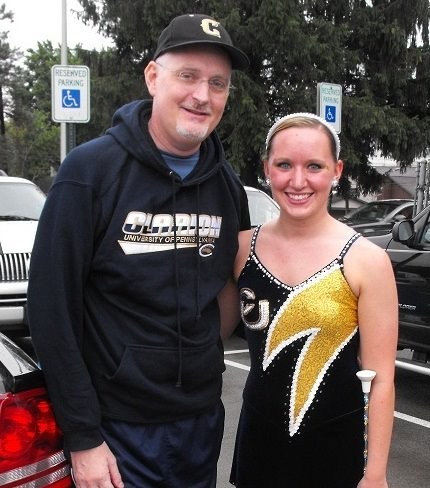
He became the poster child for organ donation. He was out of the hospital in a week and never showed any signs of rejection. And from 2011 to 2016, he lived his life to the fullest. He returned to work at the funeral home. He attended every event that our children were involved in — football, baseball, basketball and wrestling, our daughter’s baton twirling competitions and dance recitals, and stood proudly for prom photos. He attended two high school graduations as well as our daughter’s graduation from college. He watched our son leave for the U.S. Army and then saw him graduate from basic training at Fort Benning in Georgia. We also went to Hawaii in 2015 to celebrate our 25th wedding anniversary.
Through all of this, despite organ donation, his health slowly declined. He used a walker to ambulate. He had to stop driving. He had one leg amputated at the knee. He suffered a hemorrhagic stroke. His body was failing, but his mind was not.
In July 2016, he became ill with pneumonia, which is deadly for someone taking immunosuppressant medications. He suffered a second hemorrhagic stroke and was pronounced brain dead on July 29. The last thing I heard in that hospital room after I signed the papers to stop life support was the strong, healthy beat of his donated heart.
A few people have asked me since his death, “Was it worth it? He only got six more years.” My answer: Absolutely.
He and I got six years to make more memories. Six years to say goodbye to each other, and six years for him to prepare his children for the inevitable. He was able to work until the day that he was stricken with that bout of pneumonia, which was his goal. He was caring and compassionate and the ultimate professional when it came to funeral service.
Our youngest child was three weeks away from starting his senior year of high school when he lost his dad. It was the one goal not fulfilled. But considering all of the boxes that my husband checked off from his “Do Before I Die” list (and yes, that was the name of his list), we feel blessed that he was able to do so much in such a short period of time.
Those boxes would never have been checked without organ donation, and the ultimate gift from his donor’s family. It game him — and us — six more years of life that some people who reach 100 never see.
A year after his transplant, my husband sent a thank-you letter to his donor family. The family responded with a grateful letter in return, knowing how much their loved-one’s organs were helping him to live. They also stated that knowing how much the gift of organ donation benefited our family someone helped them in their grief.
The moral of my story is this: Organ donation is a true gift for the recipient, whether if it gives them six months, six years, or 60 years of life they would not have had otherwise. And in some ways, it also helps the donor’s family heal, bringing a bit of positivity into an unimaginable grief.
Please, check the box on your driver’s license. Donate life.