Pennsylvania will be in the path of a solar eclipse Monday, April 8. According to the Pennsylvania Department of Education, the last time the state was in the path of a total solar eclipse was in 1806.
According to the National Aeronautics and Space Administration, a total solar eclipse occurs when the moon passes between the sun and the Earth, completely blocking out the face of the sun and causing the sky to darken.
The eclipse’s impact across the state will range from total (100% magnitude) to partial solar eclipse (90% magnitude), according to the Pennsylvania Department of Education. Crawford, Erie, Mercer and Warren counties are the direct line of totality (100% magnitude) while the rest of the state will experience between 88.65% to 99% magnitude.
The eclipse phase sequence will begin around 2 p.m., with the moon covering most of the sun around 3 p.m. Between 3:15 and 3:20 p.m., parts of Pennsylvania will be in the path of totality of the total eclipse phase, with the moon completely covering the sun’s surface; in Centre County, the sun will cover 95.5% of the sun. From approximately 3:20 to 4:30 p.m., the phases of the solar eclipse will play out in reverse before the visible eclipse concludes around 4:30 p.m.
Safety
It is not safe to look directly at the sun without specialized eye protection. Additionally, viewing the sun through a camera lens, binoculars or a telescope without a proper solar filter can result in eye injury as well. When watching the eclipse, you must do so through safe solar viewing glasses or a handheld solar viewer. It’s important to note that regular sunglasses are not safe for eclipse viewing, no matter how dark the lens is.
How to make your own eclipse viewer
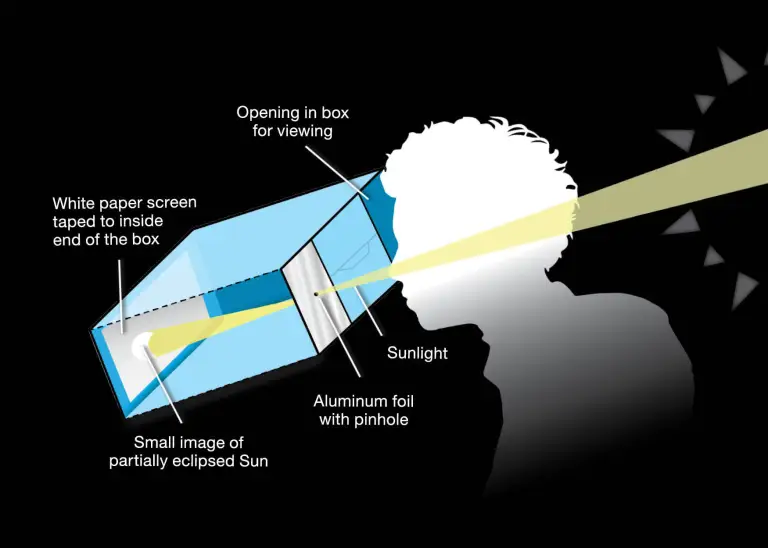
If you don’t have eclipse glasses or a handheld solar viewer, here’s how you can make your own using the indirect viewing method. The indirect viewing method does not involve looking directly at the sun.
What you’ll need
- White paper
- A cereal box
- Tape
- Aluminum foil
- Scissors
- Thumbtack or pin
- Pen or pencil
Steps
- You’ll start by preparing the base. Use a pen or pencil to trace the bottom of the cereal box onto a piece of white paper. Once you cut the traced shape, it will fit snugly into the bottom of the cereal box to create a backdrop to see the eclipse.
- Next, secure the base by taping the cut-out traced shape to the bottom of the cereal box. Taping it down will help avoid disrupting the viewing experience.
- Now you’ll cut off the two side tabs, tape down the top of the box and cut out a square on each side of the top of the cereal box, leaving the center of the top intact. This space will help ensure a safe viewing of the eclipse.
- At the top of the cereal box, cover one of the holes with aluminum foil and secure it in place with tape. When the foil is attached, poke a tiny hole into the middle of it with a thumbtack or pin. The small hole created by the pin will serve as your window to the eclipse, allowing the sunlight to enter the box.
- To use the viewer you just made, face away from the sun so the light enters through the tiny hole in the aluminum foil onto the white paper at the bottom of the cereal box. You can look through the opening at the top of the box on the opposite side of the foil to see a projected view of the eclipse. The setup you just made provides a safe way to view the solar eclipse without directly exposing your eyes. Remember, do not look at the sun through the pinhole!