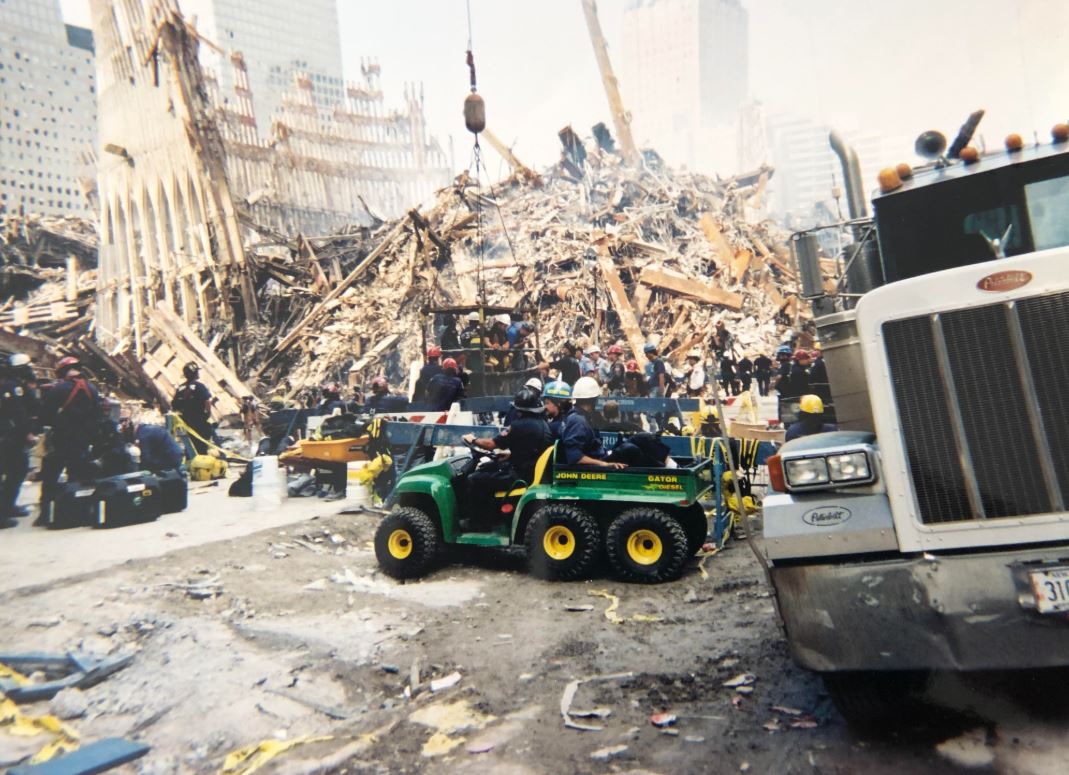
STATE COLLEGE — Twenty-five years have passed since the terrorist attacks of Sept. 11, 2001, but for State College resident John Corr, the memories remain as vivid as the smoke that lingered over Ground Zero.
Corr did not know anyone who was killed in the attacks. He was not a firefighter or a police officer. He was simply a Centre County man watching history unfold on television who decided he could not sit still.
“I said to my wife Ann, ‘I’m gonna drive down there, maybe I can help,’” Corr recalled.
What he expected would be a short trip became 10 days at what workers simply called “the Pile.”
After arriving in New York, Corr helped establish feeding stations before joining a retired Houston firefighter operating a makeshift tool depot near Ground Zero. Day after day, volunteers scrambled to supply firefighters and ironworkers with everything they needed, from water and Gatorade to boots, gloves, helmets, batteries and concrete cutters.
“There was everything to do. It never ended, never stopped,” Corr said. “Everybody needed everything.”
He slept on the floor of a public school before eventually finding a cot. Coffee replaced sleep. The work continued around the clock.
The devastation was unlike anything he had ever imagined.
Most of the surrounding buildings had been pulverized. The streets were buried beneath a mixture of crushed drywall, carpeting and debris. Heavy machinery worked nonstop as firefighters searched for survivors and, later, victims.
Whenever human remains were discovered, everything stopped.
“The place would get really quiet,” Corr said. A chaplain would be called in before the remains were carried away. Then the machines would roar back to life and the work continued.
The grief was overwhelming but Corr remembers something else just as clearly.
Kindness.
Flowers piled outside New York fire stations. Volunteers streamed in from across the country. People delivered food, supplies and equipment by boat from New Jersey because traditional supply lines could not keep up. Cab drivers refused payment from volunteers heading to Ground Zero.
“So many people told me, ‘Thanks for coming,’” Corr said. “It was a different vibe and a different attitude, citizen to citizen, about, ‘We’re all in this together.’”
One moment still gives him goosebumps.
As exhausted firefighters emerged from the disaster zone after days without going home, a woman standing behind the security fence shouted words of encouragement.
“You keep your heads up. We’re all behind you. We love you,” she called.
The firefighters stopped, smiled and nodded before continuing on.
“I get goosebumps now just thinking about it,” Corr said.
The mission changed after about 10 days. Officials announced that rescue efforts had become recovery and demolition. Volunteers were thanked for their service and gradually sent home, though many firefighters stayed because they wanted to remain with their fallen brothers.
When Corr finally left, even the police officers who hailed him a taxi thanked him for coming.
“They both looked at me, ‘Thank you,’” he said. “The cab driver was just the same way.”
Looking back, Corr says the experience changed him, but perhaps more importantly, it changed the way he viewed New Yorkers and Americans.
“Their reaction to it was exemplary,” he said. “People came together. Americans came together.”
Today, many young adults know Sept. 11 only through history books. Corr hopes they remember more than the destruction.
He hopes they remember the response.
“We should treat each other better,” he said. “We should recognize that our fellow Americans are people that we can depend on in a pinch. When push comes to shove, everybody is there to help their neighbor.”
Twenty-five years later, the smoke has long since cleared from Lower Manhattan.
For John Corr, what endures is not just the memory of tragedy, but the image of ordinary people choosing compassion over fear, sacrifice over comfort and unity over division.