
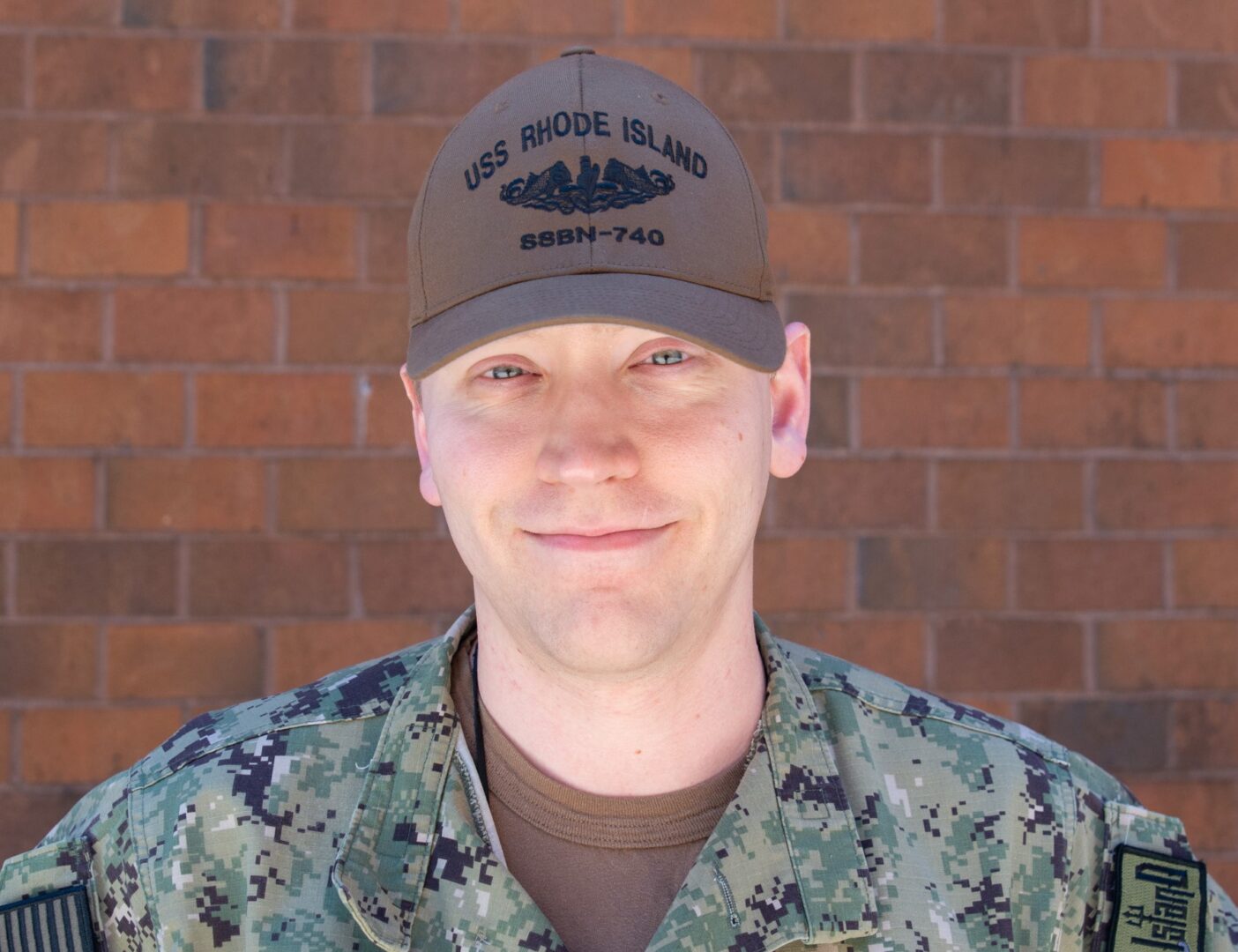
KINGS BAY, Ga. — Submariners make up only 10% of the U.S. Navy’s personnel, but they play a critical role in carrying out one of the Defense Department’s most important missions: strategic deterrence. Petty Officer 1st Class Brian Sherlock, a native of State College, is one of the sailors continuing a 123-year tradition of service under the sea to help ensure Americans’ safety.
Sherlock joined the Navy 17 years ago and today serves as an information systems technician (submarines) aboard the USS Rhode Island.
“I joined the Navy with a mix of patriotism and a desire to better myself,” said Sherlock. “I’m very tech-minded and I thought that with the opportunities in the Navy that I would be best suited here.”
Growing up in State College, Sherlock attended State College Area High School and graduated in 2005.
Skills and values similar to those found in State College are required to succeed in the military.
“State College taught me to always do your best to keep a cool head, even under great deals of stress,” said Sherlock. “It also taught me to not treat people differently just because they come from somewhere else. State College is a very melting-pot type of town.”
These lessons have helped Sherlock while serving in the Navy.
Known as America’s “Apex Predators!,” the Navy’s submarine force operates a large fleet of technically advanced vessels. These submarines are capable of conducting rapid defensive and offensive operations around the world, in furtherance of U.S. national security.
There are three basic types of submarines: fast-attack submarines (SSN), ballistic-missile submarines (SSBN) and guided-missile submarines (SSGN).
Fast-attack submarines are designed to hunt down and destroy enemy submarines and surface ships; strike targets ashore with cruise missiles; carry and deliver Navy SEALs; conduct intelligence, surveillancevand reconnaissance missions; and engage in mine warfare. The Virginia-class SSN is the most advanced submarine in the world today. It combines stealth and payload capability to meet combatant commanders’ demands in this era of strategic competition.
The Navy’s ballistic-missile submarines, often referred to as “boomers,” serve as a strategic deterrent by providing an undetectable platform for submarine-launched ballistic missiles. SSBNs are designed specifically for stealth, extended patrols and the precise delivery of missiles. The Columbia-class SSBN will be the largest, most capable and most advanced submarine produced by the U.S. — replacing the current Ohio-class ballistic-missile submarines to ensure continuous sea-based strategic deterrence into the 2080s.
Guided-missile submarines provide the Navy with unprecedented strike and special operation mission capabilities from a stealthy, clandestine platform. Each SSGN is capable of carrying 154 Tomahawk cruise missiles, plus a complement of heavyweight torpedoes to be fired through four torpedo tubes.
“Our mission remains timeless — to provide our fellow citizens with nothing less than the very best Navy: fully combat ready at all times, focused on warfighting excellence and committed to superior leadership at every single level,” said Adm. Mike Gilday, chief of naval operations. “This is our calling. And I cannot imagine a calling more worthy.”
Strategic deterrence is the nation’s ultimate insurance program, according to Navy officials. As a member of the submarine force, Sherlock is part of a rich history of the U.S. Navy’s most versatile weapons platform, capable of taking the fight to the enemy in the defense of America and its allies.
Serving in the Navy means Sherlock is part of a team that is taking on new importance in America’s focus on strengthening alliances, modernizing capabilities, increasing capacities and maintaining military readiness in support of the National Defense Strategy.
“The Navy is able to monitor from different vantage points — from the land, sea and the air,” said Sherlock. “We also have the ability to communicate very rapidly and efficiently get information that is needed in the wartime environment.”
With 90% of global commerce traveling by sea and access to the internet relying on the security of undersea fiber optic cables, Navy officials continue to emphasize that the prosperity of the United States is directly linked to trained sailors and a strong Navy.
Sherlock and the sailors they serve with have many opportunities to achieve accomplishments during their military service.
“My proudest accomplishment would be seeing so many people that I’ve coached or mentored go out, do great things and advance their own careers,” said Sherlock. “It lets me know that the future doesn’t end with me. Everyone around you has something to contribute even if it isn’t apparent. It’s important to let others be the best they can be even if they surpass you in the future.”
As Sherlock and other sailors continue to train and perform missions, they take pride in serving their country in the United States Navy.
“In joining the Navy, we took an oath to support the constitution,” added Sherlock. “Our sacrifice very handily accomplishes that goal.”
Sherlock is grateful to others for helping make a Navy career possible.
“I’m very grateful to my family, especially my mom and dad, Jack and Melissa Sherlock, and my brother Kevin,” added Sherlock. “My mom helped to shape my moral compass, my dad instilled a great work ethic in me. Kevin gave me the motivation to stay on the right path. I would also like to thank my wife, Amoni Williams, for being there to comfort me at my lows and to spur me on at my highs.”



