UNIVERSITY PARK — In a time when conversations too often end in conflict, Dr. Laurie Mulvey believes the key to healing isn’t avoiding disagreement, but rather leaning into it.
Mulvey is the executive director and co-founder of World in Conversation, a Penn State center dedicated to fostering dialogues across divides. What began as a simple experiment in a sociology classroom has grown into a global model for conflict resolution and human connection.
“It really started as a co-curricular experience,” Mulvey said. “My husband was teaching SOC 119, Race and Ethnic Relations, and students were gathering around after class, wanting to talk. At some point, he said, ‘I’m going to try discussion groups. Laurie, can you help me train some students to lead those groups?’”
What began as a few after-class conversations in the early 1990s has since evolved into a large-scale dialogue initiative involving more than half a million participants worldwide.
“It just turned into World in Conversation,” she said. “Without me intending any of this, I really explored for my whole life what conflict is, how to intervene in it and how to help things go right between people in the middle of these really controversial issues.”
At its core, World in Conversation trains Penn State students to become dialogue facilitators, or what Mulvey calls “group mediators and group managers.” Rather than sitting through a lecture on theory, students immediately begin leading real discussions about complex topics.
“They’re learning how to become a group leader while they’re doing it,” she said. “What’s kept me in this for so many years is just watching what’s possible when any human is learning something dynamically because they have to, because they’re in it and because they’re serving people while they’re doing it.”
For many students, that experience becomes transformative. Mulvey said the process of hearing and understanding viewpoints different from one’s own can fundamentally change the way people engage with the world.
“We usually don’t hear things we don’t agree with,” she said. “We hear caricatures of them. But when you’re in a conversation with someone who holds that view, it starts to crack something open. You begin to see the decency in other perspectives.”
Those discussions can range from global conflicts to deeply personal topics. Over the years, groups have tackled everything from the Israel-Palestine conflict to immigration, gender, healthcare, internet privacy and artificial intelligence.
“If it’s controversial, we talk about it,” Mulvey said with a laugh. “That’s because those are the crossroads of human value systems, the places where the most important things are happening.”
While empathy often emerges from these exchanges, Mulvey said it’s not the goal. “Empathy happens, but the goal is building solutions with our opponents,” she explained. “You don’t build the world with your friends. You build it with your opponents. Otherwise, you don’t build it at all.”
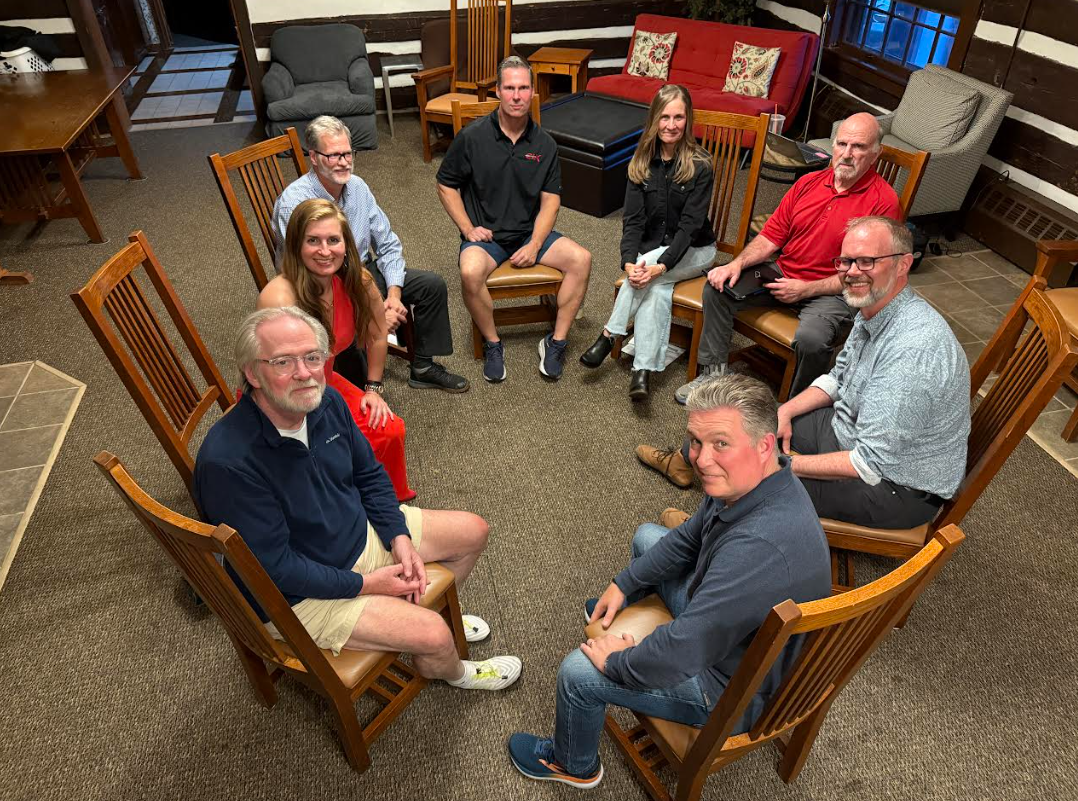
The center’s newest effort, the “Red-Blue Dialogues,” brings conservatives and liberals together in structured group settings. The goal isn’t to change minds but to cultivate understanding and cooperation on shared problems. Participants can sign up through the World in Conversation website, where they first attend a session with like-minded individuals before joining a cross-partisan group.
Mulvey hopes to expand that work beyond campus and into a broader community. “The main goal is to sustain the program and bring our student practicum into the community,” she said. “We want to train more community leaders to manage dialogues in this way so we can build alliances across political differences.”
In a culture often defined by division, Mulvey believes most people share more common ground than they realize.
“The vast majority of us are the unsexy middle,” she said. “The people who have the mic are not the rest of us. But once people meet each other, they realize how much they have in common. That’s when you can’t be manipulated, and that’s when real change starts.”
For more information or to join a Red-Blue Dialogue, visit worldinconversation.psu.edu.
Top of Form