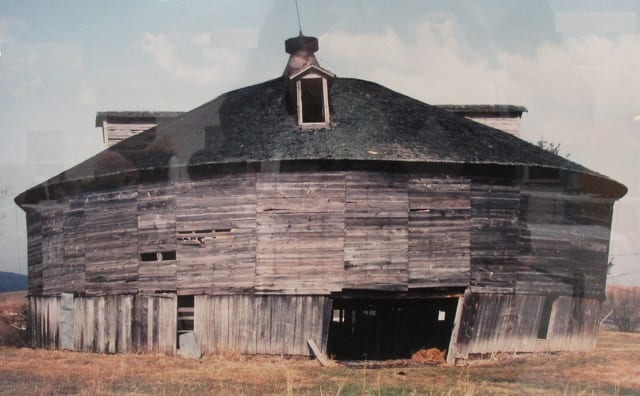
Nearly everyone in Centre County is familiar with the historic round barn along Route 45, west of Centre Hall. This picturesque, bright red structure, built by carpenter Aaron Thomas in 1910 for Calvin Neff, has been the subject of countless photographs, paintings and admiring glances by passersby. Probably far fewer people are aware that Penns Valley had a second round barn, which existed for more than 70 years. It was known as Beck’s Round Barn and was located along Route 192, about eight miles east of Centre Hall.
James Beck’s round barn was the subject of a presentation by Harry Ward during the Penns Valley Historical Museum’s winter fundraising dinner, held Jan. 13 at New Hope Lutheran Church.
Following the meal, museum board president LeDon Young introduced Ward’s presentation. Young noted that Centre County once had three round barns, including the Neff and Beck barns and a third barn, in Julian, which had burned down. Aaron Thomas constructed the Neff and Beck barns, and is thought to have built the one is Julian, too.
Ward began his discussion with a brief history of American round barns, noting that the first such structure known in America was built at George Washington’s Mount Vernon home in 1792, although that barn was not a true round barn, but rather a polygonal structure with 16 sides and an eight-sided roof structure.
True round barns appeared from around 1890 to 1900, and were fairly popular till the mid-1930s.
Beck’s 70-foot-round by 50-foot-high barn was constructed in 1913, and was built with two levels — a cattle floor and an upper mow floor. The mow floor was supported by timbers radiating outward from a central silo and resting on three concentric sills, which were each laminated from eight boards bent into a curve after soaking in water. Tapered radial rafters supported the shingled roof, which featured four windowed dormers. The peak of the roof featured a cupola, which was later replaced by a modern ventilator, and the central silo was removed.
Ward said the upper floor of the barn had gaps between the floor boards, where grain was placed and horses walked on it, causing the kernels to fall through the gaps to be collected in the granary below. The barn’s round shape made it easy to drive a team of horses into the barn, around the central silo, and back out the door without having to back the team up.
Young speculated that one of the reasons round barns fell out of favor in the 1930s was the advent of rural electrification. “Once you had power, you didn’t need to use gravity,” she said.
Ward has an ancestral connection to Beck’s barn. His great-grandparents, Hans and Lizzie LaFlamme, bought the barn around 1943, and he spent much time there as a child in the 1950s playing in and around it. He said the barn had never been painted, but rather took on a natural gray, weathered patina over the years. “That’s the color I remember ever since I was a little kid,” said Ward. “It was never painted that I know of.” He said the barn and surrounding farm had eight owners since leaving the Becks’ possession in 1932. The barn underwent several repairs over the years, but slowly deteriorated and took on an eastward lean.
The property was owned by Jorge and Judy Grimes when the barn’s roof finally collapsed in a gusty thunderstorm in 1984. The Grimes were heartsick, since they has just contacted a carpenter with plans to repair, stabilize and preserve the structure, but the damage from the collapse made that idea an impossible task. The barn’s remains were later leveled, and all that remains today is a circle of stones from its foundation.