
My headline is Yiddish for love and hate. I chose it because it’s the title of a play by my great-uncle, Hershl Eppelberg, who was part of the Yiddish theatre scene in Warsaw at the beginning of the last century.
Near the end of the last century, my mother entrusted me with the manuscript, written in pencil on the stationery of a Brooklyn hotel. I hatched a scheme: Find an alter kaker (politely, an old geezer) at a Jewish old folks home, record that person’s literal translation from Yiddish to English and transmute the literal into the literary.
First, though, I wanted to know if the play had merit. So I brought it to the YIVO Institute for Jewish Research in New York. The first person I talked to searched the archives and came up empty.
I shrugged. Even if it’s a schmaltzy play by a second-rate playwright, the translation seemed worth doing. I was almost out the door when a tiny lady with a heavy-duty Yiddish accent asked me how my YIVO visit had gone. I told her why I’d come, and how I’d made out.
“Come with me,” she said, and led me back to the library.
The tiny lady was librarian Dina Abramowicz, whose mind, according to her New York Times obituary (she died in 2000), was “a mental card catalog for hundreds of rare and obscure books and historical materials in the dusty YIVO stacks.”
I got to see that mental card catalog in action when Ms. Abramowicz materialized an encyclopedia of the Yiddish theatre and found a two-page entry on Uncle Hershl along with a head shot of a bald man with large ears, the family schnoz and a flaring Van Dyke beard.
“This is quite a find,” Ms. Abramowicz said of the manuscript under my arm. So much so that she asked me to donate it to YIVO, which I did, in exchange for a photocopy of the original.
You would think, after that promising start, I would have been eager to get on with the translation. Alas, the project molders in the overflowing bin of cool ideas I’ve never followed through on.
I don’t even know what the play is about, beyond the title. And all I know about Uncle Hershl is this, from the YIVO Archives:
“Yiddish playwright, novelist, editor, and theatrical director. Born in 1861 in Lomazy. Settled in Warsaw 1880. Settled in Brooklyn in 1921, and died there in 1927.”
My mom was 5 when he died. She didn’t remember him.
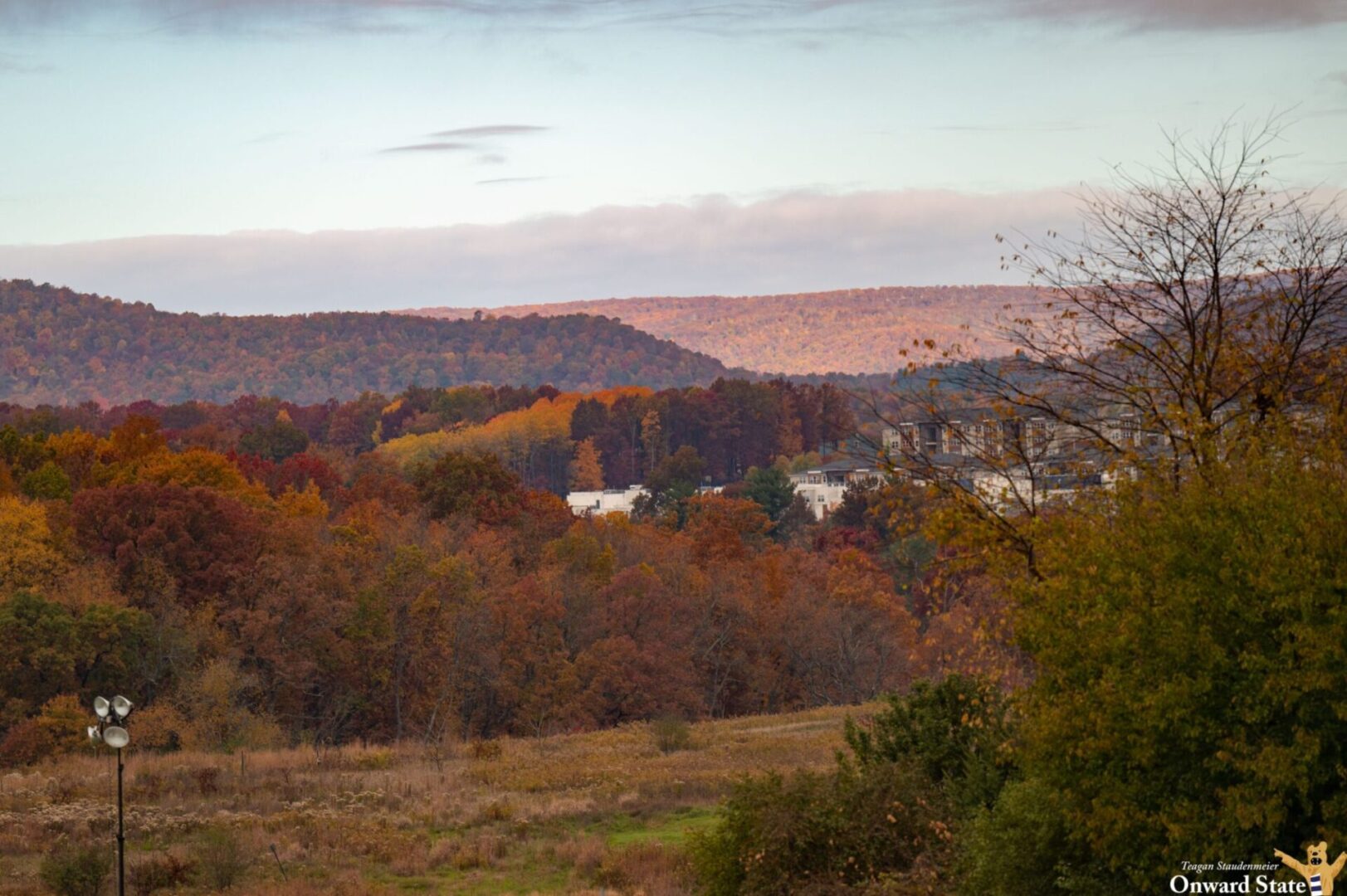
I thought of Uncle Hershl and his play at the start of this mid-autumn Election Week, the last leaves clinging to the trees, the weather delightfully, alarmingly balmy, as I reflected on all that has delighted and alarmed me this bittersweet season. So much to love, so much to hate.
Love:
- State College has come back to life! Perhaps prematurely, we have shaken off the COVID doldrums and are awash in concerts, plays and talks. I’m back to thinking I could go out every night, had I a mind to.
- Penn State students have come back to life! Last year, I taught zombies. This year, my students have ideas and opinions and are willing to express them. Hallelujah!
- Pennsylvania’s rail trails. On successive gorgeous October weekends, we hauled our bikes to the Pine Creek Gorge, and rode different sections of the trail between Jersey Shore and the Pennsylvania Grand Canyon.
- The Penn State Theatre Department. I’ve seen “Metamorphoses” and “Cabaret” so far this season and was impressed with the staging, the costumes, the overall look of the productions and the voices of the student actors. On deck: “Rent.”
- And of course, the turning, twirling, dancing leaves.
Hate: Come to think of it, just about everything I hate – other than leaf blowers — has to do with the state of our politics. The Republicans, in lockstep with their sleazy pied piper, daily sink to new lows of hypocrisy, fearmongering and callousness. The Democrats are merely inept.
On Halloween night, I watched a snippet of a show about women accused of witchcraft in 17th-century England. “Cabaret,” like so much else we’ve read and seen about the period, shows 20th-century Germany descending into madness. Both places thought of themselves as civilized societies.
One does not want to be hysterical, yet who can say for certain that our democracy won’t collapse into a white supremacist dystopia while we’re watching our shows, rooting for our teams and posting pictures of our latest fabulous meal on social media?
There’s a pattern here: “What I love,” wrote the poet Theodore Roethke, “is near at hand” (other than my children and grandchildren). While nationally and internationally, things are, to quote Jimi Hendrix, “a frustrating mess.”
That makes it tempting to focus on the near and dear, and tune out the rest. But messes, if not contained, spread.
Uncle Hershl left Poland in the nick of time. Last week, Washington Post columnist Dana Milbank wrote about American Jews pondering where they might go “if the worst happened here.”
Hysterical? Let’s hope so.
More Columns
View all Columns
The Rhyme, Reason and Rhythm of Matt Campbell Football
Matt Campbell is doing Penn State football his way. Which is quite different than how his predecessor did it. Now, in some ways, what was old is new again. Not […]

Paterno: Penn State Football’s Past and Present Meet
Last week, Penn State opened a new football exhibit in the All-Sports Museum at Beaver Stadium. That exhibit included a recreation of Joe Paterno’s office which immediately drew attention from […]

Yours, Mine and Ours: ‘We’re All Penn Staters Now’
As Matt Campbell pieced together the 2026 Penn State football staff and roster, it was a classic case of yours, mine and ours. The Nittany Lions were the Brady Bunch […]


