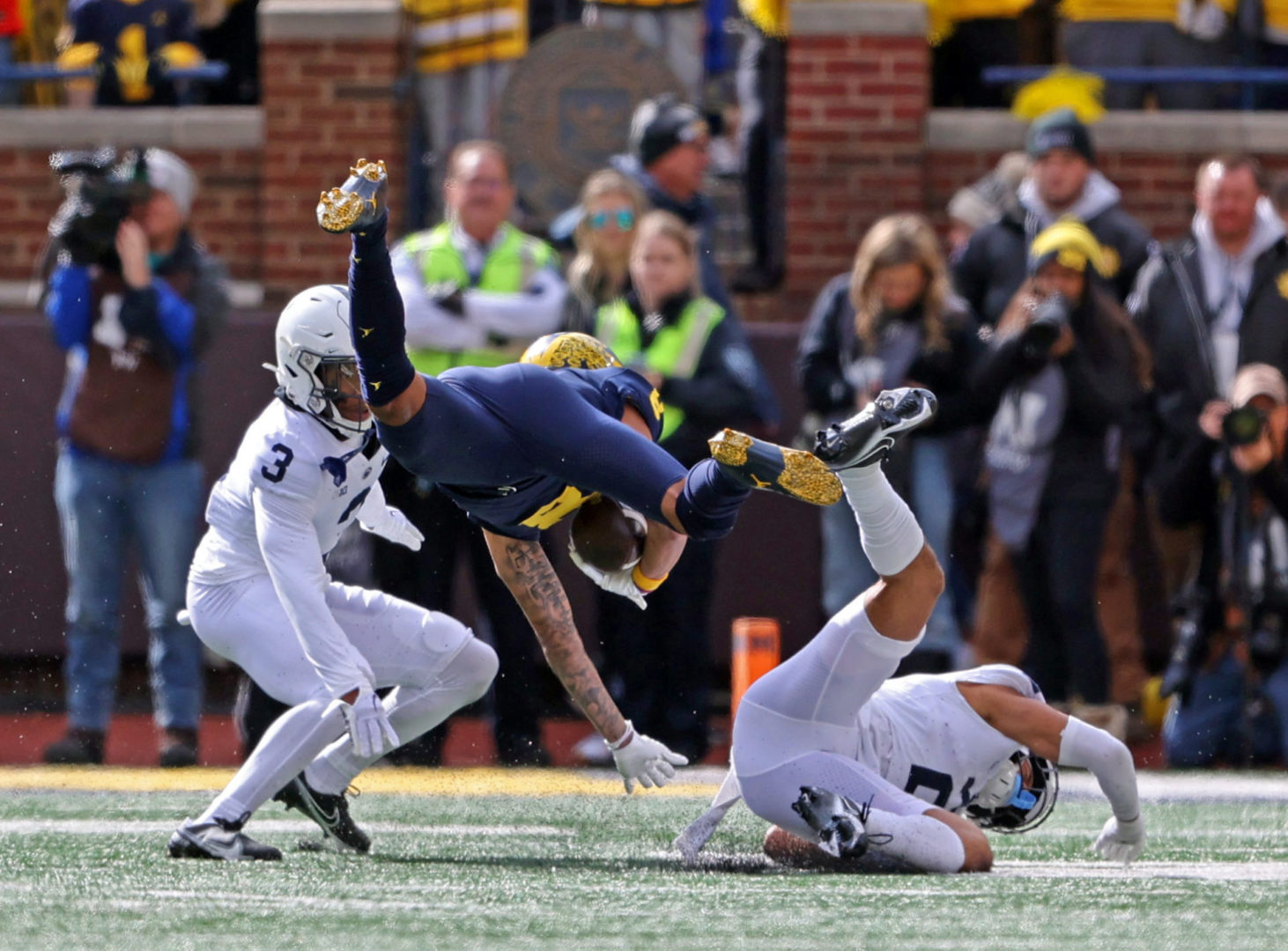
It was a disappointing, demoralizing loss.
The game had been over for just a few minutes, the taste of defeat still raw and bitter and not yet fully digested.
The Penn State head football coach walked to the front of the visiting team’s media room in the bowels of the cavernous and hallowed Midwestern stadium, took a seat on a chair behind a table, peered out to the familiar faces of the traveling PSU beat and prepared to take his second beating of the day.
The first came when his team had been embarrassed by a now-superior rival in the Big Ten Conference, an opponent that had surpassed Penn State on the playing field and as a program.
It was a blowout, and the beatdown was even worse than indicated by the lopsided score.
The Nittany Lions entered the game riding high, and feeling good about themselves. There was reason to believe it was going to be a competitive contest.
But, in the end, it was not.
Four times in the first 102 seconds of the press conference that ensued the Penn State head football coach did what should be expected, at minimum: He held himself accountable.
Less than a minute in, he took responsibility for an offensive play call that didn’t go well.
“I called a play down there in the red area,” the Penn State head football coach said. “I thought I could have called a better play.”
Fifteen seconds later, when asked to evaluate how his defense – which gave up over 400 yards rushing and a multitude of touchdowns — played, the Penn State head football coach deferred. He didn’t complain about any weaknesses at any position. Nor did he call out any player’s size. He didn’t say, “We did not do well on either front. That’s tight ends and O-line. That’s D-line, that’s the linebackers. They outplayed us on both fronts. There’s no doubt about that.”
Instead, the Penn State football head coach — who had taken the sanctions and scandal that weakened Penn State in the trenches and on the recruiting trail in stride – shifted the question.
And the blame.
WHAT THE JOB IS
As a former college football player himself, who had been an assistant coach for many years before taking the head position at Penn State, he knew the vagaries of being the top guy, the person who drew the biggest paycheck, the man who faced the brightest spotlight.
He knew that every time you point your finger at someone or something else, there are three fingers pointing right back at you. He knew that it is impossible to point the finger of blame at someone or something without simultaneously pointing a finger back at oneself.
So, he took the medicine for a locker room of defeated players. For a band of hard-working coaches and a fleet of support staff. For a passionate and broad network of fans and alumni who watched in disbelief as his team was summarily dismantled on national television, before a raucous road crowd of 100,000 against a head coach on the opposing sideline who was an even bigger name.
Given that, what was the Penn State head football coach to say?
“I take full responsibility for this loss,” was the simple yet deep reply of the Penn State head coach, who then addressed the beat writers who followed the Nittany Lions.
“I’m not going to sit here and evaluate this and evaluate that, because you guys will bust my chops when I say I have to watch the film and that I’ll talk about it on Tuesday. I’ll talk about it on Tuesday. I’ll watch the film and tell you all about it on Tuesday. All of the mostly bad and some good that we did…”
ABOUT THE QUARTERBACK
The Penn State head football coach was pissed and angry and ashamed and dumbfounded and disappointed. He was surprised his team did not play better, given how some key parts of the early season had played out.
Then he took one on the chin, when asked about his embattled and beleaguered starting quarterback who left the game with an injury. Loyalty in the face of defeat.
“He tried to go,” the Penn State head football coach said of his starting QB. “He’s a tough kid. Man, we got a lot of tough kids. He tried to go and, uh, you know, he just didn’t feel good about throwing.
“He wanted to keep going,” he added. “I felt it was in the best interests of the team at that point” to go with the backup. “I thought (the backup) went in there and did some decent things.”
Man, we got a lot of tough kids.
Then, the Penn State head football coach took a page from “We Motivate People Magazine.”
He did what great leaders do: Give credit. Take blame.
Again.
“Again, I’ll take full responsibility for this,” the Penn State head football coach said. “We didn’t have them prepared good enough as a coaching staff and me as the head coach — and therefore we didn’t play good enough.”
Then, he pointed his finger at his players. In a good way.
“Again, we got tough kids in that locker room,” the Penn State head football coach said. “They’ll put it behind them. We’ll learn from it… I think our guys gave a good effort all night. I don’t think anybody quit.”
AGAIN…
The Penn State head football coach continued: “Again, I take full responsibility for it – for the loss. I just need to do a better job of preparing these guys next time.”
You get the idea. The Penn State football head coach did.
You can watch that press conference for yourself here:
Then be reminded that the very next week that Penn State football head coach rallied his troops, who did a turnabout and won their next game against a Big Ten rival. In overtime.