
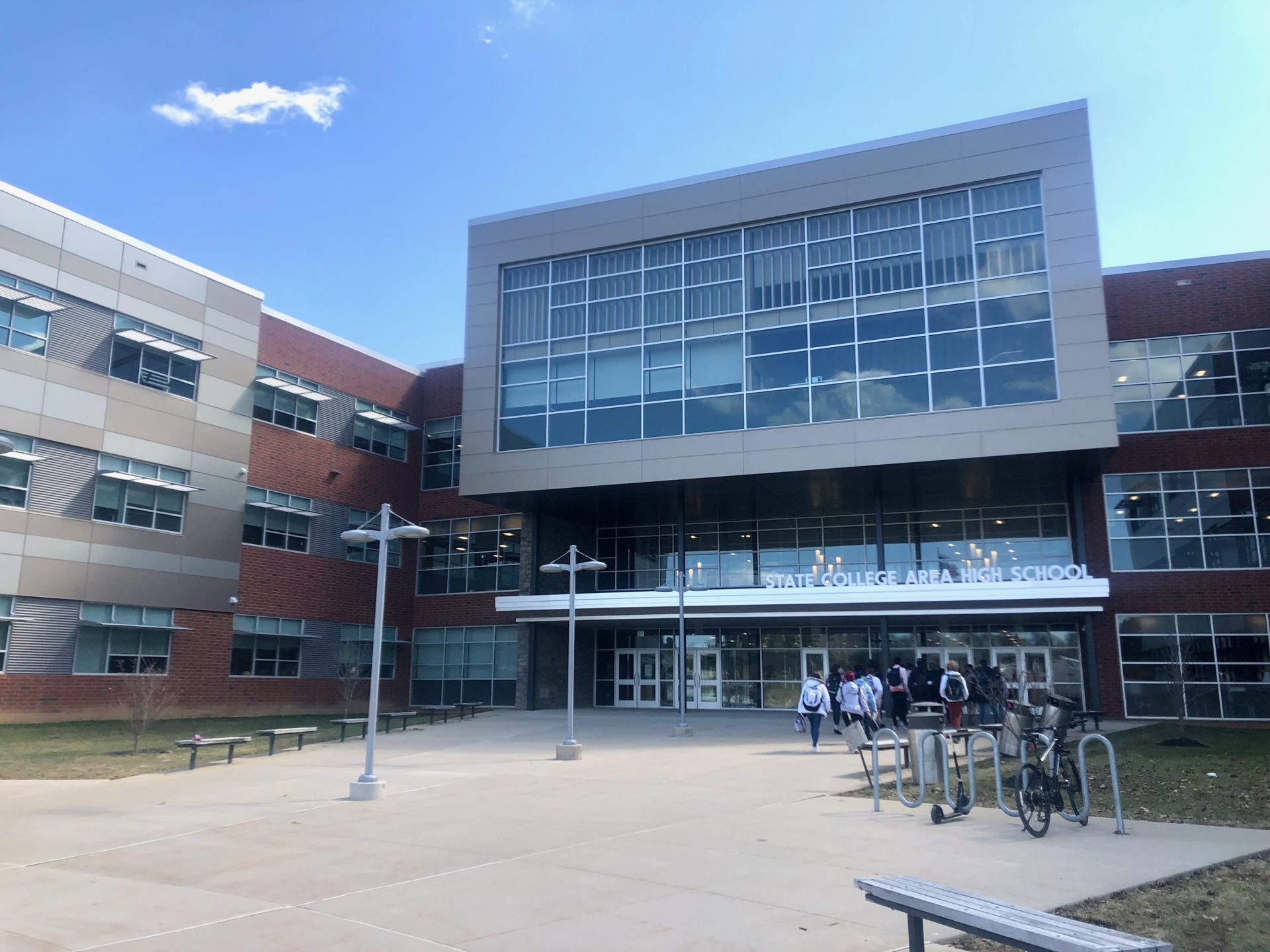
Following a student altercation earlier this year that raised community concerns about violence and racial tensions, State College Area School District officials on Monday outlined a report on safety at State High.
“As a district, we are constantly striving to create a safer and more welcoming environment for our students,” assistant superintendent Curtis Johnson and State High principal Laura Tobias wrote in a memo to the school board.
The report, which comes after an assault in February stemming from a photo of a student wearing a racial slur and antisemitic imagery, provided comparative data on incidents of assault, harassment, fighting, minor altercations and racial intimidation for each school year from 2015-16 through 2021-22.
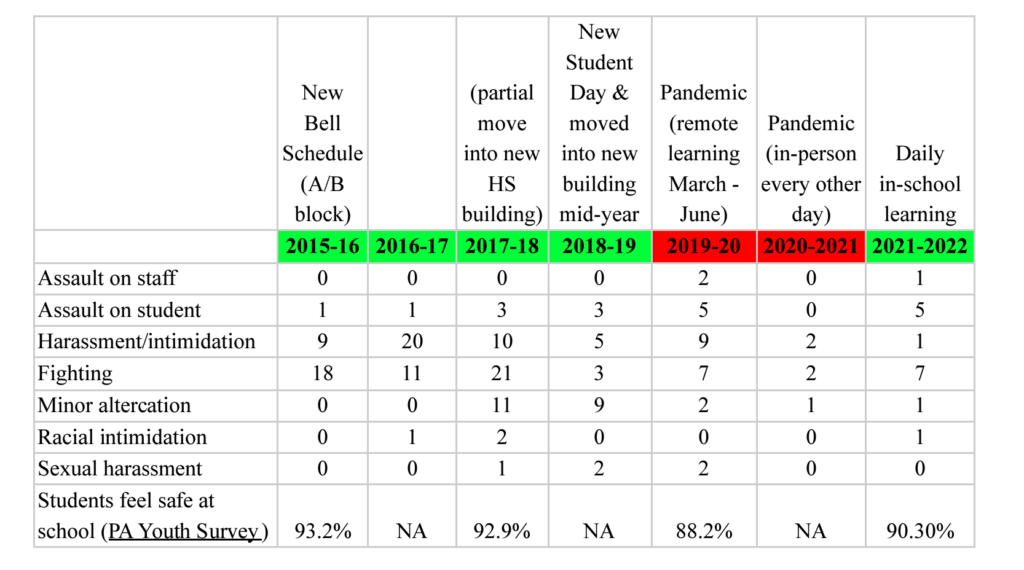
Documented incidents, Johnson said, are those which are reported to a school administrator and result in discipline according to the code of conduct.
A Pennsylvania Youth Survey found 90.3% of State High students felt safe in school, up from 88.2% in 2019-20.
Five assaults on students have been documented this academic year, the same as in 2019-20 when the district last had in-person school five days a week. Those numbers are up slightly from three each of the previous two years.
One incident of harassment and seven fights have been reported this year, both substantial decreases over the past eight years. In 2017-18, there was an eight-year high of 21 fights, while harassment incidents reach a high of 20 in 2016-17.
“The data shows that harassment, intimidation, fighting incidents have significantly decreased since 2018-19,” Johnson said. “That’s when we moved into the new building so I don’t know if that had anything to do with the new building and how it’s laid out.”
No sexual harassment incidents and one assault on a staff member have been documented this year.
One racial intimidation incident is on record for 2021-22 and over the past eight years the most that have been documented in a year is two, in 2017-18. Johnson noted that racial intimidation is defined as “a direct threat toward an individual based on race.”
The report states that 81% of the 25 reports to the school’s REACT Team were for race-related bias or prejudice. REACT is a group comprised of faculty and students that aims to use education, dialogue and restorative practices to help any State High community member who believes they are a victim of racial bias.
Another tool for reporting incidents is Safe2Say, a partnership between the Pennsylvania Office of Attorney General and school districts that provides an anonymous tip line available 24 hours a day to school community members. District-wide, 651 reports have been made to Safe2Say, most related to secondary schools.
“We strongly encourage students to report experienced sexual harassment, racial intimidation and any incident of harassment or bullying to a trusted adult and an administrator,” Johnson said.
He added, however, that there are various reasons why incidents might not be reported or result in disciplinary action.
“Some students may report to confidential sources in the school such as school counselors or clinical mental health counselors,” he said. “Additionally, some students may ask that an incident not be reported to the administration. Finally, some students may want to repair harm outside the code of conduct via restorative circles, mediation or peer counseling. School staff work closely with impacted students to ensure students are supported no matter the decision.”
Board member Laurel Zydney said she spoke to parents over the past few years whose children continued experiencing bullying while administrators told them they were addressing the issue.
“One person’s ‘let’s work on getting restoration here,’ is another’s ‘we want you to keep quiet; we’re just going to keep saying we’re going to deal with it…’” Zydney said.
“The administration has gone through a lot of training and will continue to do more training… to help resolve these issues and dealing with them and making sure we’re handling them with fidelity… taking them seriously and not waiting too long to act upon them,” Johnson said. “We have gone a long way as far as dealing with those particular incidents.”
Board member Dan Duffy said he believes in restorative practices, but added that incidents that do not make their way to discipline need to be documented as well.
“I really believe in the need to provide more guidance and more direction for those involved in whatever the harmful behavior might have been,” he said. “We still need to account for those events.”
Tobias said the school maintains records of information received through Safe2Say and REACT, which help administrators to take preemptive actions to curb issues. She added that different factors and student situations mean each case has to be approached individually.
“We really try to repair the harm and educate while we’re doing it so that it never occurs again,” Johnson said.
The high school has introduced several programs and made security adjustments “in response to recent events,” according to the report.
In March, the school partnered with Student Problem Identification and Resolution of Issues Together (SPIRIT) program representatives and volunteer facilitators from around the state for an event with 46 volunteer State High students, who met in small groups throughout the day to discuss positives, areas for improvement and potential solutions.
Twelve students were then selected to form a SPIRIT Council that will work directly with administration on improving school climate.
“To improve school climate, we sought out this student-driven program, which engages students, school administrators, teachers, school resource officers, and other school and community members to address tension and conflict related to issues of race, color, national origin, gender, gender identity, sexual orientation, religion, or disability,” Johnson and Tobias wrote. “Through elevating student voices, the goal is to develop and implement solutions to resolve these issues.”
The Office of Equity and Inclusivity worked with a group of students, including the peer advocates program, to produce “Lift Every Voice,” a school-wide cultural celebration event held last week and featuring performances and art.
As part of the ongoing, student-led No Place for Hate program, all students took part in a lesson this spring on “the importance of being an upstander rather than a passive bystander…” and reinforcing reporting mechanisms available.
To further address safety concerns, the district reassigned security officers to increase their presence in the hallways and restrooms before, during and after school. Teachers also will be more visible in those areas during class changes.
“Moving forward, we will continue our collaborative efforts to provide an equitable and inclusive school climate for our students and employees,” Johnson and Tobias wrote. “In all respects, we’re fully committed to this critical work, including sharing updates about actions with our students, employees, families, and other important stakeholders.”
More Local News
View all Local News
New Principal Named for Easterly Parkway Elementary School
The State College Area School Board on Monday unanimously approved a new principal for Easterly Parkway Elementary. Meredith Henderson, currently the assistant principal at Mount Nittany Middle School, will begin […]
Anne Demo Launches Campaign for State College Area School Board
A former Penn State professor and paraprofessional in the State College Area School District is running for school board. Anne Demo said in a press release that she will seek […]

Alum’s Gift to Fund New Memorial Field Scoreboard
State College Area School District’s Memorial Field is getting a new scoreboard, mostly funded by a gift from a State High alumnus. The school board voted unanimously on Monday to […]


