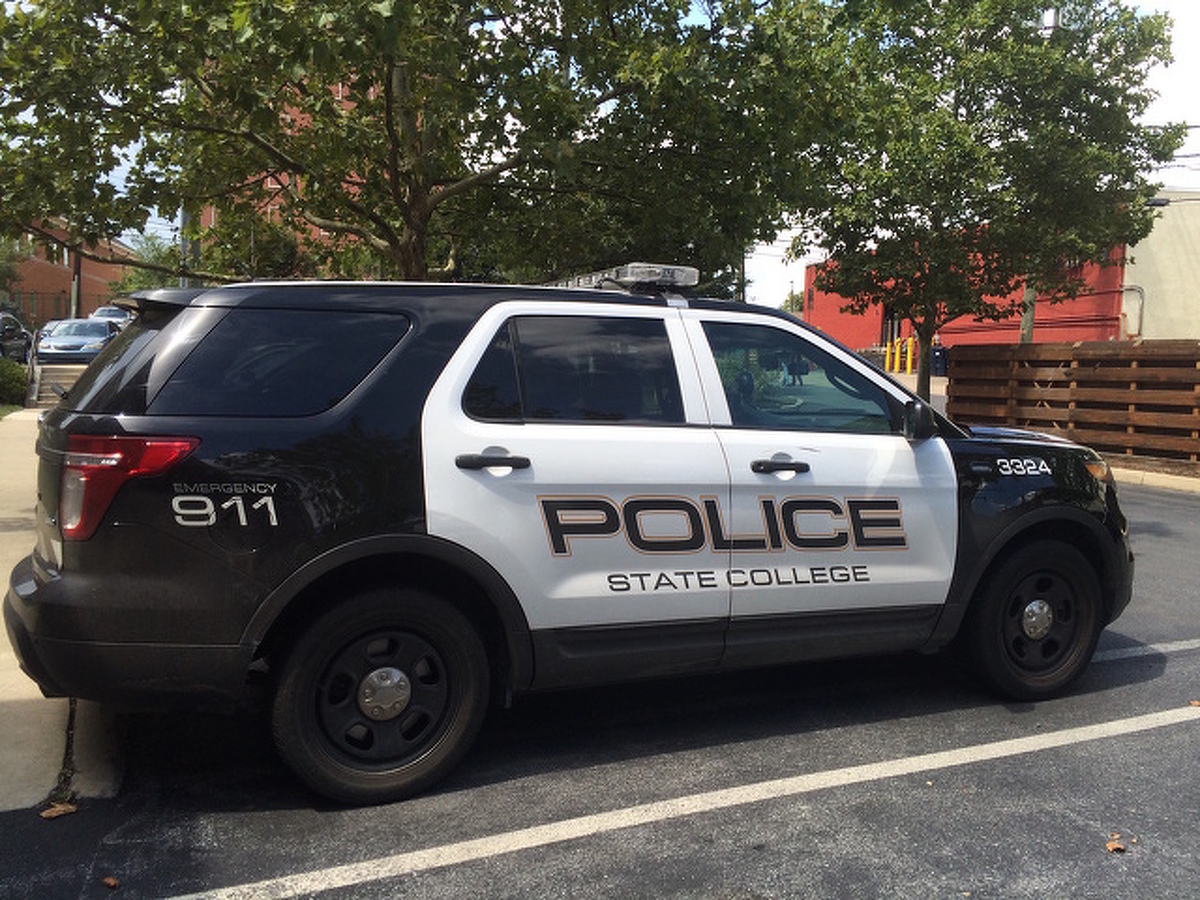
After addressing some final questions on Monday night, State College Borough Council will vote next week to establish a Community Oversight Board for the borough police department.
Though the idea for a COB in State College has been around since 2016, it was set into motion last summer amid calls for reforms following the police killing of George Floyd in Minneapolis and a renewed spotlight on the fatal shooting of Osaze Osagie by borough police in 2019. An ad hoc study committee was appointed in the fall and presented its recommendations to council in December.
After numerous discussions throughout the past year, a draft ordinance to create the COB — which almost entirely aligns with the study committee’s recommendations — was published in June and council held two special meetings this summer solely for public input.
The nine-member COB, which will be appointed by council, will have auditing, monitoring and data analysis functions, as well as some investigative ability.
During Monday night’s work session, borough staff and the study committee’s chairman addressed remaining questions and concerns raised by community members and council about the board’s staffing, funding, membership and training.
Since the draft ordinance was published, some community members have raised questions about the role of a coordinator, who would be a borough staff member assigned to the board. The study committee recommended the creation of an executive director position dedicated to the COB.
Borough Manager Tom Fountaine said the coordinator will be a new employee who will be hired as director of the Department of Diversity, Equity and Inclusion, which will become the borough’s sixth department. In addition to coordinating the activities of the COB and working closely with the board chair, the director will collaborate with other departments and oversee diversity, equity and inclusion strategy and training, recruitment and retention of underrepresented populations and analysis of proposed legislation and policies for guidance on equity issues.
While supervising administrative support staff funded by the department’s budget as well as the existing community engagement manager position, the director will report to the borough manager, as required by the home rule charter, Fountaine said. The COB itself, as a borough board established by council, would not have legal authority to act as an employer.
The director/coordinator will not be a voting member of the COB.
Recruitment for the director position will begin immediately after the ordinance is approved, Fountaine said
As part of the COB’s auditing function, the coordinator will observe the police department’s internal affairs investigations of officer misconduct allegations by sitting in on interviews, asking questions “and observing the overall direction of the department’s disciplinary process and procedures,” according to the draft ordinance. The coordinator would then make a redacted report to the COB.
Study committee chair Mark Bergstrom said the reason for having a borough staff member fill the auditor role is that there “would be clear consequences if someone violated,” the confidentiality required for internal affairs investigations — namely, that a staff member could be fired for doing so.
“This would be an opportunity the board would have to be engaged in auditing while having procedures in place that hopefully would safeguard the confidentiality of that process,” Bergstrom said.
While the COB will be able to “receive, process and investigate complaints about the department from members of the community through a civilian complaint process,” it will not replace the internal affairs procedures for investigating allegations of officer misconduct, something that is governed by Pennsylvania law for police collective bargaining agreements.
It also cannot override existing responsibilities and authority of council, the police chief or the borough manager.
The COB will have a monitoring responsibility that includes quarterly meetings with police department representatives to review redacted reports about incidents involving use of force or complaints against officers. The plans for the COB call for the coordinator, the board chair and two other board members to participate in each of those meetings.
Bergstrom explained that format was chosen for practicality and to ensure each COB member is involved with at least one of the review meetings each year. Members who attend the meetings will then report back to the full COB for discussion.
“It’s supposed to be a give and take and a discussion of these cases even though the information is redacted,” Bergstrom said. “We thought that it was not manageable to have nine members of the COB, plus the staff of the COB plus the … representatives of the department all in a meeting together for quarterly review of cases… It’s to keep the board totally involved in the process but to keep it manageable as well.”
At a special meeting in July, critics and proponents of the COB called out concerns about training provisions for board members. Opponents bristled at the mention of critical race theory, while advocates said attending a Citizens Police Academy or police ride-alongs should not be included.
Bergstrom said that while the recommendations provide a framework, the COB will be responsible for identifying and implementing its training programs.
“The idea was that this should be broad-based training that individuals are fully informed of the responsibilities of the department and the limitations of officers and also that some of the community concerns we heard about race and other types of issues are also part of that educational process,” he said. “The intent was to have balanced training that was broad and covered the issues that would be before the COB… Having objections to some of the trainings on both sides might have been consistent with our view that we want to have all the information on the table and have a very well informed group of citizens involved in the advisory committee.”
How those members will be appointed and the COB’s degree of independence were among other issues raised during community input meetings.
Council ultimately will be responsible for appointing the nine members, who will serve three-year terms with a maximum of nine continuous years on the board. The ordinance calls for a diverse array of members with varying experiences, but a reference to council using existing procedures for filling vacancies on authorities, boards and commissions led some to question whether the COB would be appointed through rote ABC processes.
“There is a lot more in this ordinance than is in any other ABC,” Assistant Borough Manager Tom King said. “This ordinance has significant qualifications. It has significant categories of membership and both of those sections articulate the various requirements that must be considered in appointing. It goes much further than any other ABC.”
King said it would not be appropriate to include a full detailed application in the ordinance, but that staff will recommend the application developed by the study committee be used, once it has undergone legal review.
“We don’t recommend and staff does not think that the standard standing application used for most all other ABCs works for this position,” King said.
One member of the COB, according to the draft ordinance, should be a Penn State student. The study committee recommended that the student be appointed for two years instead of three because students are most often in the community for a limited time and may not become engaged with local issues for a couple of years. But King said based on feedback from council at previous sessions, the ordinance was written for all members to have three-year terms.
Council made no further comment on the student term on Monday night.
“I think we can find a board that will be able to do this job,” Councilman Evan Myers said. “There are a lot of engaged citizens in our community that certainly will bring a lot of expertise and a lot of experience and I think that’s what’s important.”
Responding to concerns about the independence of the COB given borough staff involvement, Councilwoman Theresa Lafer noted that existing boards such as zoning and health have a large degree of autonomy.
Fountaine said the COB could be likened to the Zoning Hearing Board.
“The borough planning department provides staff support for that, but the zoning board is independent,” he said. “Even though the staff that is supporting them is appointed and reports to the planning department and borough manager, that board itself still has a level of independence.”
Fountaine also sought to clear up concerns about funding for the COB. State College’s 2021 budget allocated $165,000 for the COB and when it was approved in December, the funding was described as coming from unrestricted reserves.
On Monday, Fountaine said that about $2 million in reserves was used to balance the budget because of the decision not to raise taxes or fees in the midst of the COVID-19 pandemic, but that the reserves were not earmarked for a specific purpose. Funding for the COB, he said, is not temporary.
“This is an appropriation in the budget the same as every other department in the budget is a permanent appropriation,” Fountaine said.
Lafer said that the COB appearing as a line item in the budget, and not as a subcategory of another department, makes its funding relatively secure.
“Long-term, if we want to make this a permanent item, which we do, giving it a budget line which comes up every year at the same time and place is much more secure over time,” Lafer said. “…I am much more comfortable as we finished the last budget and as we face the one coming this fall for next year that we have a secure line for this COB for as long as we want it. I think that’s extremely important.”
Councilwoman Katherine Yeaple noted that the borough funded the COB while choosing not to fill six vacant positions, including two police officers.
“We’ve clearly prioritized the [Community] Oversight Board,” Yeaple said. “We’ve let six vacancies go in the borough. This is clearly a priority of the State College Borough.”
While the ordinance appears on track for approval, Councilman Peter Marshall stressed that council cannot and should not cede it ultimate oversight authority.
“We were elected to provide this oversight and direction and we cannot transfer that responsibility to a citizen ABC,” Marshall said. “First, this is an ABC of thoughtful citizens that we expect to be objective and truthful. That’s what we expect of all our ABCs. We should not be trying to establish a supergroup to watch every move made by our police officers. Their actions are already subject to review by the manager, the council, the district attorney and the courts.”
He said his view of the COB is that it can “set up a system of communications where individuals can complain or applaud police officer behavior through a non-police channel.” It can also review police department data and complaints, make recommendations to council, report wrongdoing to council or administration and request additional information or investigation.
“I see an ABC of engaged citizens working in cooperation with the police department, the manager and the council to ensure that our police services continue to serve as a model accredited community police service within the commonwealth of Pennsylvania and beyond,” he said.
Myers said the COB’s purpose is to serve the community.
“Foremost, it has to serve the community well… and that is the main reason that we’re doing this,” Myers said. “It’s not to serve the police department. It’s not just to serve the borough council — although I believe that in establishing this it is to help restore trust in this council and the police department and the administration — but it is to serve the community and the just concerns of the members of the community that have pushed for the formation of this oversight board.”
Council is scheduled to vote on the ordinance during its regular meeting at 7 p.m. on Monday, Aug. 16. If approved, the establishment of the COB will be effective Oct. 1.