How Bellefonte-born sculptor George Grey Barnard’s unconventional vision of Abraham Lincoln sparked an international debate
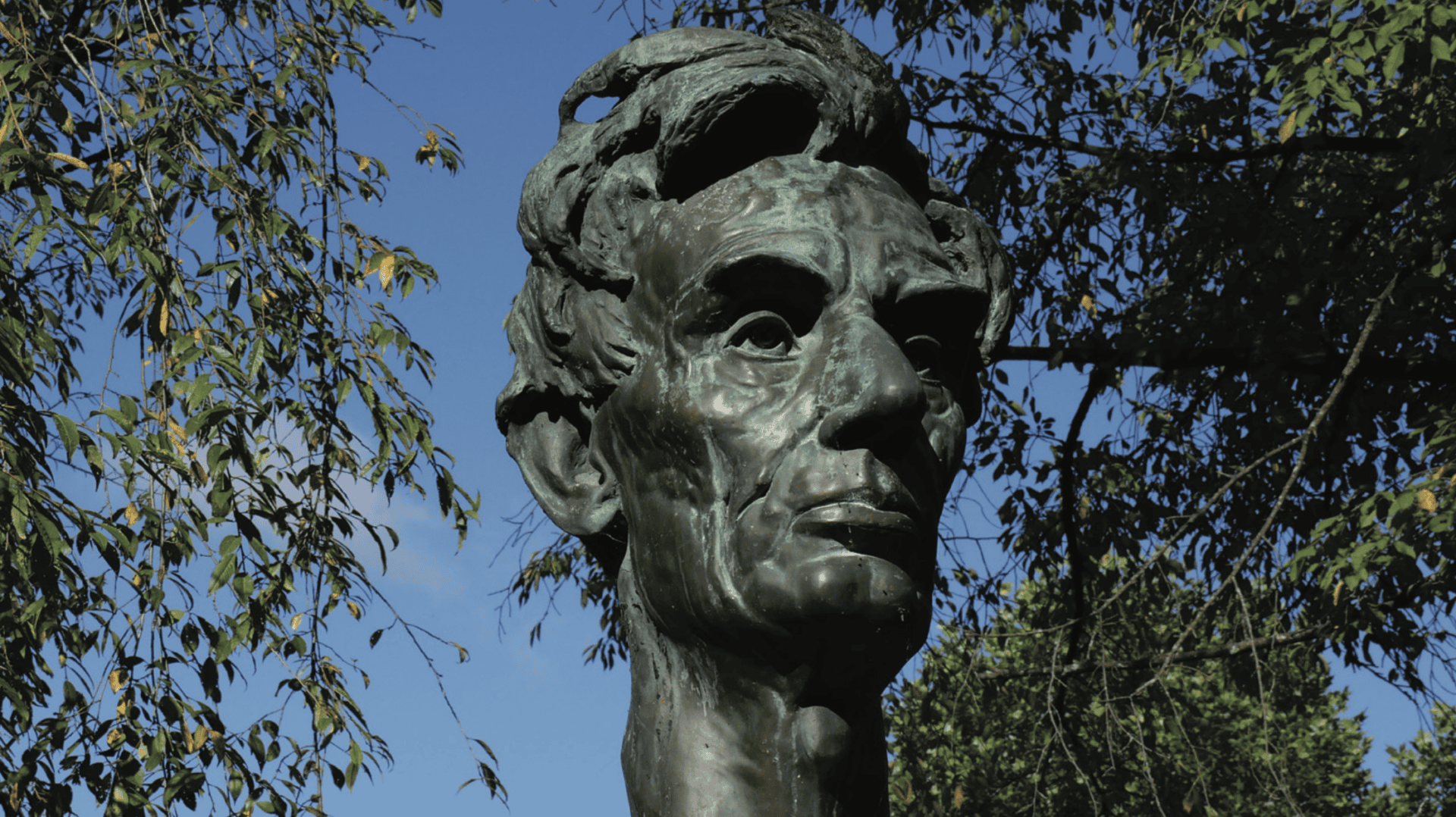
Within Bellefonte’s Talleyrand Park, there is an intriguing space known as the George Grey Barnard Sculpture Garden. There, you can find a bronze bust of Abraham Lincoln. It’s one of my favorite works of art — not just because of its dramatic beauty, but because of its story.
The Lincoln statue in Bellefonte is not the only one of its kind. It was cast from the original plaster head used by Barnard back in 1917. While traveling to a wedding in Cincinnati, Ohio, I could not pass up the opportunity to visit the original sculpture in Cincinnati’s Lytle Park. I had heard about the full-size statue and some of its history. However, seeing it in person inspired me to learn more about its origins.
In 1863, George Grey Barnard was born at 113 E. Linn St. in Bellefonte, Pennsylvania. The son of a Presbyterian reverend, Barnard found his calling as an artist. He attended the Art Institute of Chicago at 19 before traveling to Paris in 1883. There, he studied at the École des Beaux-Arts for several years. When he presented his first exhibition there in 1894, he was critically acclaimed for his sculpture “The Struggle of the Two Natures in Man.” Barnard’s work was strongly influenced by the French master Auguste Rodin.
Barnard spent most of his life studying, creating, and collecting art. His well-known works include the sculptures that flank the Pennsylvania State Capitol in Harrisburg, his contributions to the famous Cloisters Collection, and, of course, his Abraham Lincoln statues.
Barnard never seemed to shy away from large projects. Among his most ambitious was the unfinished “Rainbow Arch,” which occupied more than 15 years of his life. It was a full-scale antiwar monument featuring more than 50 figures. Unfortunately, he died in 1938 at 74 before completing it.
In 1910, Barnard was living and working in New York City when he was commissioned to create the Abraham Lincoln statue for Cincinnati. In fact, he exhibited his Lincoln in the courtyard of Union Theological Seminary in Manhattan before bringing it to Cincinnati.
The full-size Lincoln statue was commissioned by Mr. and Mrs. Charles P. Taft as their gift to the city of Cincinnati. Charles Taft was the half-brother of President William H. Taft. Along with former President Taft, Barnard attended the unveiling ceremony at Lytle Park in Cincinnati in the spring of 1917.
The artist commented that he was pleased that he was “able to give among the best years of my life to the Lincoln statue.” The Cincinnati Enquirer estimated that 20,000 people came out to the unveiling. In 1917, with the end of World War I in sight, the dedication was an especially patriotic event. In his public address, former President Taft concluded that “Lincoln’s memory is a living force, an anchor of hope, an inspiration to highest effort, an earnest of victory.”
Spirits were so high that Charles Taft wanted to give more replicas of Barnard’s Lincoln statue to London, Paris, and beyond.
Unfortunately, this friendly act of diplomacy created an “international problem” as public and artistic criticism began to surround Barnard’s Lincoln. Barnard used life masks of Lincoln’s face and hands to produce what he interpreted to be “America’s Great Commoner.”
Such a realistic, plain, and humble version of Lincoln was so unconventional that it received polarized reactions. While many praised Barnard’s sculpture of Lincoln, it was Abraham Lincoln’s son, Robert Todd Lincoln, whose opinion weighed heavily on its future.
In a letter to former President Taft, Robert Lincoln strongly objected to sending Barnard’s statue to Europe. Lincoln’s son said:
“The result is a monstrous figure, which is grotesque as a likeness of President Lincoln and defamatory as an effigy.”
— Robert Todd Lincoln, March 22, 1917
London rejected Barnard’s work, instead placing another Lincoln created by Augustus Saint-Gaudens at Westminster. There were just too many protests against Barnard’s Lincoln and its “uncouth characteristics.” But Manchester, England, welcomed a replica of Barnard’s Lincoln in 1919. Another replica was given to Louisville, Kentucky, in 1922.
This brings us back to Bellefonte. In 1979, the Centre Daily Times reported that the “idea of bringing Barnard’s work to Bellefonte came from Harold Dickson, professor emeritus of art history at the University [PSU].”
That same year, True Fisher unveiled Bellefonte’s 30-inch oxidized bronze head of Lincoln at the Centre County Courthouse. Rob Fisher had worked for weeks with other professionals to apply the “complicated lost-wax process of casting the head in bronze.”
The community event kicked off the process of building the George Grey Barnard Sculpture Garden in the park on land donated by Gulf Oil Company. Along with the Fishers, members of the Talleyrand Park Committee dedicated themselves to fundraising, landscaping, construction, and activism until Barnard’s Lincoln was installed in 1983.
The next time you stroll through Talleyrand Park, take a long look at the bust of Abraham Lincoln and think of its story. And while it might not be for everyone, there are many like me who are grateful and charmed to have it right here in Bellefonte. You can also find more of George Grey Barnard’s work at the American Philatelic Center in Bellefonte and at the Centre County Library & Historical Museum. T&G
Local Historia is a passion for local history, community, and preservation. Its mission is to connect you with local history through engaging content and walking tours.
Local Historia is owned by public historians Matt Maris and Dustin Elder, who co-author this column. For more, visit localhistoria.com.
Resources:
“Barnard, Famous Sculptor, Is Native of Bellefonte.” Centre Daily Times (State College, PA). May 2, 1935. https://www.newspapers.com/image/892056843/
Barnard’s Lincoln, the gift of Mr. and Mrs. Charles P. Taft to the city of Cincinnati; the creation and dedication of George Grey Barnard’s statue of Abraham Lincoln, including the address of William Howard Taft.” Stewart & Kidd Company (Cincinnati, OH). 1917.
https://babel.hathitrust.org/cgi/pt?id=uiuo.ark:/13960/t8df6sb0g&seq=9
Blumberg, N. “George Grey Barnard.” Encyclopedia Britannica, May 20, 2026. https://www.britannica.com/biography/George-Grey-Barnard.
“Defends Criticism of Lincoln Statue.” The New York Times (New York, New York) Sept. 28, 1917. https://www.newspapers.com/image/20595046/
“George Grey Barnard.” Smithsonian American Art Museum. Aug. 31, 2026
https://americanart.si.edu/artist/george-grey-barnard-240
“Sculptor.” Cincinnati Enquirer (Cincinnati, Ohio). April 25, 1938.
https://www.newspapers.com/image/103357431
“Sculpture Unveiled in Bellefonte.” Centre Daily Times (State College, PA). May 7, 1979.
https://www.newspapers.com/image/755963263
“Westminster Closed to Barnard Lincoln.” Trenton Evening Times (Trenton, NJ). Dec. 21, 1918. https://www.newspapers.com/image/1191107569/