
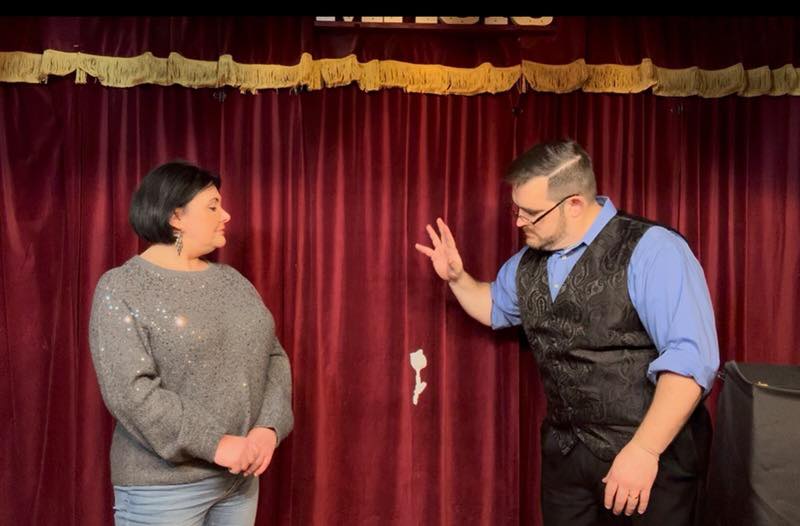
With Adaptive Magic in Motion, magic truly belong to everyone
This is not your average magic show. There are no flashy bursts of fire or dramatic, sudden loud noises. There are no frantic doves bursting from top hats or wildly fast sleight of hand that leaves your mind whirling and your eyes searching for hold — and yet, even without all the typical bells and whistles that you might expect from a standard magic show, what Adaptive Magic in Motion does is nonetheless supremely magical, and for one key reason.
Adaptive Magic in Motion welcomes everyone to the show, regardless of ability, communication style, or sensory processing difficulties, and the result is an environment that feels safe and welcoming, an environment where everyone can truly appreciate the joy and wonder of magic.
Challenging Beginnings and Groundbreaking Revelations
The story of Adaptive Magic in Motion starts with sole owner Carmen Miller, her husband and magician, Phil Miller — or, more accurately, with their daughter Angela.
Carmen and Phil met in her home country of Romania. Phil’s medical career — he’s currently a doctor of osteopathic medicine at Mount Nittany Health — brought the couple to the United States. They moved around the country before eventually settling in State College. Here, they began growing their family. Today, they have three children, with Angela being the oldest.
Motherhood did not start out, though, perhaps the way Carmen first expected. By the time Angela was 18 months old, Carmen says, as far as autistic traits go, her daughter was exhibiting “everything in the book.”
While Phil was quite busy pursuing his career, Carmen found raising Angela primarily on her own to be challenging. She became focused on, she says, “trying to heal my daughter, to make her better, to take away her autism.” She began investing all her time in studying Angela’s needs and exploring various forms of therapies.
“It took me a while to understand that I can’t hold the keys of the universe, to heal her completely and not to be autistic. She’s always going to be autistic. She’s always going to have communication problems. Once I accepted [who she is] and, that if she’s never going to speak, it’s okay … my life changed. I focused on her talents rather than her lack of speech and communication,” Carmen describes.
After this revelation, Carmen discovered an effective way of bonding with Angela — cooking. As the two cooked together, with Carmen incorporating various therapies, such as speech therapy, she says Angela began opening up and communicating.
“Her speech improved,” says Carmen. “She started communicating [with] more sentence structure. … She had interest in initiating communication.”
Now, Angela cooks a range of dishes on her own and helps with the grocery shopping, while Carmen is writing a book to help other parents follow a similar process.
However, while Carmen and Angela may have bonded over their shared appreciation for cooking, there was one area of the family’s life that Angela still couldn’t fully participate in: magic.
Being Part of the Magic
Phil says he’s always loved magic, ever since he was a child. During his residency at St. Joseph Medical Center in Reading, Pennsylvania, one of his attendees who knew of this interest asked him if he would do a show for some children at a party. At the time, Phil didn’t have much in the way of the tools of the trade, so he headed to Mingus Magic Shop, one of the oldest brick-and-mortar magic shops in the country.
“I went to the store and said, ‘Can you give me $100 worth of easy kids’ stuff for me to do?’ And I did my first show. I thought it was terrible, but everybody had a lot of fun. That kind of gave me the bug and took things a step further,” Phil explains.
He started reading books on magic, taking courses, and doing shows to raise money. Over the course of his medical career, though, magic took a backseat, even if it remained a peripheral interest. Then, several years ago, Mount Nittany Health included Phil’s love for magic in an employee spotlight and, shortly after, WTAJ came calling, wanting to do their own story.
“That got my juices flowing again. I started getting requests to do shows at churches, schools, and whatnot,” Phil describes. “It really reignited that passion in me.”
The family began traveling with Phil to magic workshops and conventions in destinations like Las Vegas and, while Carmen and Phil’s other two children enjoyed the experience, Angela struggled with anxiety when attending such events.
“She used to cover herself [or] hide under the table,” describes Carmen. “All this time, I felt like we were forcing her and she’s not happy. She’s not enjoying it. Over time, we even thought probably it’s not a good idea to take her. … So, we thought, why don’t we … create something for special needs children … a different version of magic?
“One Sunday, I talked to my husband. I say, ‘Can you do something that children can touch, can smell, a trick they can actually see happening in front of them, but it’s not complicated? It’s easy to follow, easy to understand.’ … And he performed a few tricks — very, very simple tricks.”
“Something very, very slow, deliberate, nothing too flashy,” Phil chimes in. “There are no sparks or fireworks, or anything that could be overwhelming for somebody with sensory issues.”
Angela gave the results her seal of approval and now Adaptive Magic in Motion is a growing effort to involve children with neurodiverse backgrounds in the whimsical, curiosity-filled world of magic.
“Oftentimes, these children, they want to participate,” says Phil. “They want to go to birthday parties and be included with a group of friends, but they can’t because it’s too much for them. Hopefully this will be the answer to that.”
Phil’s also using his connections within the magic world to get more magicians involved in the process, with the goal of taking Adaptive Magic in Motion regional and then, ultimately, national. Several of the involved professional magicians have had their own experiences with neurodiversity or similar differences, giving them a keen insight into how best to serve their audiences.
For example, there’s Cody Clark, an autistic magician and autism advocate based in Louisville, Kentucky; Sam Sandler, America’s premier deaf magician; and Immy Barr, a 13-year-old stage magician and balloon animal maker on the autistic spectrum. The world-renowned Jeff McBride, creator of the Magic and Mystery School in Las Vegas, who Phil describes as “one of the all-time greats,” is also a firm supporter of the endeavor.
For the time being, Phil says he plans to do some area shows mostly to get the word out about Adaptive Magic in Motion, with half the show being your typical, expected experience, and then the other half showing audiences what an adaptive magic show might look like, if it’s of interest for schools, churches, or similar groups.
“[It’s] things like toning the lights down a little bit, bringing the sound down a little bit, no crazy moves or flashy outfits — very, very, very subdued,” he says, “but at the same time, it allows participants to pretty much do what they want. If they need to get up and leave, they can get up and leave. If they want to be part of the stage, they can be part of the stage production. We have them come up as an assistant. … What we tell participants is this: Anybody who’s on the spectrum or has any kind of issues like this, being in an environment like this means you never have to say you’re sorry.”
“Kids act up,” he continues. “When they’re overstimulated, they’ll tantrum. They’ll flap their hands. They’ll make noises. Okay. You never have to apologize for this because this environment is for you. It is your time. You are part of the magic.”
Still, while audience members are encouraged to express themselves however feels best, Phil notes that the shows often successfully focus children’s attention.
“They’re not tantrum-ing. They’re not roaming around. They’re actually engaged — and that’s something that some of these parents see very rarely,” he says.
As Carmen and Phil continue to exemplify a crucial element of the Adaptive Magic in Motion mission statement — that magic truly belongs to everyone — Carmen remains heavily involved with autism advocacy, including pushing for insurance coverage for early therapy and resources to enrich the home lives of autistic children. She also has the dream of one day creating a culinary-focused trade school for children with high-functioning autism.
Learn more about Adaptive Magic in Motion at adaptivemagicinmotion.org. T&G Holly Riddle is a freelance writer for Town&Gown.



