
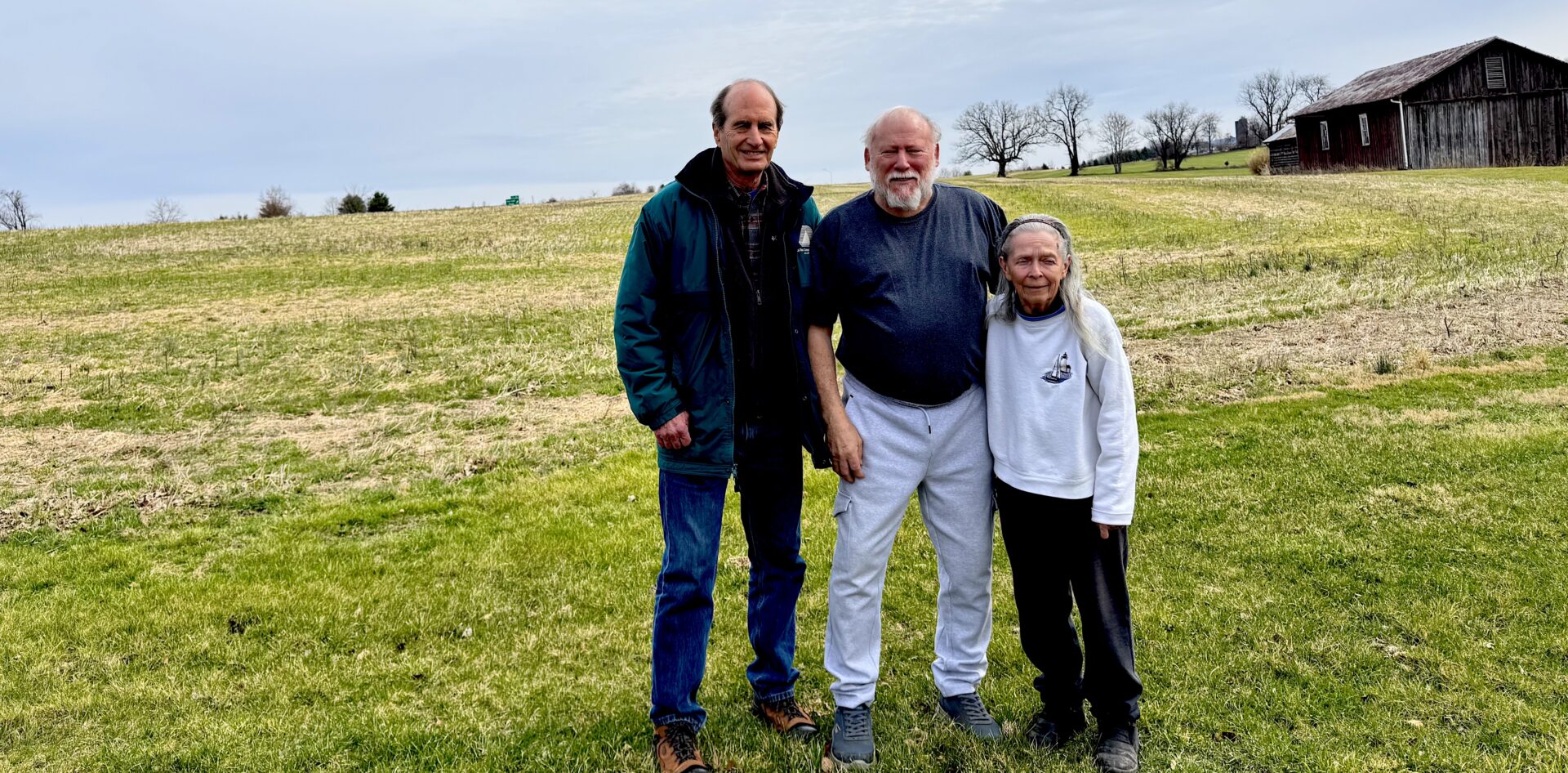
The Centre County Farmland Trust explains how conservation easements, zoning, and community involvement can shape smarter growth
Farming is an integral part of Centre County’s heritage.
“It gets in your blood when you live around here,” says Dan Guss, president of the Centre County Farmland Trust and the grandson of a dairy farmer.
But as development pressures increase, the county has lost about 18% of its farm acreage in less than a decade. The number of farms in the county fell from 1,023 in 2017 to 892 in the most recent agricultural survey, conducted in 2022.
Guss acknowledges that it’s “impossible” to save every tract of land, but he’s proud of the nonprofit Farmland Trust’s work as a “small piece of the puzzle” in preserving some of the county’s agricultural way of life.
“You worry about what’s going on in the world and how are we going to balance growth, people making a living versus what the natural world requires,” says Guss, a State College-area native who is a retired environmental engineer. “There’s just so much work to be done in every area you can think of. I’ve gotten myself to think, ‘Well, let’s just do one step at a time.’ And if we can help our organization be one cog in the wheel to preserve a couple hundred acres at a time, that’s something.”
The CCFT preserves farmland primarily through conservation easements donated by landowners who essentially sacrifice development rights to their land “for the greater good,” as the trust’s website puts it. The trust, founded in 1994, holds easements on 19 properties covering 1,728 acres. The farmland trust announced its latest conservation easement in August; it preserves Jeff Biddle’s 170-acre Bear Meadows Farm near Tussey Mountain. An additional easement was also in the works.
The all-volunteer board of the CCFT works in partnership with two other important pieces of the local farmland preservation puzzle:
ClearWater Conservancy and the county’s Purchase of Agricultural Conservation Easement (PACE) program.
Unlike the Farmland Trust, the state- and county-funded PACE program is able to compensate landowners for the development rights they give up. Since 1989, PACE funds have been used to purchase 64 permanent agricultural conservation easements on 9,410 acres of farmland in the county. At last count, the local PACE program had a waiting list of about 31 active applications, according to the county.
“If it’s really a prime piece of agricultural land, in an area where there are other preserved farms, then chances are fairly good that they’ll end up on the county program and get paid for the easement,” says Guss, who has served the CCFT since 2012 and as its president since 2021. “So, we’re picking up that group of people that really just want to preserve their land and don’t need the money from the county to make that happen.”
The easement process is complex and expensive for the CCFT, requiring land surveys, legal documentation, and annual site visits to make sure terms of the easement are upheld, even after a property has been sold (the easement stays with the deed). Funding comes from grants and private donations, including $13,305 through Centre Gives this past year.
Lisa Duchene, who leads communications for the Farmland Trust, notes that the organization’s updated website, centrecountyfarmlandtrust.org, also offers other ways residents who don’t own farmland can help with preservation.
“To Dan’s point, you’re not going to be able to preserve everything, but the website gives us an opportunity to say, ‘Hey, if this matters to you, pay attention to the zoning in your community,’” she says. “There’s a whole page on that website about how you can help preserve farmland. … I always say zoning’s not sexy, but it really, really matters.”
Here’s more from our conversation:
Is it difficult to convince landowners to preserve their farmland rather than sell to a developer? Or, do they come to you?
Guss: Generally, they come to us. We’re not selling them anything; we’re helping them to preserve their land. … We’re always scouting and making sure people know about us. But I don’t think it’s our business to convince somebody or trick somebody into doing something like that. There are really enough people out there that are living on the land, and they are not necessarily farmers either. There are a lot of retired Penn State people and [others]. People that are living on the land like that, they’ve been there for a long time, they really love their land, and they don’t really want to see it change. This is an instrument for helping that to happen. And, of course, it is a big social good because it’s really in everybody’s interest to see open land and not have willy-nilly development all over the place.
With all the development that’s been happening in Centre County, are you feeling more pressure to preserve land now? Is it becoming more of a challenge?
Guss: The pressure is that we know that in time development is going to come in. I personally don’t worry about saving every piece of land because it’s impossible. We just have to do what we can do and help save the land with willing owners.
Are there certain areas in Centre County that are feeling the most pressure now in terms of development of farmland?
Guss: Anywhere in the valley here, but certainly anywhere on the edge of State College. But also, you’re seeing it around Bellefonte, and Penns Valley is getting a little bit more pressure now, too. So those are the areas where we have done a lot of preserving land. But really, anyone that’s living on their land and wants to be sure that the land continues to be preserved, they could live anywhere in Centre County. There’s always a possibility, where you’re not in the growing areas, that there’s very poor or no zoning. There’s been a thing out there where the I-80 interchange is going in [north of Bellefonte]; the people are really worried about what kind of development is going to be right there at the exit and so on. That’s an example of just out in the country, where there’s not so much zoning, where you can get some really runaway development.
What’s the best way to balance preserving farmland with the inevitable development that’s going to happen in Centre County?
Guss: Good zoning. It frustrates me because we’re a volunteer nonprofit. We’re stepping in to help it not be so awful when we don’t have adequate zoning.
If you go up to, say, the province of Quebec in Canada where my son lives, I’m sort of familiar with what goes on up there. They have really good zoning for their agricultural lands, and you just can’t go out and build a house in the middle of a farm field up there. It’s a lot more strict.
Good zoning means things like building where infrastructure is in place and higher-density housing?
Duchene: Yes. It’s not whether you grow. It’s how you grow. Do you use the land efficiently?
Guss: I’m on the board of the University Area Joint Authority; that’s the sewer area that serves what they call the growth boundary [the Centre Region growth boundary includes the State College Borough and portions of College, Ferguson, Harris, and Patton townships]. … That’s the area where the townships in their wisdom decided that growth can occur. And if you go outside that boundary, you aren’t going to get sewer service unless all five governments vote to extend that area, which is not easy to do.
Duchene: And what you said about a house in the middle of a farm field, there’s a term for that. It’s called leapfrog development. When you go outside of all that infrastructure and put a development out in the middle of nowhere, now those people have to drive farther. You’ve got more congestion. You’re outside of public transportation, so conservation overall suffers by that.
The Farmland Trust was among a coalition of local conservation groups that sent a letter to the governor this spring seeking transparency and a voice about what happens with the land surrounding the former Rockview prison. Is there anything new with that?
Guss: We’re hoping that they’ll start listening to conservation groups and maybe form a regional committee. I think that that might happen, where they can listen to ideas about what can be done with that land [the property encompasses about 5,800 acres between Bellefonte and State College]. … There’s some really beautiful agricultural land there. Let’s not just have it be a car dealership or something like that. Let’s keep good agricultural land and agricultural production if we can. But also, there’s really beautiful open land, forest land there. When we preserve farms, because of the topography here, you have the farmland in the valley and then the farm usually goes up the mountainside, and that’s their woodlands. I think we have like 40 or 50% of our land that we preserve is actually wooded because that’s the way farms are here. That Rockview land has some of the nicest, pristine woodland because they had guards keeping people out for 100 years. Their forest up there is beautiful.
How would you like to see that agricultural land used?
Guss: I’d like to see it put under easement so it stays as agricultural land. And then I think that there are entrepreneurial farmers in this area that — especially with good open land like that — they’ll come and bring their machinery and do the farming. If you don’t keep that land open, that can’t happen.
You’re working on a couple of more conservation easements this year. Is there anything else ahead on your agenda?
Guss: I have an idea that there are a lot of people around here that have small wood plots — somebody who’s a hunter and just has 50 acres somewhere in the mountains. I have at least three people that are interested in preserving their small plots of land. And it’s too expensive for us to do a small plot like that and go around and steward it. So, I’m trying to work up a way that we could get some grants and have it possible to preserve those smaller [forest-land] plots like that. And then, we have to always be ready when somebody’s willing to preserve their farm to be able to come in and help them. T&G
Mark Brackenbury is a former editor of Town&Gown.



