
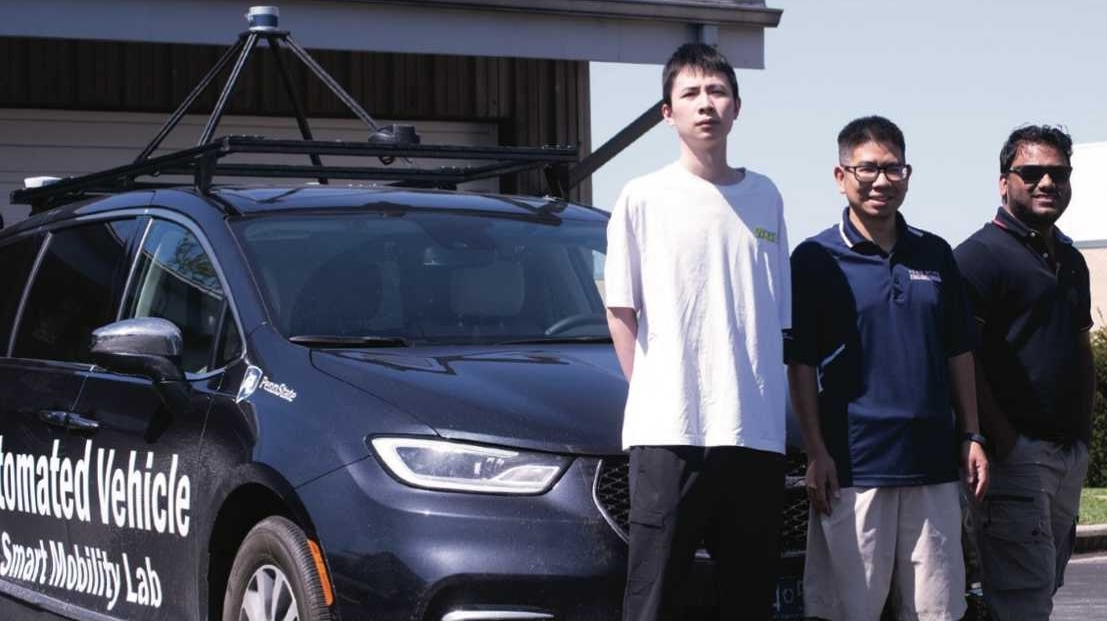
From Penn State labs to Pennsylvania highways, highly autonomous vehicles are moving closer to everyday reality
By Angelique Redwood
When leaving Happy Valley to visit our neighboring cities of Pittsburgh and Philadelphia, you may find yourself staring into the window of a moving car with an empty driver’s seat. Although it sounds like something from “The Jetsons,” highly autonomous vehicles, or HAVs, have landed on Pennsylvania roads, quickly ushering us into a future where self-driving cars may become the norm.
Although we have yet to see smart mobility hit the streets of Happy Valley, we can look no further than our backyard to gain a better idea of the research behind this blossoming technology. Penn State’s Smart Mobility Lab, run by Dr. Xianbiao Hu, is one of a few units at the university conducting HAV research for deployment in cities across the state.
After PennDOT passed its 2022 legislation legalizing highly autonomous vehicles on local roads, Hu and his team have collaborated to bring research, insight, and deployable technology to the growth of self-driving vehicles. “Back in 2024, my lab and PennDOT began working on an impact analysis of the new law,” Hu states. “Essentially, we organized a focus group asking participants about feedback, opinions, and recommendations, and these are suggestions to PennDOT for the next step [with HAV technology].”
Some of that research is also conducted at Penn State’s Human-Technology Interaction Lab, where researchers study the human reactions behind emerging technologies. The Connected and Autonomous Vehicle Program, which includes a test track for self-driving cars, is another tool at Penn State helping researchers gain clearer perspectives on the future of autonomous vehicles.
“We are fortunate to live in Central Pennsylvania,” Hu exclaims. “This is a nice, friendly, quiet, safe neighborhood, and this is also a living lab of Penn State. We live here, and our research can support communities.”
To Hu, HAVs aren’t in our future just for technology’s sake. Statistics show increases in both safety and sustainability with wider adoption of HAVs.
Hu explains, “Most automated vehicles are either electric or hybrid. Those vehicles are very intelligent. They can decide their own route and decide how to drive,” which inadvertently helps with the rate of car accidents and carbon emissions. According to the U.S. Department of Transportation, 94% of driving accidents are directly linked to human error, which is removed when technology takes over the steering wheel.
“Automated vehicles can perceive the environment better, even at night,” Dr. Hu explains. “Even if a human is sleepy while driving, it doesn’t really matter because computers and AI are driving the vehicle.” Those same technologies directly impact HAV’s sustainability.
“When we drive our own human-driven vehicles and approach intersections, our human nature is we drive as fast as possible. … Then we wait for the light to turn green and accelerate,” Dr. Hu explains. “In this process, there’s a lot of emissions that consume gas and fuel. But automated vehicles can intelligently see traffic lights and reduce that acceleration.”
Project Drawdown’s Drawdown Explorer lists mobilizing electric cars as a highly recommended climate solution, as the more electric vehicles we have on the road, the fewer emissions from fossil-fueled cars.
Mining for electric car parts makes this climate solution imperfect, but collaborations between Hu’s Smart Mobility Lab, Pennsylvania’s Department of Environmental Protection (DEP), and the Centre Region Climate Action and Adaptation Plan (CAAP) help push HAV research in cleaner directions.
As part of the CAAP Implementation Technical Advisory Group, Hu works alongside fellow community leaders to best blend his HAV research with local sustainability goals. “We assemble a panel of experts from different fields, and we work towards the sustainability goal of Centre County,” Hu states.
In more ways than one, self-driving vehicles are making their way onto Pennsylvania’s open roads, but even with large amounts of research backing their safety and efficacy, Centre County residents aren’t the only ones hesitant to see this new technology deployed.
A 2022 Pennsylvania poll, conducted by RABA Research shows 80% of the commonwealth’s citizens are uninterested in seeing more HAVs on the road. Four years later, Happy Valley residents’ opinions echo similar hesitations.
From a preference for manual vehicles to fears of technological malfunction, Pennsylvania citizens have made their disinterest clear. Residents of Centre County even bring up the challenges unique to our area that play a large part in HAV adaptability, including harsh winter weather and fluctuating traffic patterns. Even the possible challenges to Uber and Lyft drivers came up in conversation.
Still, Hu projects that HAVs are sneaking their way into Central Pennsylvania sooner than we’d think. “I think in less than 10 years, we will have autonomous vehicles driving in Happy Valley, Hu says. “I feel within three years, we will definitely see a lot of automated vehicles driving in Happy Valley.”
As a hub for future HAV technology, Centre County voices play a large part in what we’d want our Jetson-style future to look like. The possibilities for smart mobility are endless, even if its best asset is providing humans more than one option to hit the open road.
These possibilities are ours for shaping, whether as a researcher, stakeholder, or Happy Valley citizen. By championing collaboration, Happy Valley gets to decide how this technology will shape our daily lives. The HAV takeover is nearly here, but it’ll only be as great as the diverse human input coded into its steering wheels. T&G
Angelique Redwood is a freelance writer based in State College.



