
A local freedom seeker hunted by “Slave Catchers” in 1856
When the Underground Railroad comes to mind, people often think about freedom seekers in secret hideouts, traveling clandestinely in the night. While scenes such as these certainly occurred, many had to come out of hiding, “above ground,” along a journey of step migration to freedom.
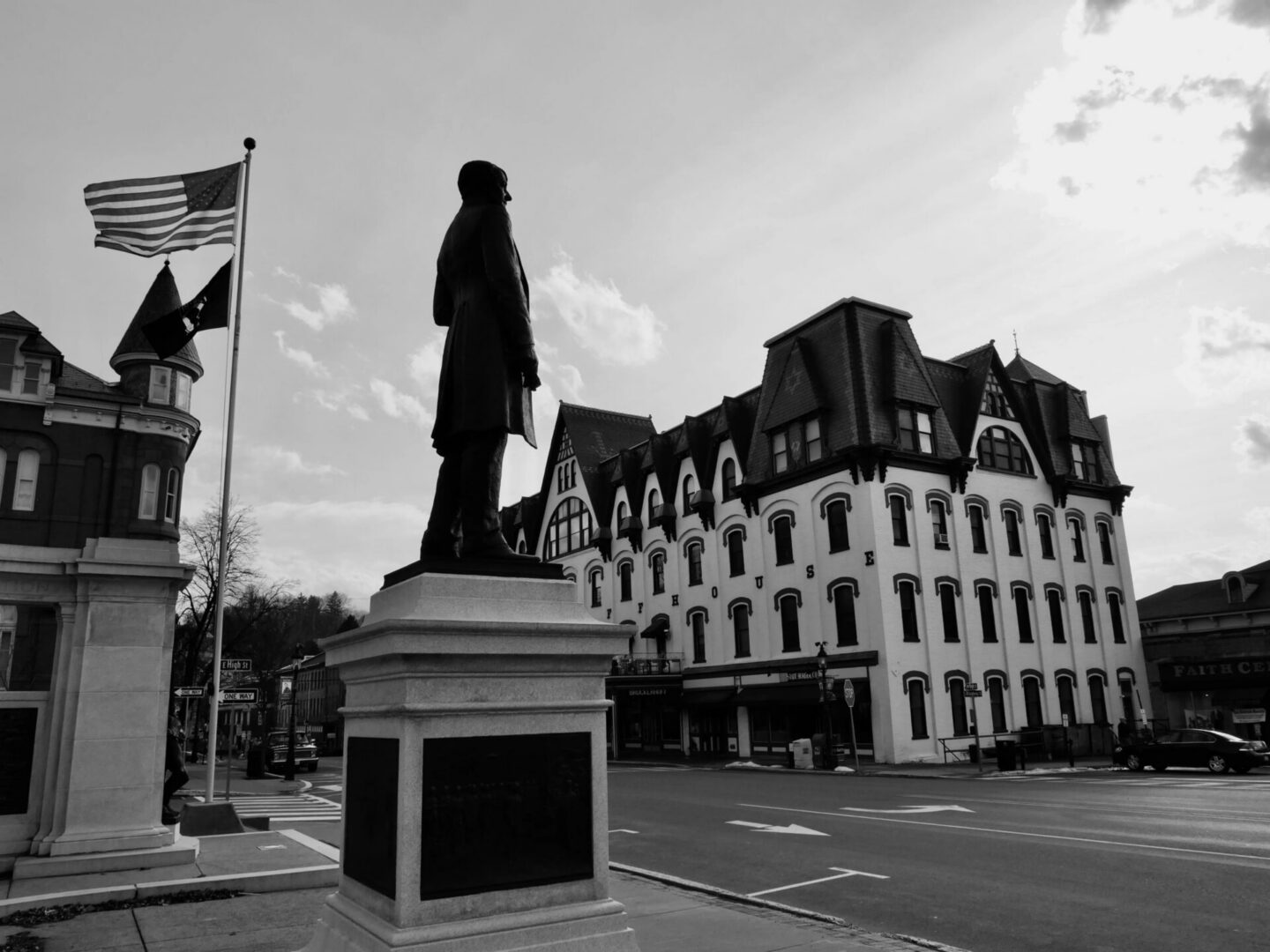
Around 1856, Henry Thomas was a “fugitive slave,” likely from Maryland or Virginia, who found himself in Bellefonte, Pennsylvania. Henry was employed at the Pennsylvania Hotel, trying to make a living. The Hotel or “House,” as they called hotels back then, was “conveniently located” on the southwest corner of the “Diamond” in Bellefonte. According to an advertisement in the Democratic Watchman in 1856, stagecoaches arrived and departed daily. Guests dined on “the best that the country will afford,” enjoyed large and well-ventilated rooms, and its stables were managed by the most experienced hostlers.” Amidst the hustle and bustle, Henry was tending to his duties. Unbeknownst to him, two or three strangers showed up at his place of work, and everything was about to change. The men were “slave catchers.” The following details about the fate of Henry Thomas were documented by William H. Mills in a brief history of the A.M.E Church in Bellefonte. William H. Mills is well known as the grandfather of the famous Mills Brothers vocal group. Grandfather Mills remembered Henry Thomas “the slave” from his childhood.
Central Pennsylvania was a node for Underground Railroad activity. Any migration north and west from the Mason-Dixon Line toward Lake Erie, en route to Canada, could geographically steer freedom seekers through the valleys and roads of Centre County.
By the 1850s, largely due to the iron industry, a proportionally strong Black community thrived in Bellefonte. According to historian and researcher Philip Ruth, the 1860 census records reveal that persons of color accounted for approximately 11% of the Bellefonte area population. He added that “such a percentage would move the Bellefonte area into the uppermost tier of Pennsylvania boroughs renowned as waystations on the Underground Railroad.”
Historically, how and where people migrate is influenced by push and pull factors. With folks fleeing slavery, Centre County had several pull factors, such as an established Black community, jobs, and the support of abolitionists. In particular, prominent Quakers and conductors William A. Thomas and Eliza Thomas provided refuge for many men, women, and children “from the cruel hand of slavery” in Bellefonte.
With these factors in play, Bellefonte became a relatively safe haven for freedom seekers in the geographic center of the state. However, after the passage of the Fugitive Slave Law of 1850, nobody was actually secure unless they made it outside the federal jurisdiction of the United States. Runaways had been captured in Bellefonte before. In 1826, “two negros” were “bound hand and foot” and brought to the Centre County Courthouse. According to the U.S. Gazette in 1826, evidence proved that the freedom seekers were “children of bondage and were accordingly remanded back to servitude.”
After 1850, slave catchers were further empowered by the federal government. With it, slave owners were not limited to just hiring their own bounty hunters. The 1850 law required any and all law enforcement officials to “arrest people suspected of escaping enslavement. … In addition, any person aiding a fugitive by providing food or shelter was subject to six months imprisonment and a $1,000 fine.” Back at the Pennsylvania Hotel, representing themselves as “agents,” (likely land agents) on official business, the group of gentlemen enlisted the services of Henry Thomas to drive them to Halfmoon Township.
Contrary to 1826, these slave catchers did not bother taking Henry to the courthouse for due process. Instead, they knew the “law” was on their side and aimed to avoid situations that had occurred in other outraged Pennsylvania towns, such as Christiana in 1851, Hollidaysburg in 1855, and, eventually, Blairsville in 1858, where locals intervened. In such cases, angry mobs assaulted the slave catchers, allowing the freedom seekers to evade capture.
As Henry Thomas transported the men, their dreadful scheme unfolded. According to William H. Mills.
“When they had driven a few miles into the country, they bound Thomas with cords such as were used in those days to make the fugitive secure from escape. They proceeded through the valley in the direction of Huntingdon and were met by Gov. Curtin on his return from that place. Mr. Curtin recognized Thomas, the slave in the conveyance, but was perfectly ignorant of what had transpired until he arrived home. He was then informed that Henry Thomas had been recaptured and taken back to his master. Mr. Curtin proceeded at once to gather a posse of men of his own sentiments and pursued the party, which was a very dangerous undertaking. But all was in vain, for the kidnappers had made good their escape, carrying poor Thomas back into slavery.” Unfortunately, not much is known about Henry Thomas after 1856. Slavery continued to tear apart the nation. Andrew Gregg Curtin was unable to rescue Henry, but as Pennsylvania’s governor during the American Civil War, Curtin became a key ally to President Lincoln and contributed to Union victory. We can only hope that Henry Thomas lived to witness the abolishment of slavery with the 13th Amendment in 1865. History has proven time and again that societies break down whenever bona fide laws come into conflict with human rights and justice. Sadly, for many like Henry Thomas, the perils of their present were brought into focus by historical hindsight too late. Marginalized peoples often find themselves at the ‘wrong place and wrong time’ in history whenever those in power stand on the ‘wrong side of history.’ T&G
Visit townandgown.com for a full list of sources. Local Historia is a passion for local history, community, and preservation. Its mission is to connect you with local history through engaging content and walking tours. Local Historia is owned by public historians Matt Maris and Dustin Elder, who co-author this column. For more, visit localhistoria.com



