
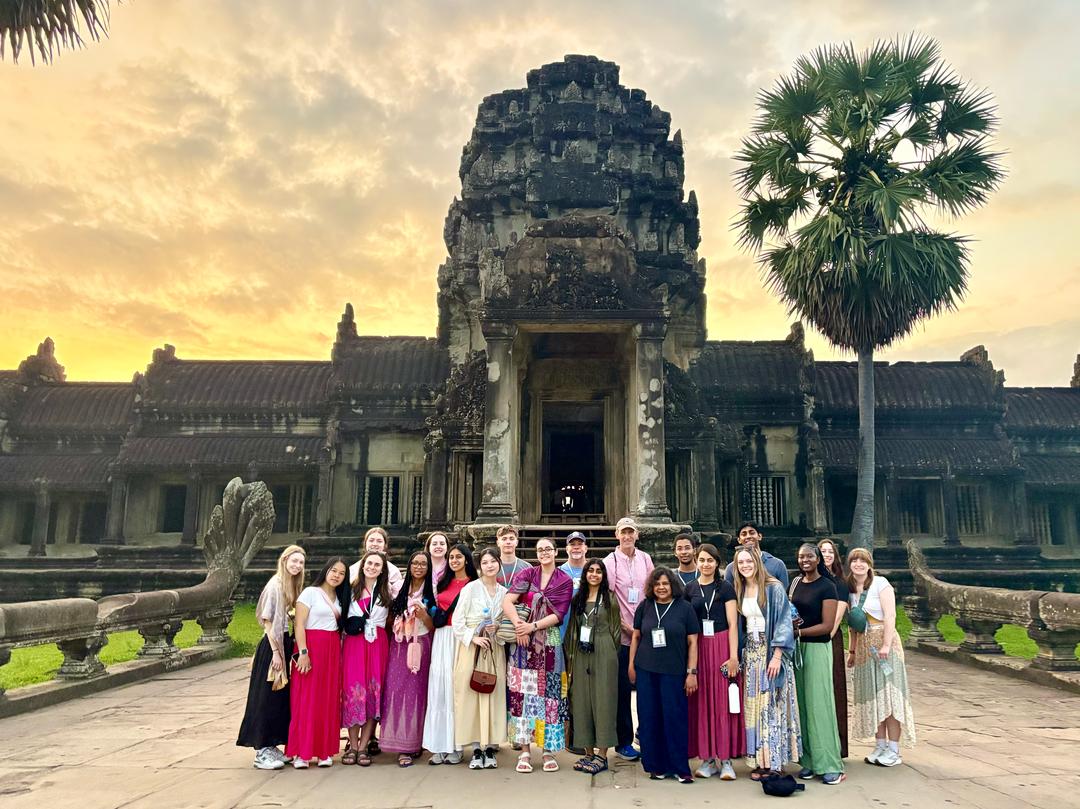
Through travel, collaboration, and cultural exchange, Penn State students discover new ways to understand the world
During the 2025-26 academic year, more than 3,000 Penn State students studied abroad. They visited more than 50 countries. They represented academic majors such as business, liberal arts, and engineering, and traveled to destinations such as Italy, Spain, and the United Kingdom.
For those who’ve never studied abroad before, this optional part of the college experience may, at first, seem unnecessary. However, a closer look reveals the myriad benefits of international education.
According to a 2025 report from The Forum on Education Abroad (forumea.org/salary-study-2025.html), students who study abroad, on average, can expect higher starting salaries than their peers who do not study abroad. If that difference in starting salary persists over time, it could translate into substantially higher earnings over the course of a career.
It’s not all about the money, though. Students who participate in one of Penn State’s many study-abroad offerings can see the benefits and skills gained from the experience when they return. Whether they spend a semester, three weeks, or even just one week abroad, students find themselves in new environments where they may be forced to problem-solve, adapt, and step outside their comfort zones.
As Terrence Guay, associate dean for international programs and director of the Center for Global Business Studies, says, “It’s more than just … being outside of State College for a period of time. You’re learning a new culture. You’re making decisions. You don’t have your phone with you all the time. You don’t have your parents to answer a question that you might have. You might have to negotiate and interact with a local person in whatever limited language skills that you might have. It’s trying to figure out how to navigate an environment where you’re more of a minority than part of the majority.”
Students and faculty report that studying abroad teaches participants resourcefulness, empathy, analytical thinking, communication, and other skills that are in high demand among employers — but are also applicable to students’ lives right now.
Building International Connections
Nick Wetherhold, class of 2028 and a finance and accounting major in the Smeal College of Business, has seen this firsthand. Wetherhold is president of PSU Global Business Brigades, a student group that facilitates international business education opportunities ranging from bringing in industry professionals as speakers to providing consulting services to area businesses.
However, the highlight is a seven- to 10-day trip during which students work directly with a local business in a foreign country.
“We’ll spend the first days just understanding how their business works, connecting with them on a personal level, and then we’ll give them business recommendations,” Wetherhold says.
Last year, he and about a dozen other group members traveled to Ghana. There, the team worked with a soap producer, designing a new accounting system for the business. The process required learning about the country’s political systems and infrastructure, and how factors like these — which can differ significantly from what students are accustomed to in the United States — should affect the consulting process.
However, on a broader level, Wetherhold says, “The biggest takeaway for most students is how similar each country is in terms of [how] everyone wants to connect on a personal level before they do business … and how welcoming the communities were. … Every community seems to want to connect.”
Expanding the Idea of What Global Learning Looks Like
Recognizing the many benefits of international education and study abroad, Penn State is working to expand its offerings and make them more accessible to students.
Fundraising is one area of need, helping support students in varying financial situations who may not qualify for existing funding but are still unable to cover the costs themselves.
Additionally, continuing to offer more one-week study-abroad experiences embedded in larger courses is another area of interest. Guay notes that there is student demand for these short programs. They appeal to those who may not be able to get away for an entire semester or even three weeks in May but can find a week over the holidays or spring break to travel as part of another class.
Furthermore, the university is expanding how it defines “global learning,” going beyond the standard study-abroad experience and exploring how students can achieve similar outcomes on their Penn State campuses.
Brian Brubaker, associate vice provost for Penn State Global and global learning, says one of the major benefits of studying abroad is that students gain perspectives beyond their own experiences.
“They gain perspective on maybe how another person views a problem or an issue, or how to approach a challenge through another cultural lens,” he says, “and that … can take place with other people right here. We have immigrants in our community. We have students here from all over the world. So when we use words like ‘global learning’ and ‘global learning outcomes,’ we’re trying to really telegraph to the students and the faculty that this isn’t something that you have to wait until you go abroad for.”
One example of creating these global learning opportunities at home is Penn State’s EDGE Program, which stands for Experiential Digital Global Engagement. Through the program, faculty incorporate peer-to-peer projects into their classes, allowing Penn State students to collaborate with peers in other countries.
“We want students to go abroad,” Brubaker continues. “We think that’s really a very transformational thing, but there’s probably also a lot of other projects or programming that you can get involved in without leaving the state that still helps you gain a global perspective.”
For the first time this year, the university is also introducing a program called Lion Launch, which allows incoming students to spend their first semester at Penn State studying abroad. The idea is that students will experience the benefits earlier, creating a positive impact throughout the rest of their college careers.
As Kate Manni, director of education abroad at Penn State Global, says, “Something that we see is, after students study abroad, typically junior year, they come back to campus and they’re a changed person. They’re having an impact. … Now, we’ll have students entering classrooms during January of their first year with that same kind of new global perspective and mindset, able to have an impact on the students who didn’t yet study abroad, bringing that value into their classroom.”
Learn more about Penn State’s global learning opportunities at global.psu.edu. T&G
Holly Riddle is a freelance writer for Town&Gown.


