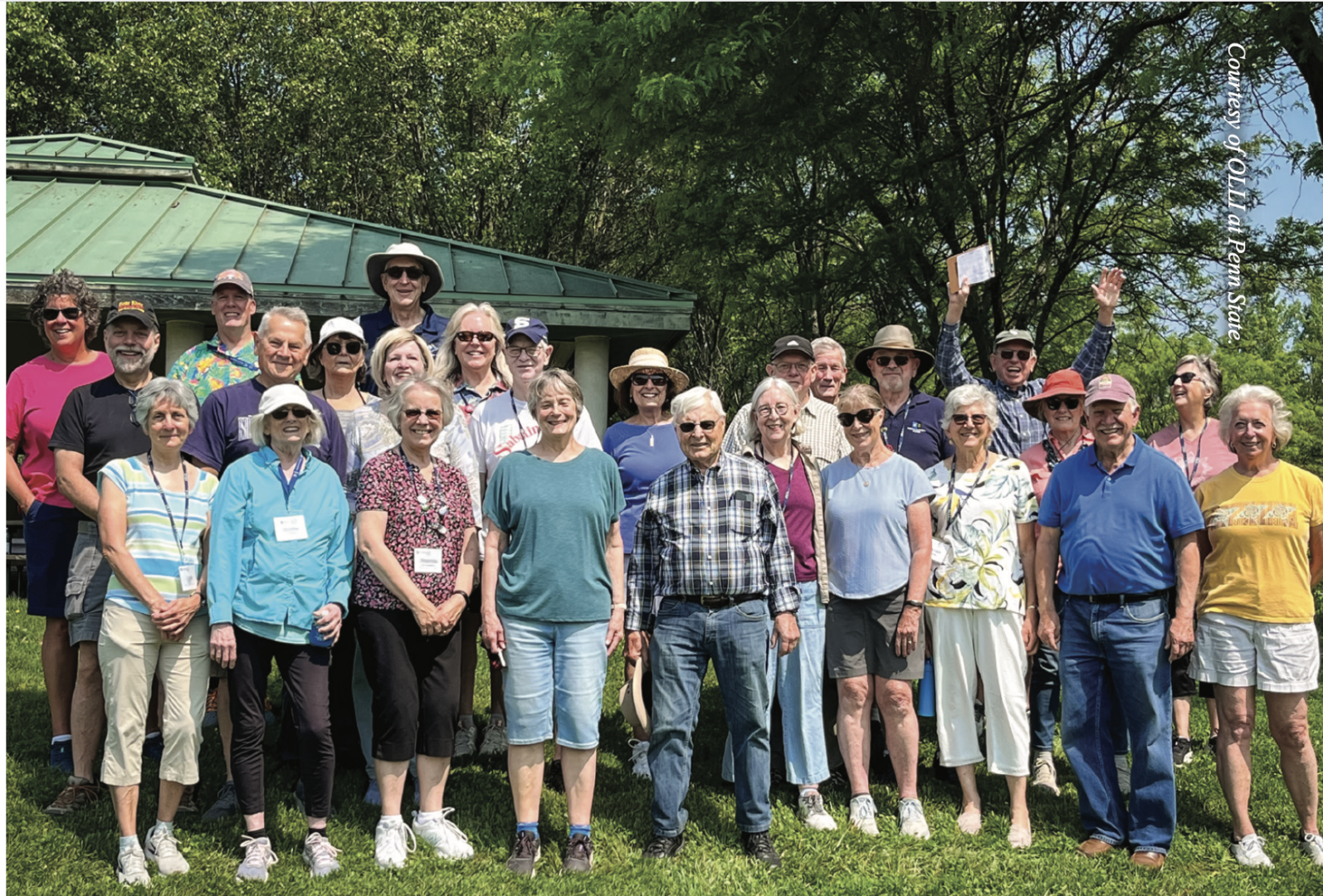
Brynn Rousselin discusses how Penn State OLLI brings lifelong learners together through education, travel, and community engagement
By Mark Brackenbury
Brynn Rousselin began her tenure as executive director of the Osher Lifelong Learning Institute at Penn State in late 2019, just a few months before the COVID-19 pandemic sent everyone home.
Not an ideal time to start a new job, particularly one focused on in-person learning for people ages 50 and older. But Rousselin helped the program make the best of a difficult situation by introducing many in the OLLI community to their first online classes, through Zoom, a video-conferencing platform that became a staple of pandemic life.
“We spent April of 2020 teaching our members how to use Zoom, ironically, while on Zoom,” Rousselin says. “It was an interesting time. … With this population in particular, there is a fear of isolation and loneliness. And it can impact more than just their day. It can have a long-term impact on their mental well-being and their physical health. And so, we thought it was really important that we find a way to still create community and connection through that time.”
Six years later, the program — based locally in the Penn State Outreach Building at Innovation Park — is once again bustling with in-person classes, tours, special-interest group activities, and social events like dinner-and-a-movie nights and a bocce league. There are even international trips, including to Africa (which filled quickly), Croatia, and Iceland in 2027.
But Zoom still helps keep the OLLI community connected, particularly for those who “have transportation issues or mobility issues” or, Rousselin adds with a laugh, “I-don’t-want-to-get-out-of-my-pajamas issues.” OLLI has committed to offering about 30% to 40% of its content online, which has helped broaden its membership base, she says.
“Before the pandemic, we were around 1,200 (annual members at University Park). That was our high point. We went down into the 600s during the pandemic. We’re now back up to just over 1,000, which I think is probably our sweet spot. We’d always welcome in more, but that’s a great place for us to be,” she says.
Penn State’s OLLI program is one of the most affordable nationwide, she says. An annual membership is $65; single-session courses are $15 locally for members and $30 for non-members. Look for the fall semester course catalog to be posted at olli.psu.edu around July 31.
Adult education has been a focus of Rousselin’s career, much of it in the corporate world before she joined Penn State in 2008. After serving in various roles involving strategic planning, budget management, and learning and development, Rousselin welcomed the opportunity to lead OLLI at Penn State.
“It’s a pleasure to create and offer programming for a cohort of people who are so grateful and appreciative and happy to be here themselves,” she says. “It really changes the whole dynamic. … We just meet people who have had incredible life experience, and they’re willing to share that with each other and our local community.”
Here’s more from our conversation:
What is the profile of OLLI students?
Rousselin: We offer (noncredit) programming for anyone, we say, age 50 and better. Primarily, I’d say the bulk of our membership falls between the ages of about 64 and 85. But we have plenty on either end of that spectrum.
How do you define success for OLLI beyond the numbers?
Rousselin: OLLI is such a dynamic organization. We have a small staff for the number of people that we serve [Rousselin’s team includes two full-time and one part-time staff member in University Park, two full-time staff members in Harrisburg, and one full-time and one part-time staff member in York, supported by interns]. And the reason that it works is because members get involved. They become volunteers (317 in University Park at last count). They take on leadership roles within the organization.
Most of what we do is decided by committees and by those volunteers on those committees. We have a curriculum committee. They source all of the content that you see show up in our catalog. Staff might help round out some edges, fill in some gaps where needed. But the majority of the heavy lifting is done by those volunteers.
We have a travel committee, a social committee, and so on. So, to me, the success of OLLI rests in how active those committees are. As long as members are engaging, OLLI will be successful. And we have a saying that we use that OLLI is an organization for the members, by the members, and through the members.
Volunteers help select the courses?
Rousselin: Yes. We gather feedback from our members, post-program feedback forms, and ask them, “What else would you like to hear about?” We do a biennial survey and ask what courses people would like. We have found that if the course selection is coming from the membership base, they’re more likely to attend the class. We don’t need to come in and be the saviors and say, “Look what we can offer you.” It’s about what can we help make happen that you want. That’s the model that we follow.
And the teachers for the courses are volunteers as well; they’re recruited through the same process?
Rousselin: They are. It’s members who use their personal networks or, they attend a lecture somewhere or they have an interesting conversation with someone. And they make the ask. It’s an art, I think, in making that request. But I am really just in awe of how willing people are to do that for OLLI. And how many instructors say yes (while instructors are volunteers, they receive a one-year OLLI membership).
I love to say that people here within OLLI give of their time, their talent, and their treasure, because they support us financially as well through their course fees, their membership, but also through donation to OLLI.
Is part of OLLI’s mission to connect Penn State to the broader community?
Rousselin: It is. We are part of Penn State Outreach. And so, we help to make those connections. We’re always looking for ways to partner with faculty or centers or institutes on campus. We offer some intergenerational programming as well. We’re looking to expand that within OLLI and connecting OLLI members with undergraduate students to create some moments for intergenerational communication and co-learning. We’re working on some projects there.
Some examples have been with health and human development. We embed OLLI members in one of their undergraduate classes. Members have the opportunity to attend the entire length of the semester or a smaller version of that if they would like. We’ve done that work also with the College of Nursing. And as I said, we are hoping to expand that. Right now, I’m working on a project with the College of Arts and Architecture using art as a vehicle for intergenerational communication.
(OLLI volunteers are also working with international students in the Penn State Intensive English Communication Program. A class of students in the IECP course “Oral History and Digital Storytelling” recently partnered with 13 OLLI volunteers to create digital storytelling projects with the support of Penn State Teaching and Learning with Technology.)
Are there certain courses that are big hits every year?
Rousselin: History is the number one most requested content area in our OLLI. But it is also the number one across all 124 OLLIs.
We are also seeing a request for culture, current events, art, science, literature. You name it, we offer it. We also get involved in some hands-on art, hobbies, and crafts. We have great partnerships with people in town. For example, the Rivet. We host classes there in connection with them. We find ways of connecting our members through our programming to the local community and to Penn State.
Some of the most popular Penn State-related courses are tours. We do a tour of the dairy barns. We do tours of the All-Sports Museum, the Breazeale Nuclear Reactor. Getting people connected to research and/or what’s happening on Penn State campus is always a big hit.
What’s the biggest challenge you face to keep this program thriving?
Rousselin: Coming out of the pandemic was interesting for us. And I’ve had conversations with other people who are leading similar organizations or volunteer organizations for that.
First, what we knew about what members would want in terms of programming completely changed. Courses that would normally fill and have a waitlist before the pandemic weren’t filling. And those that didn’t fill were [now] filling. Things seemed to turn upside down. We had to regroup even with the committee and think about, what is it that people want? How can we find this out? And so, we started reaching out a little bit more frequently, asking for that feedback. I think it’s ever-evolving. OLLI can never be static. We are always evolving, always changing. No two semesters are the same.
The other, then, is in volunteerism. It took a while for people to get back and get re-engaged. The staff picked up that load. And we are still, as a staff, covering more than what we were before the pandemic. So, I think one challenge will be to maintain a cadre of volunteers who are willing to step up and be part of the organization. And I know when we say we have 317 [volunteers], that sounds like we should be fine. But the sheer number of programming and/or social events that we offer, we engage all of them plus need more.
What trends are you seeing in terms of a shift in what courses people wanted before the pandemic versus after?
Rousselin: Let’s use history as the example. History was number one before the pandemic. It’s still number one. But it’s what we’re focusing on within history. Now, people are more interested in things like, “Well, tell me the history of foods in the ’60s,” or, “Let’s learn about the history of the Martin Guitar.” We still do have those history buffs who want world history, war, military history, U.S. history. But it’s expanding. It’s stretching beyond how we might have categorized history in the past. T&G
Mark Brackenbury is a former editor of Town&Gown.