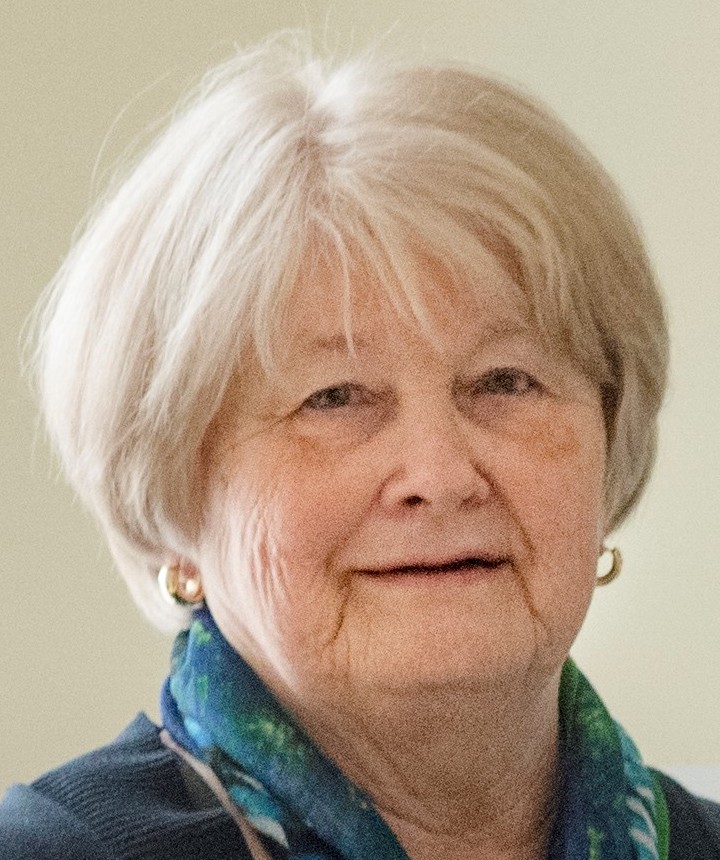
Mary Lou Bennett started as a Realtor in 1973 and was co-owner of RE/MAX Centre Realty in State College from 1992-2015. Retired in July 2020, she continues her philanthropic work to make a difference in the community through numerous organizations, including the United Way, the Renaissance Fund, the Arboretum at Penn State, and her congregation at the University Baptist and Brethren Church.
She was born in Jefferson Barracks, Missouri, as an only child and grew up in Lubbock, Texas. She first met her late husband, Peter, in high school in Austin, Texas, but they didn’t start dating until they were at the University of Texas, where she studied journalism. After getting married, they lived in Del Rio, Texas; Monterrey, Mexico; and Santiago, Chile, before coming to State College in 1964 when her husband was offered a position at Penn State.
A long-time friend of Town&Gown founder Mimi Barash Coppersmith, Mary Lou Bennett sat down via Zoom to discuss her involvement in the community.
Mimi: I wrote down more notes than I usually do because, for me, this is a very important interview for a whole bunch of reasons. Because our lives have crossed in so many ways and turns, involving so many friends and important people.
I’d like to try to convey in this interview the true, underlying importance of a good life in the friendship that you and I have shared personally between one another and with a great friend who we both cherished, Barbara Palmer, all of which has had a remarkable influence on who we are. And I’d like to try to explore that in a way that will help other people join the parade of words to one another and the community because that’s what I hope is our combined legacy to where we are. Barbara’s memory is always here and so many experiences cause us to remember how joyous it was to be a friend of hers and for her to be your friend of ours.
I wanted to start by listing some of the ways you and I are alike: We are six months apart in age; we love nice clothes; we’re businesswomen, and sometimes can be pretty tough. We’re community-oriented. We believe in a responsibility to give back, and we both do it with pleasure. We’re retired – recently – and we’re in community living, learning the new way of life. And we’re reasonably healthy for women our age.
So, in general, there’s a large blessing that makes us strong enough to try to be better every day of our life, and if we can only remember how to do it. So, I found friendship with you through our combined friendship with Barbara and Jim [Palmer]. They’re both gone. Their legacy lives on. I’d like you to explain what your friendship with them did to help you on the paths you ultimately chose.
Mary Lou: That’s an interesting and good question. We belonged to a newly formed congregation that formed in 1967, the Diakonia United Presbyterian Church. Barbera and Jim were founding members – we were all founding members – but they were on a committee that chose, traveled around, and listened to prospective preachers. I remember being invited to their house about this new venture we were getting into and being so concerned about ever inviting them to my house. I couldn’t imagine. It seemed to me they had such broad experiences, and they were so generous and so welcoming. I was told that I didn’t need to worry about that and, indeed, I did not need to have worried about that. I learned a great deal from both of them about being generous and community-minded. I had an aunt who I also got that from, but knowing Barbara and Jim opened up such a wide range of activities and people.
Mimi: We wouldn’t have air service in this county were it not for the help of Jim Palmer and Jay Claster helping make it happen when I was lucky enough to be president of the Chamber of Commerce. That’s a hidden fact, I’m sure. I felt so accomplished being a part of that happening. And today, very few people can remember that because most people aren’t around part of that.
Mary Lou: Well, and you may not even know this part, that I, too, was a part of that, stranger as that may seem. It must have been 1982 or 1983, I don’t remember exactly, and I was president of the Centre County Association of Realtors. I received the letter from Jay Claster asking what the Association of Realtors could do about helping with the expansion of this airport.
It was a tough job to persuade, and we came up with fifteen-hundred dollars, which I proudly sent to Jay Claster. I retired last year, but I still kept some of the old correspondence, and part of that correspondence was from Jay Claster thanking us. I said, “It’s not much, but maybe it’ll provide one parking space.” I didn’t know.
Mimi: And look at what we have now. I think I nuzzled up to RE/MAX early because they chose to enter the marketplace with those delightful, clever ads in Town&Gown.
Mary Lou: In those first several years, every month, it was a delight for us to do it. It was just such fun. I think, at the time, a lot of people would anxiously await the next month to see what we might have come up with.
Mimi: I believe that your heart and how you like to support humanitarian causes have been a part of RE/MAX’s brand in this area. Tell us a little bit about how you brought that about?
Mary Lou: Well, I didn’t bring it about by myself. I was one of six founding members. We purchased the franchise in December of 1992. Richard Porter was the broker of record. Linda Lowe was a partner, Lassie Martsolf was a partner, Scott Yocum, Jackie Hunt. I was the sixth one. I think we all felt a desire to be a part of the community. I know that Richard and I were interested in doing that, but so were the rest of them. Everybody felt that. We supported many causes in a pretty significant way: the expansion of the library; the expansion of the State Theatre – a great deal of input into the community.
Mimi: The whole story of RE/MAX was that you had the foresight to start at a time when things were beginning to explode in Happy Valley.
Mary Lou: Yeah, 1992, and we were the owners until 2015. We sold our interest to a younger group. We all stayed there, but we did not have ownership after 2015. But that was, you know, a big marketing venture being a part of the community.
Mimi: Just tell us a few of the things in which you’re seriously involved.
Mary Lou: Well, my congregation, University Baptist and Brethren, is very socially conscious. I’m very much interested in the new Palmer Museum of Art at the Arboretum at Penn State. I’m a docent at the Arboretum. So, the combination of those two things is really exciting for me.
I’ve been involved in the Mount Nittany Medical Center Foundation, expansion of the hospital, the cardiac unit, and the pavilion. I’m a part of a subgroup of the United Way of Women in Leadership group. I think it must have been about 2007 when then-President Judge Tom Kistler was pursuing child access. So, I’ve been a part of that group.
Mimi: Lots has happened in the giving world in State College over the last couple of decades. We have an amazing organization called Centre Gives by the Centre Foundation, and it has given severe competition to United Way, in my opinion. It’s up to us to stay the course to help ensure that both organizations continue to thrive. However, the one who has the most challenge is the United Way because, with increasing days, months, and years, people like to give the most to what they most can identify with. That will be a problem unless we all open our minds to the necessity for both organizations to thrive. How do you think that can happen?
Mary Lou: I don’t think I know the answer to that. I think that’s something that has to be worked out and figured out. I’m not sure I know how that can work. It will, it certainly will. I’m also a big supporter of Centre Foundation. It’s a remarkable organization.
Mimi: Speaking of remarkable, this community has a remarkable collection of nonprofits who make a difference, a measurable difference, and live up to standards.
Mary Lou: We’re an exceptionally generous community. It’s amazing to me.
Mimi: We are not as good as we should be in the area of diversity, and there’s no simple answer, but you and I both feel we all have to get on the wagon for equality and justice for all.
Mary Lou: Without question.
Mimi: I’d like to philosophize a little bit, together, on how lifelong friendships never go away. They’re continued in the next generation. You and I are good friends because we were both good friends of the Palmers. That’s how we met. There seems to be so much divisiveness in our community these days. How do we remember what made the Palmers unique? They never lost the importance of the overall community, and more of us need to understand that we all belong.
I, of course, am Jewish. You are one of the million ways you can be a Christian. I remember vividly as a child that I knew where I wasn’t allowed to go because I was Jewish. So, I’m probably a bit too far left if serious people were judging me. But you and I, we have learned, even though we’re quite different, that we’re very much alike. We believe in helping others, being a part of the solution, not the problem, and encouraging others to do [the same.]
What would be your best helpful hints? Just somebody who hasn’t gotten the word yet that we have? How would you tell them to describe the personal reward in those moments of giving?
Mary Lou: I’m going to diverge a slight bit to a story that I think you’ve not heard. When I was about ten years old, and this has affected my life from that day until this very instant. I lived in Lubbock, Texas, and there was segregation, and I was on a city bus. I was sitting in the seat by the window reading a book, which I usually did, and this African-American gentleman came and sat beside me. Two Caucasian men across the aisle didn’t like that and told me to move, and I remember saying, “I’m fine.” I didn’t want to do that, but he was an adult telling me to do something. They told me to move again, and I did get up and sat across the aisle and said, “I’m fine.” I knew from that age that wasn’t right.
Mimi: That’s an important message. You have to learn how to be fair to all, and what a great example for you. How old were you then?
Mary Lou: Ten.
Mimi: And it’s lasted forever. When we do good, we get rewarded for a lifetime. More of us have to be able to do that. So, you have a wonderful family. You do for others, and you do for yourself. We all have to do that to be these well-rounded people. Friendships are forever when you have the experience of true and dedicated friendship. I recently screwed up on one of our dates. You were not at all reluctant to say, “Oh, don’t worry about it. We all forget.” That’s what friendship is all about.
I wanted to do this interview to try to convey to more and more people to take time to have good friends. They’re the people you can talk to. They’re the people you can let it hang all out, unless you have a therapist, and they have reason to help each of us stay on the path of goodness. I believe, in our friendship, we’ve managed that. Each of us would drop what we would we’re doing in an emergency, and each of us cares about one another in a special way.
We need to promote that kind of situation for more people to have the pleasure of love beyond their immediate family. It is a gift that you can’t put a price on, but it’s a gift worth enhancing better return. It’s my turn to tell you how much I’ve appreciated having you whenever I need you, and you know you can have me wherever you need me. That’s really what life is all about.
Mary Lou: Well, it’s an honor to sit down and talk with a friend, and I appreciate it.
Mimi: I would say you are blessed to have a child and her family move back to town, which has been a blessing for all of you.
Mary Lou: Yes, absolutely true. Three-and-a-half years ago, they moved from Austin, where Kate had lived for 40 years, and Bruce had lived for 50 years. I think they thought I was getting old. So, they moved here. I’m more than grateful for that. My daughter Blythe in Syracuse has always been good to come to visit. Family is an important thing, and that’s what keeps me going. I have six-voting age grandchildren and two great-grandchildren.
Mimi: We all need to put our arms around one another to say I love you.
Mary Lou: Yes, absolutely, and I love you. You and Barbara were great role models for me.