
Half a century of inspiring curiosity in nature and conservation
In the heart of central Pennsylvania for the last 50 years is Shaver’s Creek Environmental Center, a Penn State-affiliated outdoor education and recreation facility. Founded in 1976, the center originally consisted of one room in a building on the Stone Valley Recreation Area side of Lake Perez. Most early programming involved interpretive talks for recreation area visitors and those staying in the Stone Valley cabins.
In March 1976, the new Shaver’s Creek Nature Center offered a free film festival, a houseplant workshop, and a maple sugaring demonstration. Also offered were two Sunday nature walks: a winter ecology walk and a cultural history exploration of old homestead sites, charcoal mounds, iron furnaces, and more. With the arrival of spring, April activities included ecology walks, an early morning bird walk, and programs for children in fifth through eighth grades.
All of these programs were offered based on staff knowledge at the time and the surrounding environment. They have grown steadily and remain a core part of Shaver’s Creek’s mission.
Laurie McLaughlin, program director and a faculty member at Shaver’s Creek, started working at the center in July 1993. She was hired to direct the Team Development Center, oversee the Maple Sugaring Program, and teach classes in the Recreation and Parks Department.
“Overall, our programming portfolio has changed a lot over 50 years,” McLaughlin says. “Our staff has grown immensely from just two to 25+ full-time staff. We have added teaching academic classes (working relationships with eight different colleges) to our workload and incorporating those students into the experience of leading and facilitating programs.”
In 1974, Corky Potter was hired by Penn State’s Recreation and Parks Department to teach environmental and outdoor education. Following the first Earth Day in 1970, the department saw increased interest in the field.
“The department had already been running Penn State’s residential ‘Outdoor School’ program for 5th graders since 1956, but there was a desire to grow the major and develop an experiential field lab where students could put into practice what they were learning about in the classroom and interact with real world kids and adults,” Shaver’s Creek Associate Director of Operations Joshua Potter says. “Shaver’s Creek would become this field lab.”
When Shaver’s Creek began, staff looked for ways to connect with the community through the natural world. Programs, originally called “public programs,” were created around topics staff had an interest in or local resources to share, such as bird walks and the flora and fauna of the area.
“This has always been and still is a part of our mission – to connect people to people and people to the natural world through these kinds of experiential and informative programs,” McLaughlin says. “But they have certainly grown.”
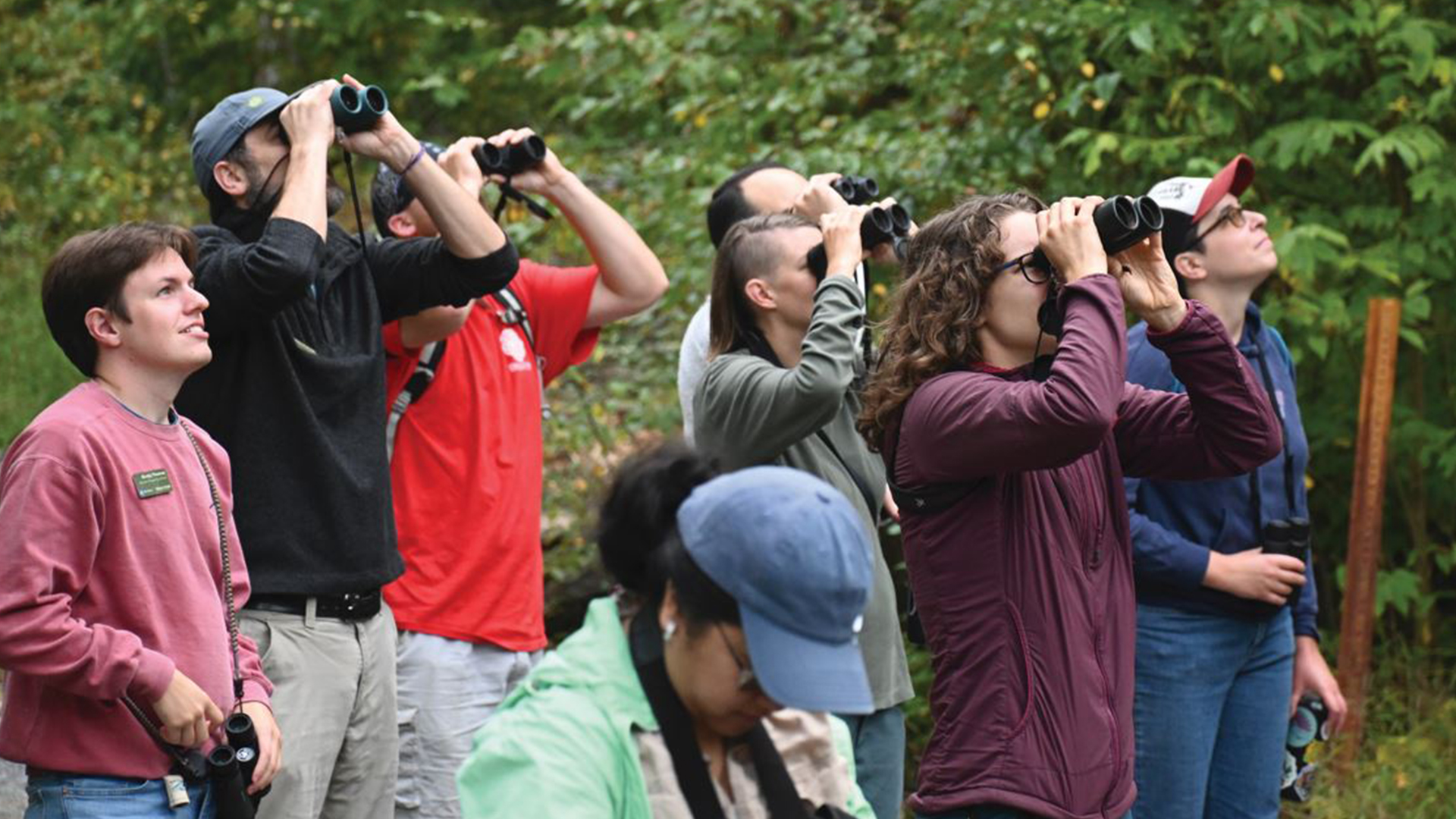
Now referred to as “public workshops,” Shaver’s Creek offers a wide range of programming, including a spring and fall bird walk program called Migration Mornings, in its 29th year.
“This is a program that allows the general public to learn about birds, with the support of other community members,” McLaughlin says. “Then we contribute to citizen science by recording birds identified through the citizen science platform called eBird. In the 1970s, citizen science was happening but not really talked about, and eBird didn’t exist.”
Shaver’s Creek’s bird walks have also grown to include their largest fundraiser, The Birding Cup. Originally called Pledge-A-Bird in the ’90s – where a large group walked the trails – it is now a large spring event where more than 100 birders form 15 or more teams and head out over a seven-county area for 24 hours to look for as many bird species as possible.
The Alan Seeger Natural Area, near State College, has long been used for hikes. Located within Rothrock State Forest and about a 20-minute drive from the center, the area once featured a dense stand of massive centuries-old hemlocks and towering rhododendrons along the trail. Many of those hemlocks have been lost to the woolly adelgid insect.
“Unfortunately, many of those original old-growth hemlocks have died in my lifetime, but you can still see some of their massive stumps,” Potter says. “And I think there may still be some old-growth tulip poplars still in there. A beautiful place for a hike.”
Some of Potter’s earliest memories of Shaver’s Creek are coming to work with his dad in the mid ’80s and spending hours exploring the woods, creeks, and nooks and crannies of the Stone Valley Forest.
“Whenever it was time to go, my dad would stand at the top of ‘Potter’s Knob’ where our current Aerie Reflection Garden sits, and bellow my name across the creek valley, bidding me to come home,” he recalls. “From ages five until 18, I was a Shaver’s Creek summer camper. These camps have had a deep impact on me and my connection to nature and place.”
The Shaver’s Creek staff and revolving door of seasonal interns were like Potter’s extended family.
“Their enthusiasm for the natural world and curiosity for being lifelong learners transferred through osmosis into my bones,” he says. “Although I would temporarily wander away from the natural world in my first year or two as an undergraduate at Penn State, like a magnet it quickly drew me back into the orbit of conservation, sustainability, and environmental interpretation, as I realized I wanted these things to be part of my life and my career.”
“By the late ‘70s, the very small staff of one or two, which initially was just my mother, Cynthia Potter and a handful of grad students, migrated to our current location on the northeast end of the lake in what was at the time called the ‘Forestry Lodge,’” Potter says “The structures around the lake had been built in the 1930s, and our facility had been used by Penn State’s school of forestry until the 1950s or ’60s. But by the late ’70s it was mostly used by the University as a rental facility,” Potter says.
In 1976, Shaver’s Creek began in the Mineral Industries Lodge on the Stone Valley side of the lake, where boat rentals are today. In 1980, the center moved into the Forestry Lodge and has remained there ever since. The Mineral Industries Lodge has since burned down.
Shaver’s Creek was originally established for Penn State students to connect with the natural world and gain skills to help them in their future careers. They learn skills and interpretation methods to share and teach others about nature and the environment.
“As a center, they offer a variety of programs and experiences that give these students hands on and experience-based learning to support their growth in careers they are interested in and learn how to connect with each other and the community,” McLaughlin says. “Their involvement in Shaver’s Creek allows them to gain life skills and experiences that help them transition into their careers.”
In the early development of Shaver’s Creek, maple sugaring walks were held to get people outside and use sugar maple trees to teach and connect them with the natural world. Fifty years later, the Maple Harvest Festival attracts more than 2,000 people.
“My mom has talked about early maple sugaring programs where they would bring kids into the Shaver’s Creek kitchen to show them sap boiling down on the stove – presumably after exploring outside to see sap buckets on sugar maple trees and such,” Potter recalls.
The festival celebrated its 40th year in 2024, having begun in 1984 as a small exploration of the sugar bush and boiling sap over a fire. In 1986, the sugar shack was built, and the program expanded to school children before transitioning into a community festival in the mid ’90s.
“Through the ’80s and into the early ’90s growth was constant, but slow and incremental,” Potter says. “Shaver’s Creek staff grew slowly from a few full-time staff to 10 or so by the early ’90s. The slate of programs, events, camps and traveling interpretive shows continued to grow and offer the community many ways to make connections to the natural world.”
“The festival has grown from being just a short walk among the sugar maples and an opportunity to enjoy pancakes in the ‘back room’ of Shaver’s Creek to an experience for the entire community, where we host about 2,000 people over the course of the weekend,” McLaughlin says. “It is also an opportunity for many past staff and students to return to Shaver’s Creek and help out, see each other and enjoy a place that means so much to them.”
In 2002, McLaughlin developed a class called Interpreting Maple Sugaring to Families, offered to all Penn State students.
“I like to tell students that this class is more than just learning about syrup!” she says. “It is an opportunity to be a part of something bigger than yourself. The students learn leadership skills, teamwork skills, collaboration, and how to teach and work with others. The class is very experiential and is one of the highlights of the Maple Harvest Fest.”
McLaughlin oversees all aspects of the festival, including tickets, parking, food, programs, music, and day-of operations, as well as environmental education interns who play a major role in producing the event.
“The current Maple Harvest Fest is a very large friend-raiser, and it encourages people to come out to Shavers Creek to enjoy the space, the natural world, the community, some great food and time with friends and family,” McLaughlin says.
Over the last 16 years, Potter’s role has shifted from marketing to overseeing operations. He works closely on capital improvement projects, interpretive wayfinding signage, visitor services, and program registration, while collaborating on day-to-day grounds and facilities work.
“As many of us do at Shaver’s Creek beyond our day-to-day job descriptions, I try to also contribute to the community of programs by making time to do things such as help lead bird walks and staff the welcome tent at the Maple Harvest Festival,” he says. “This model of collaborative leadership is something that I was aware of at Shaver’s Creek when I was a kid, and deeply value as a current staff member.”
McLaughlin hopes to build on the center’s legacy.
“I hope that our programs can continue to inspire discovery and curiosity with all who walk our trails,” she says. “I hope that all with whom we connect will feel inspired to go into the world and make a difference wherever they end up.”
Potter emphasized continued growth through partnerships and student engagement.
“My hope is that we continue to be a strong center of student engagement and success, providing not only Penn State students, but emerging professionals from around the region and the country a place to come and learn and build their skills and confidence to be leaders in wildlife conservation and environmental and outdoor education,” he says. “I hope that we continue to offer the local community a welcoming and engaging place to be inspired, to deepen their curiosity, and to seek ways to make an impact and support conservation in their own lives.” T&G
Jason C. Klose is a Central PA writer of Arts & Entertainment//History/Life.



