How the Philipsburg Revitalization Corporation is rebuilding spaces, community pride, and a long-term vision for the borough
The Philipsburg Revitalization Corporation is progressing in its vision for what a renewed downtown can look like, and part of its strategy involves opening eyes to the possibilities — outside the community and within.
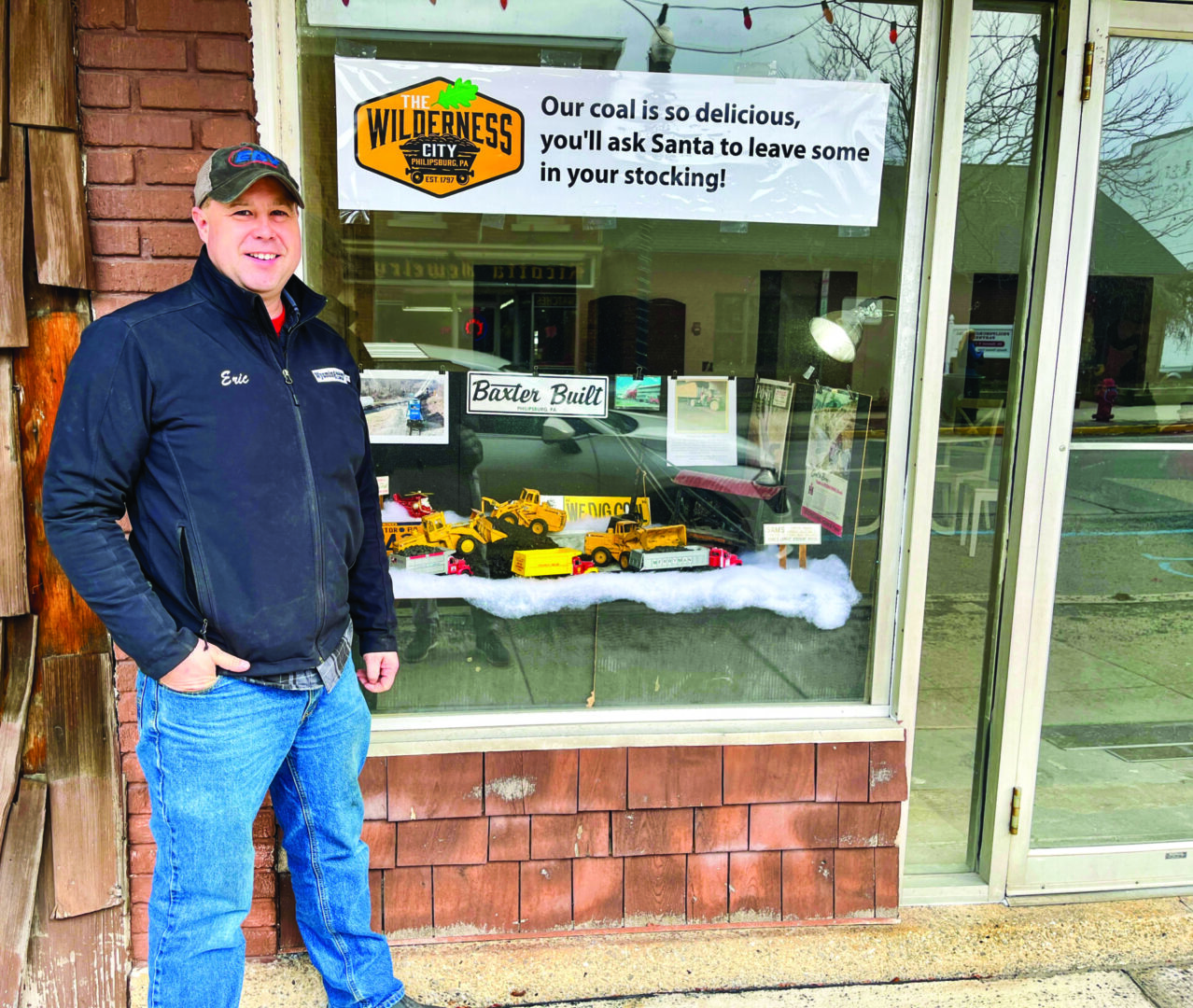
“We have a generation of people who have grown up with a blighted downtown,” says Eric Rusnak, president of the PRC’s all-volunteer board. “They’re not used to there being anything here. Whereas people who grew up in the ’60s or ’70s, they remember when downtown was bustling.”
A downtown Philipsburg consistently teeming with activity again will take time, but the PRC is doing its part to chip away at it.
Adjoining, crumbling buildings at 104 and 110 N. Front St. that the PRC purchased in 2020 are set to come online this year after years of extensive rehabilitation. One will house the ARTERY, a community art space, while the other will include the PRC’s offices, a business incubator, and community meeting space. Two refurbished apartments are set to open on the second floor.
In recent months, the PRC has hosted a series of community visioning workshops as part of the Main Street Initiative to develop a long-range strategic plan for Philipsburg. More than 120 people have attended the workshops to share ideas, and more than 400 responded to a community survey, Rusnak says.
Putting Philipsburg on the radar of county, state, and federal officials has been a key focus of the PRC in recent years to gain critical grant funding for its efforts and, simply, visibility.
“That’s probably been the most meaningful thing that we have done in terms of a strategy, is bringing the county commissioners, state representatives, federal representatives here, people from agencies like (the state Department of Community and Economic Development and the U.S. Department of Agriculture), and having them meet with us and saying, ‘This is our vision,’ and then showing them what we’re doing so far,” Rusnak says.
Through the Keystone Community Partnerships initiative, a collaboration between Penn State and Pennsylvania communities, Rusnak and other PRC and Philipsburg community leaders are part of a steering committee in which youth is one focus, to “give them a sense that Philipsburg is a place where they have a future because that’s how you create new leaders,” he says.
While the PRC has been around in some form since the mid-1980s, Rusnak credits Eric Kelmenson and Faith Maguire with in more recent years spearheading the renewed efforts of the non-profit group, which he joined in 2020.
Rusnak grew up in Ohio but vacationed as a youth in Philipsburg, where his father was raised and where the family’s deep local roots in coal mining date to the late 1800s. Eric, who is a partner in a Washington, D.C., law firm, decided in 2019 that he’d had enough of the metro-area lifestyle and moved to small-town Philipsburg.
“Everyone thought I was crazy, especially my dad,” he says with a laugh. “And then COVID hit and everyone was homebound. (That) allowed me to start getting involved in the town.”
While he cites challenges including a borough council that he says should be more proactive and forward-thinking, absentee landlords, and some community stakeholders “just interested in preserving their own pot,” Rusnak says he’s in this for the long haul.
“I figure we’re on a 10- or 15-year plan,” he says. “We’re in the next generation of Philipsburg. We’re not just doing this for us today. We’re also doing it for the next group of people.”
Here’s more from our conversation, which took place in the renovated space at 110 N. Front St.:
What do you see as some of the PRC’s biggest successes so far?
Rusnak: These two buildings (104 and 110 N. Front St.) were in tear-down condition, and the PRC bought them shortly before I got involved, and renovated them. There’s two apartments upstairs that are really nicely done. We’re just finishing them. … We took something that looked like it should have been torn down and then reused it. People remember coming in here when this was an appliance store, and now they come in here and say, “Oh my gosh, look how beautiful it is.” I think that’s really important for generating a sense of pride for town and also preservation.
And then some of us, on our own, own other buildings in town that we have saved and restored. The first couple of blocks here now are, if you look back like 10 years ago, the buildings were uninhabitable. Now they’re habitable again. I think that’s a huge success. Just our network of resources, of other stakeholders, developing that has been very successful. It’s incredibly time-consuming. The amount of work that we have done as volunteers is something that I’m really proud of and has drawn a lot of positive attention to Philipsburg. Because now people say, “Oh, I hear something good’s happening in Philipsburg.”
What has come out of the community visioning workshops?
Rusnak: People want a more robust downtown. And the path to that is going to take everyone’s work and involvement. If you want a local economy, you have to pay for it. The idea is to try to attract businesses that people want and then get them to support it. And we have a generation of people who have grown up with a blighted downtown. They’re not used to there being anything here. Whereas people who grew up in the ‘60s or ‘70s, they remember when downtown was bustling. So, changing some attitudes and behaviors, I think, is going to be important that if we get a new business to try to support it so we can bring in another new business.
A lot of people downtown complain that there’s not sufficient foot traffic, which is true. There’s not much of a nightlife, which is also true. And so, trying to bring businesses in to build something toward having more foot traffic, more of a night or weekend life, is challenging because if you get one in, you’ve got to hold them there while you get the next one in. And in the meantime, you’re taking buildings that are not habitable and trying to make them habitable and trying to do these things all at the same time.
It’s going to take some time. But the town didn’t get this way overnight, so it’s not going to change overnight. But I think we’ve made some real serious progress.
The other thing about having a strategic plan is that it gives us some data to point to. I think there’s always people with opinions about what kind of business we should have or what our true problems are in town. And I never know whether there’s any validity to them because there’s no data behind it. It’s just somebody’s opinion. And so having a study behind this, I think, is really helpful in determining what are the real challenges and maybe what are perceived challenges
In terms of your biggest challenges, it sounds like you feel some more community alignment would be helpful?
Rusnak: Our biggest challenge, I think, is we have too few people doing too many things, too many big things. And so, there’s always a risk of burnout. I think the community is very supportive of what we’re doing, but we’re going to have to get the community also to participate in what we’re doing. … I think there are people in town who need to make some sacrifices for the benefit of the town moving forward, meaningful sacrifices. You have people that are just kind of used to getting their own way at the expense of Philipsburg, and that’s going to have to stop. And I’m sure that’s true of any town
What would you want people who are not from here to know about this community that would make them want to come here?
Rusnak: It’s a community that has a lot of heart and a lot of grit and people who enjoy living in a town like Philipsburg. We don’t want to be State College. We don’t want to be Bellefonte. We want to be Philipsburg. We just want to maybe be a better version of ourselves. It’s a place that’s affordable. It’s a place where you can make friends that care about you. It has a certain character to it that is interesting and sometimes funny. You get to be part of it. I think that it’s a town where things are really happening. And so, if you’re somebody who wants to be part of shaping the future of a town, now’s the time to come to Philipsburg. If you just want to be an observer of how things are dramatically changing, now’s the time to come to Philipsburg.
We have rich history. There’s a lot to be part of. We have great teachers in our schools that really care about their students and know them and participate in their lives. I think it’s a good place for kids to grow up. There’s still a small-town community here. If you really participate in town, you’re never really alone in town because you always see somebody that you know, and you always have somebody that you can call to help you. There’s always somebody that has your back.
The Case for Re-mining
Eric Rusnak sees cleaning up Moshannon Creek — polluted by a century of acid mine runoff — as central to Philipsburg’s revitalization. Working with coal miners to achieve that goal represents a full-circle moment for him.
Rusnak’s great-great-grandfather, Martin S. Rusnak, immigrated to the United States around 1883 from what is now Slovakia, then part of the Austro-Hungarian Empire.
“He and his wife, B.F. (Barbara Francis), formed the Hawk Run Coal Mining Company, which mined coal in North Philipsburg using the deep mining, and later surface mining, methods,” Eric says. “They built a tipple for processing and cleaning coal and had a rail siding for loading trains. The coal mining tradition continued through my grandfather, Joseph Lewis Rusnak.”
Today, safely finishing coal removal and cleaning up legacy mine sites is “the right thing to do for our community and to honor the work of our families,” he says.
A trial lawyer by training, Rusnak works with local coal mining companies to educate the public about the current state of the coal industry, demonstrate how he believes re-mining benefits the economy and the environment, and help coal companies obtain permits for large-scale reclamation work.
He says it’s important because,
“I don’t think a town with polluted water running through it will ever succeed,” he says. “So, we need to clean it up. There’s a generation of people who say it’ll never be cleaned up, and I just disagree with that. There’s a couple of ways of cleaning it up. One is to install active treatment plants, which is incredibly expensive and you’ve got to run them forever. But I work with several coal companies around, and the coal companies are solving a lot of these problems through their current coal mining operations. It’s a process called re-mining where they go down into these deeper seams of coal that have been deep-mined and remove the rest of the coal. And while they’re in there, they either plug up the water that is polluting the creek or they treat it at its source by putting fresh limestone in the bed of the pit.”
“… (It) seems illogical that the solution to legacy coal mining problems is more coal mining. … To move the project forward in a meaningful way, some of these coal companies are going to have to make major investments in their equipment. And to do that, they need assurances that they can get mining permits. Right now, the (Department of Environmental Protection) does not want to give coal mining permits. They just want to drag their feet. So that has to be addressed at a policy level, not at a bureaucratic level. Getting policymakers interested in this, I’ve been working on that. I think that’s really the path forward.”
“If we can get permits to do that — this is a town that was built on coal mining — you’re going to change the economy in a meaningful way because now there’s going to be an environmental cleanup that’s going to go on probably for decades, that will employ not just the people on the ground but everyone that they buy things from, that they sell things to, the people working there — where do they eat? where do they shop? — all of those things.” T&G
Mark Brackenbury is a former editor of Town&Gown.