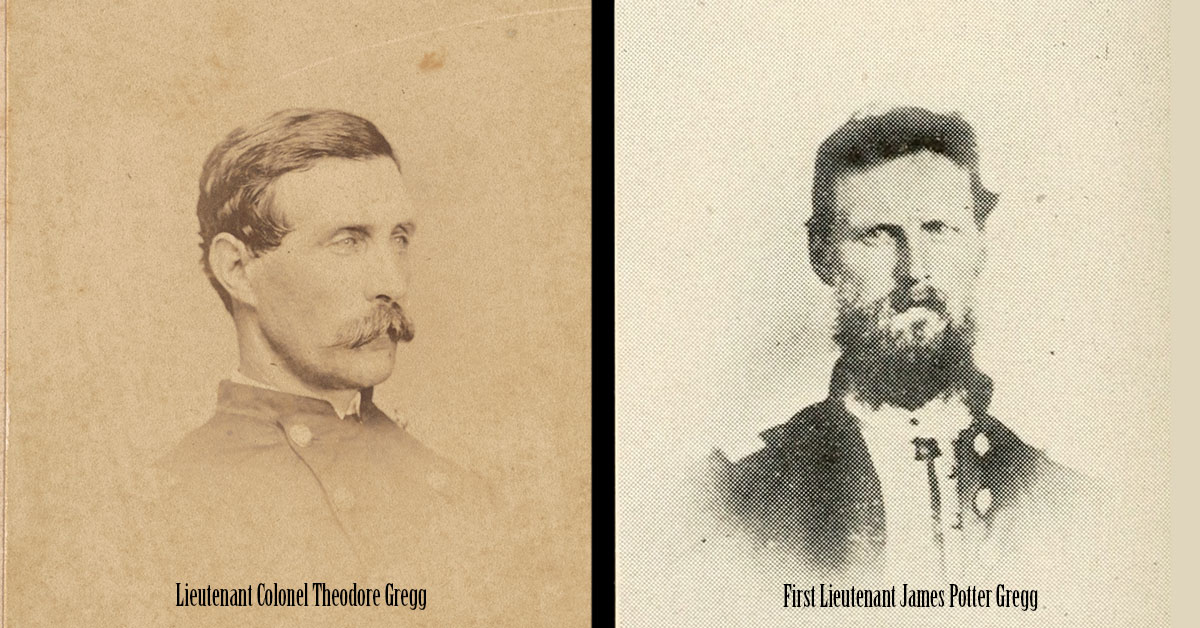
The Grand Army of the Republic (GAR) was an organization of Union Veterans who served and were honorably discharged from the Civil War (1861-1865).1 Starting in 1866, GAR members would meet at local posts to fellowship with their comrades and to serve their communities through “fraternity, charity, and loyalty.” The GAR also became a powerful political force by the end of the 19th century, peaking with about 400,000 members in 1890.2 It was a national organization with state departments and local posts. Bellefonte’s Post was known as the Gregg Post No. 95.
Gregg Post No. 95 was located in the Harris Block, within the large brick building on the corner of Water and West High streets in Bellefonte. At the time, this building was primarily known as the Potter & Hoy Hardware Company. Men like General James A. Beaver, and countless others, would attend regular meetings in their GAR Hall located on the third floor. While perhaps rare, Gregg Post No. 95 was named after two different men with the same last name. As is often customary, posts are usually named in honor of a deceased comrade. Both of these men were deceased by the time the Gregg Post No. 95 was organized on June 3, 1879.
Before James Potter Gregg joined the army, he was a practicing physician in Milesburg. Gregg was born in 1834 in Potter Township. He served in the Bellefonte Fencibles for 90 days before joining the 45th Regiment Pennsylvania Veteran Volunteer Infantry. Lieutenant Gregg served in commissary and administrative roles until about the time of the Wilderness Campaign. Around then, Gregg requested “to be allowed to return to his company in the line.” He was actually a month past his term of service and could have gone home. “He had repeatedly been besought by his commanding officer, Colonel Theodore Gregg, to return home since he had already more than done his duty in repeated engagements with the enemy.” Instead, he marched with his men and was killed on Sept. 30, 1864 at the Battle of Peebles Farm (Poplar Springs Church). His body was never recovered because it unfortunately fell “in the possession of the enemy,” so he is buried in Poplar Grove National Cemetery in Petersburg, Virginia. Lt. Gregg was almost 30 years old when he died on Sept. 30, 1864; a bullet entered his neck close to the ear. On his official GAR “Personal War Sketch,” it states that James P. Gregg is “one of the two deceased soldiers after whom Post No. 95 of Pennsylvania received the name of ‘Gregg.’”3
Peebles Farm was a costly battle to the 45th Regiment. On the same day that Lt. James P. Gregg was killed in action, Col. Theodore Gregg, was captured and sent to the infamous Libby Prison in Richmond.4 Col. Gregg, the second veteran after whom the Gregg Post is named, was born in 1824 near “Curtin’s Station.” Gregg had served in the United States Navy during the Seminole War in Florida and also in the army during the Mexican War .
By 1862, he was a captain in the 45th Pennsylvania Volunteers, the same regiment Lt. James P. Gregg served in. At Petersburg in 1864, Theodore Gregg led a legendary charge into “the Crater” that was created by exploding mines beneath enemy lines. “His sword gleaming in the sun-light above him,” he gallantly battled three Confederate officers hand-to-hand, pinning one through the body to ground with his sword. He was reported to be “one of the best swordsmen among the volunteers, having acquired the art in the Navy.”6
Theodore Gregg was brevetted Colonel and died in Milesburg on July 4, 1878. He is buried in Eagle Cemetery, in Boggs Township. GAR records also mention that “Theodore Gregg was the other of the two deceased comrades after whom Gregg Post No. 95 was named and therefore specially memorialized.” He was about 54 at his death, “a man beloved by all who knew him and one who was regarded as an able leader in battle and a courageous soldier.”
As highly regarded officers in the 45th Regiment, James P. Gregg and Theodore Gregg were not only cousins, but brothers in arms. Both of their names held tremendous respect and value to their comrades at the Gregg Post and beyond, an honor they share eternally. T&G
Local Historia is a passion for local history, community, and preservation. Its mission is to connect you with local history through engaging content and walking tours. Local Historia is owned by public historians Matt Maris and Dustin Elder, who co-author this column. For more, visit localhistoria.com.
Sources
[1] https://suvcw.org/brief-history-of-the-grand-army-of-the-republic
2 https://guides.loc.gov/grand-army-of-the-republic
3 Personal War Sketches Grand Army Of The Republic p. 15
4“Col. Theodore Gregg’s Death.” Centre Reporter (Centre Hall, PA). July 18, 1878.
5 https://panewsarchive.psu.edu/lccn/sn83031987/1878-07-10/ed-1/seq-1/
6 History of the Forty-fifth regiment Pennsylvania veteran volunteer infantry, 1861-1865, written by the comrades. Ed. and arranged by Allen D. Albert p. 525.
“Personal War Sketches Grand Army Of The Republic Presented To Gregg Post No. 95”, Centre County Library & Historical Museum – Centre County Gregg Post No. 95 GAR Veteran Books, 1890. https://digitalarchives.powerlibrary.org/papd/islandora/object/papd%3A532835.
“Research Guides: Grand Army of the Republic and Kindred Societies: A Guide to Resources in the General Collections of the Library of Congress: Introduction.” Introduction – Grand Army of the Republic and Kindred Societies: A Guide to Resources in the General Collections of the Library of Congress – Research Guides at Library of Congress. Accessed May 5, 2026. https://guides.loc.gov/grand-army-of-the-republic.