Revisiting one of the strangest and most unsettling afternoons in Centre County history
By Dustin Elder
All summer, our region has been inundated with some of the most extreme weather in recent memory. A record-setting July heat wave, powerful thunderstorms that drove Central Pennsylvania to a record number of year-to-date severe weather warnings, an alarming number of tornado warnings and confirmed tornadoes, historic flash flooding, and days of unhealthy air caused by smoke from Canadian wildfires have made it seem as though Mother Nature has had a particular grudge against the Keystone State.
Yet if you ask around, you’ll quickly discover that Centre Countians have long memories when it comes to unusual weather. Every community has an “old-timer” with a story about the Blizzard of ’93 or Hurricane Agnes, but among the rarest and most unbelievable weather tales is one that sounds more like a scene from a science fiction movie than a page from local history: the day the sky turned black.
On Sunday, Sept. 24, 1950, the weather in Happy Valley wasn’t particularly remarkable. The day had dawned cool and cloudy, with many residents reaching for winter coats as they headed to church. After services, families settled into their Sunday routines. Football fans tuned in to listen to the Steelers and Eagles on the radio, while die-hard Pirates supporters endured another difficult season as Pittsburgh prepared to finish in last place.
By early afternoon, however, something began to change.
A strange haze drifted into the region. At first, it resembled the leading edge of an approaching storm, but there was no rumble of thunder and no rain on the horizon. As the afternoon wore on, the haze thickened into something no one had ever seen before.
Then, shortly after 4 p.m., daylight simply … disappeared.
Across Centre County, residents stepped onto porches and into farmyards to find themselves staring at a sky as black as midnight. Streetlights flickered on automatically. Drivers scrambled to switch on their headlights. Businesses illuminated their storefronts in the middle of the afternoon, while families lit lamps inside their homes.
The darkness was so complete that nature itself became confused. Chickens wandered back into their coops to roost for the night. Reports from Cook Forest claimed nocturnal animals emerged from the woods hours ahead of schedule. Farmers watched livestock settle in as though the day had ended, while birds fell eerily silent.
The event wasn’t confined to Centre County. The strange darkness stretched across much of Pennsylvania and portions of New York, Ohio, and New England. In nearby Tyrone, the sudden lack of visibility turned deadly when a 65-year-old man was struck and killed while crossing the street.
For many, the darkness was unsettling. For others, it was terrifying. Some believed the darkness was a sign from God, pointing to biblical passages describing the sun refusing to shine before the end of the world. Others insisted it was connected to secret nuclear testing or an atomic explosion somewhere in North America. In coffee shops, church parking lots, and around family dinner tables, speculation became the day’s biggest story.
The real explanation, however, was no less remarkable.
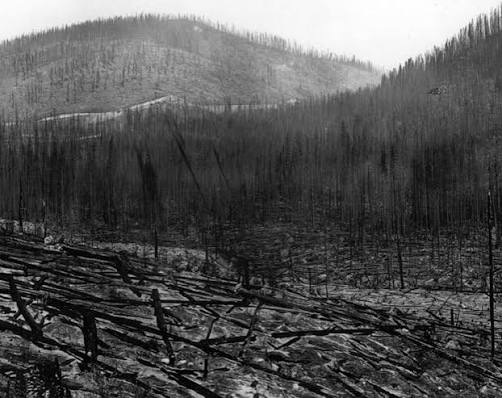
Thousands of miles away, one of the largest wildfires in North American history had been burning across western Canada. Known today as the Chinchaga Fire, the massive blaze consumed millions of acres of forest, sending enormous quantities of smoke high into the atmosphere. Under a rare combination of weather conditions, that smoke traveled across the continent, eventually descending over the Northeast in such concentration that it dramatically blocked sunlight.
Ironically, the same type of Canadian wildfire smoke that has dimmed our skies and prompted air quality alerts over the past several summers was responsible for the darkness of Sept. 24, 1950, only on a scale almost unimaginable today.
As we’ve watched smoke-filled skies, torrential rains, and record-breaking storms roll across the region this summer, it’s easy to think we’re living through unprecedented times.
Yet history reminds us that nature has always had the power to surprise, and occasionally frighten, even the most seasoned Pennsylvanians.
After all, this isn’t the first time Centre County has looked to the heavens and wondered what on earth was happening. On one unforgettable Sunday in 1950, the answer didn’t come until long after the sun had disappeared. T&G
Visit townandgown.com for a full list of sources. Local Historia is a passion for local history, community, and preservation. Its mission is to connect you with local history through engaging content and walking tours. Local Historia is owned by public historians Matt Maris and Dustin Elder, who co-author this column. For more, visit localhistoria.com.