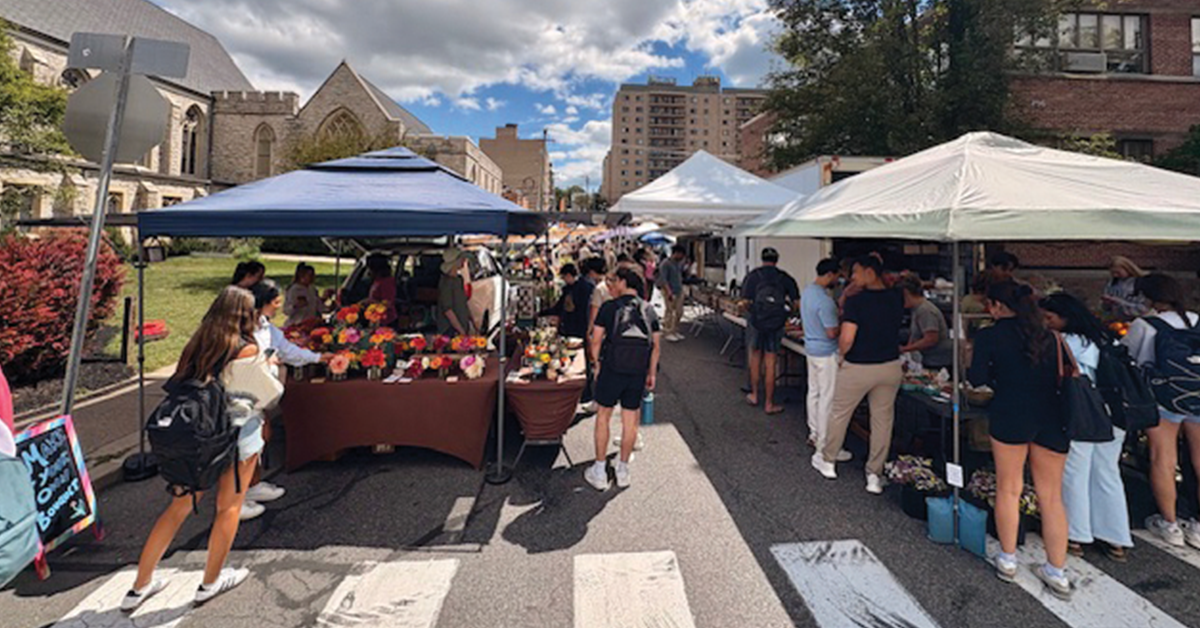
A 50-year tradition shaped by changing tastes and community needs
This year, the Downtown State College Farmers Market — the weekly gathering that transforms Locust Lane into a showcase of seasonal produce, flowers, baked goods, and locally made treats — celebrates its 50th anniversary.
Over the decades, the market has served as a vital connection between local growers and Centre County residents, adapting to changing tastes and shopping habits while staying rooted in its mission of providing fresh, local food and supporting small farms.
Downtown State College Farmers Market was founded in the mid-1970s, during a period when interest in homegrown food and local agriculture was gaining momentum nationwide.
Dan Harner, retired owner of Harner Farms, was one of the market’s founders. “The Penn State Agriculture Extension had an article in the paper about starting a farmers market and said if anyone was interested, they should come to a meeting. About a dozen of us showed up, and we decided to start the market,” he recalls.
Harner was named president of the new venture, which first operated on Benner Pike in the parking lot of Dean’s Market, near where Goodwill is located today. After an initial season of “enthusiastic, curious” customers, attendance and sales began to slow, prompting organizers to consider a move downtown.
Harner met with developer Sid Friedman and pitched the idea of relocating the market closer to students, office workers, residents, and visitors who otherwise had limited access to fresh food without traveling outside the borough. The rest, as they say, is history.
“Originally, it was a lot of farmers producing similar items, mainly fruits and vegetables, flowers, eggs and honey and baked goods,” remembers Eda Case of Patchwork Farm and Greenhouse in Aaronsburg. Case was just 12 or 13 years old when her mother joined the original “loose conglomerate” of growers who launched the market.
Today, Case is part of what the market has become in 2026.
Amy Fisher, the market’s current president, is also part of a multi-generational market family. Her mother, Deb Fisher, owns Deb’s Flower Farm, which has been selling fresh-cut organic flowers at the market for decades.
As additional markets have opened throughout Happy Valley, Fisher says the downtown market has sharpened its focus on serving students, faculty, and downtown visitors.
“It’s just a great way to offer local produce and items to students who don’t have vehicles,” she says. “People walk by, discover it, and come down. We also have First Fridays and live music, which has been a great attraction.”
Each vendor has a story about how they found their way to Locust Lane.
For Case, that journey began after she and her husband left office jobs in Massachusetts in search of a more hands-on lifestyle.
“There was a beautiful property just waiting for us in Pennsylvania with an established business and a mentor, my mom, on site!”
“For more than 30 years, we have been endlessly fascinated by the progression of seed to supper,” she says. “We have customers who can buy everything they need to sit down to a fully locally grown meal. Our market does that! In this era of corporate food production … our market is LOCAL.”
Fisher says she and her sister are continuing to grow their family business while bringing new ideas to the market.
“It’s a lot of work, but it’s very rewarding. It’s great to work outside with plants. My mom started the business about 30 years ago, selling flowers at the market. My sister and I have taken on more responsibility in recent years, including launching a DIY flower bar this year.”
Like the community around it, the market has evolved over the past five decades. In the 1970s, many shoppers maintained large gardens or preserved food for large families. Today’s customers tend to buy smaller quantities but seek greater variety, seasonal specialties, and organically grown foods.
The changing demographics of the borough and Penn State campus have also shaped what vendors bring to market.
“Now there is a larger diversity of items on offer, including meat and fish, and a higher number of vendors with prepared food. Also, as the international population at Penn State has changed, so too have the specific vegetable offerings changed as farmers adapt to the preferences of the students for certain hot peppers, cooking greens, and herbs, etc. There has also been an increased demand for organic foods,” Case says.
Harner says adapting to changing customer preferences has been essential to the market’s longevity.
“We do more peaches and new varieties of apples now, and we sell smaller quantities because people only want a dozen and a half apples or so. We started selling cider donuts downtown last year. If you look at the market mix now, there’s not nearly as much produce. There’s coffee, plants, cooking items, donuts, and a lot of different things you didn’t have back in the ’70s.”
What has remained constant over the past 50 years is the market’s role as a community gathering place. “It’s always fun,” Fisher says. “As different events happen in the downtown, we will see crowds of people — people who haven’t necessarily even heard of the market before, and they can come down and experience it. We also have live music on First Fridays. It’s a good attraction.”
“It’s a gathering place,” Harner says. “A place to mingle and walk the downtown.” Case says the market also helps shoppers — and especially students — develop a stronger connection to local agriculture.
“Graduates return years later, sometimes with their own kids, and talk about what the market meant to them when they were attending Penn State. The students frequently say that market day is the highlight of their week. It’s a chance to connect in a real way to the land and to those who work the land,” she says.
As the market has adapted to better serve the Penn State community, its schedule has evolved as well. While many farmers markets peak during the summer months, the Downtown State College Farmers Market intentionally aligns its busiest seasons with the academic calendar.
The market now runs from early April through late November, offering Amish baked goods, maple syrup, cookies, candles, produce, flowers, and prepared foods during much of the school year.
This summer’s session will feature nine vendors, with another seven joining for the fall session beginning in August.
Fisher says visitors this season can expect make-your-own bouquets, shiitake mushrooms, small-batch preserves, pasture-raised beef, apples and peaches from local orchards, and much more.
And while the market is celebrating its past, vendors are equally focused on its future.
“I hope it continues to grow, have a good mix of people, and sustain itself,” Harner says. “One thing feeds another.”
“The next generation of young market farmers is on their way,” Case adds. “This group will bring their own passion and vision. But what they and we all share is a love for people, for real connections and real interactions, and a pride in our products.”
Fisher agrees.
“I see continuing to have more variety. [We are] serving [the] needs of students by offering more prepared food options that they can grab between classes. We want to stay true to the tradition of producer-only and prioritize our local farmers while also incorporating other local goods like crafts.”
The Downtown State College Farmers Market is held on Locust Lane off College Avenue every Friday from 11:30 a.m. to 5:30 p.m. Visitors can find updates, vendor information, and seasonal announcements on the State College Farmers Market Facebook page (@statecollegefarmers). T&G
Cara Aungst is a freelance lifestyle and business journalist who writes about people, events, and how Happy Valley ideas change the world. She can be reached at caraaungst@gmail.com.
State College Farmers Market Lineup
Summer Vendors (What to Find)
Piper’s Peck — Small-batch salsas, pepper jellies, preserves, and spice blends
Idou Coffee — Coffee drinks, teas, baked goods, and coffee beans
The Peaceful Kingdom Farms — Candles, lotions, soaps, and artisan goods
Harner Farm — Apples, peaches, plums, nectarines, and cider
Moser’s Garden Produce — Seasonal produce including tomatoes, greens, and pumpkins
Hilltop Woodfired Bakery — Amish baked goods, pies, cookies, and breads
Nature’s Reward — Locally made CBD products for people, and pets
Treaster Kettle Farm — Honey, maple syrup, eggs, chicken, and shiitake mushrooms
Fatima’s Kitchen — Persian cuisine food truck
Deb’s Flower Farm — Fresh flowers, succulent gardens, and handmade jewelry
Fruiteek — Organic juices, smoothies, and healthy foods
Joining in Fall (August–November) (What to Find)
Happy Vale Farm — Succulents and cacti
Inside Out Cookies — Gluten-free, vegan, and keto treats
Stem to Stable — Pasture-raised beef, pork, lamb, and eggs
Patchwork Farm — Organic produce and flowers
Anna’s Healthy Bakery — Gluten-free and naturally sweetened baked goods