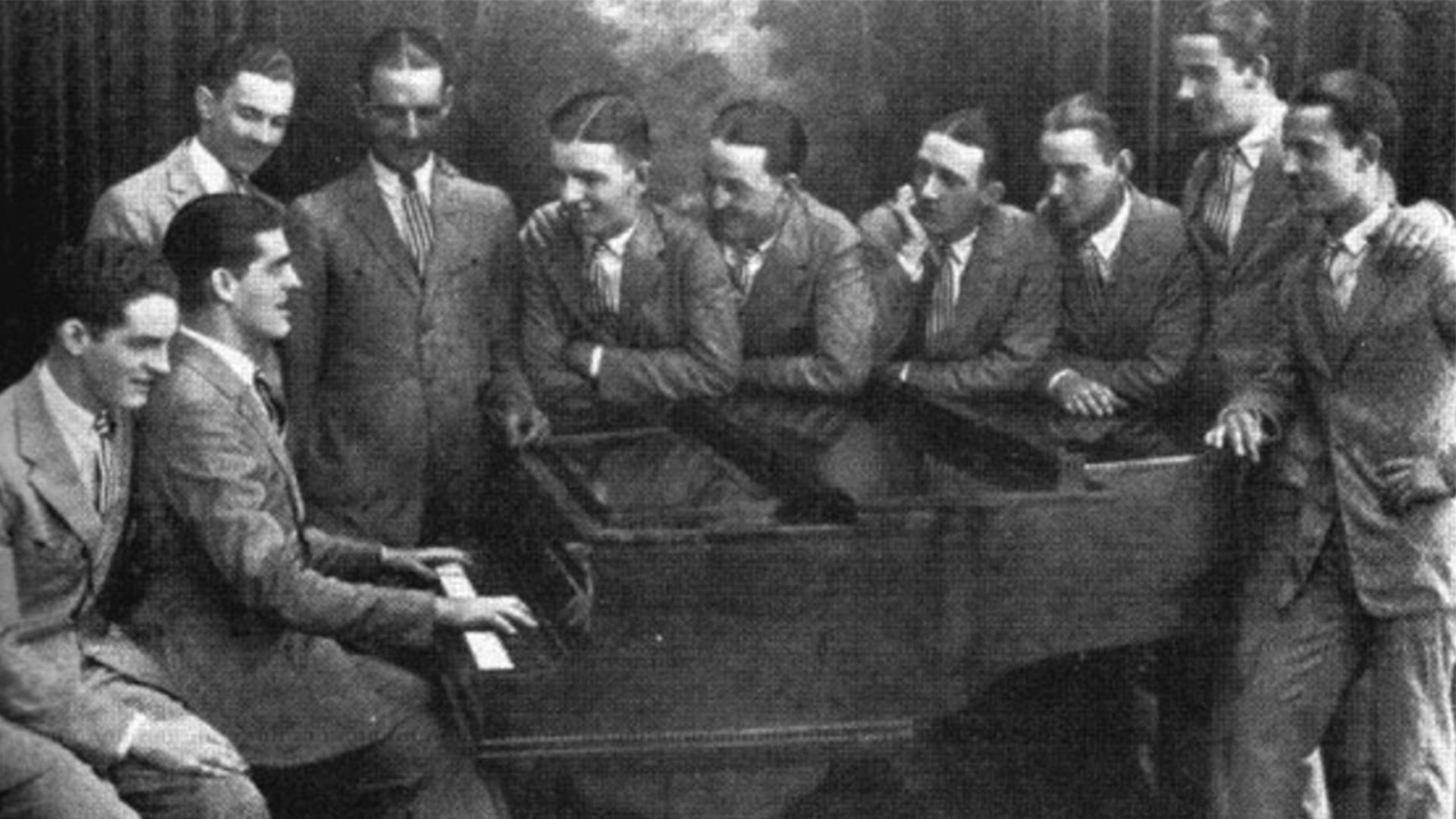
Fred Waring’s journey from Central Pennsylvania to radio, television, and American culture
In the era of snap orchestras, swing, and the Big Band, one personality rose from the industrial heart of Pennsylvania to captivate audiences across the country and “taught America how to sing”: Fred Waring.
When he was born in Tyrone in 1900, Fred Waring would have seen an industrial town at its peak. Waring’s father, a banker, and his mother, a local choir leader, were well-respected and deeply involved in the railroad community. Music was never far from reach. As a boy, Fred played in the Boy Scouts Drum Corps, sang in his church choir, and, as a teenager, formed a banjo quartet with fellow Tyrone youths called “Banjazzatra,” entertaining crowds at local dances.
The Waring family’s roots in Tyrone ran deep, stretching back to the town’s founding in the 1850s. So when it came time for Fred to attend college, there was only one choice: the Pennsylvania State College. At Penn State, Waring initially studied agricultural engineering, but his true passion was always music. After auditioning and “being rejected” from the Glee Club, he doubled down, expanding his small student group into a full orchestra. That group soon became known as “The Pennsylvanians,” and before long, they were the hottest ticket on campus and far beyond.
Throughout the Roaring Twenties, Waring and The Pennsylvanians found national success. Songs like “Collegiate” became cultural touchstones of the flapper era, while novelty hits such as “I’ve Never Seen a Straight Banana” and “I Wonder How I Look When I’m Asleep” filled dance halls and living rooms alike. Waring proved not just musically talented, but also remarkably forward-thinking. As radio and television began reshaping American entertainment, he positioned himself at the forefront.
In the 1940s, Waring became a pioneer of early television with “The Fred Waring Show,” bringing choral music and polished performances into homes across the country. At a time when TV was still a novelty, Waring understood its potential. His programs emphasized musical precision and vocal training, helping elevate standards for broadcast performances. For many Americans, his show was not just entertainment, but was an introduction to organized singing and choral harmony.
Waring’s influence extended far beyond the stage and screen. In the postwar years, he partnered with engineers and manufacturers to help popularize a kitchen appliance that would become a household staple: the blender. Marketed as the “Waring Blendor,” it was one of the first commercially successful electric blenders in the United States.
Even as his national fame grew, Waring never lost his connection to central Pennsylvania. In his later years, he returned frequently to Penn State, where he worked closely with students and faculty. He held music workshops and orchestra classes, sharing his expertise with a new generation of performers. These sessions weren’t just guest appearances, they were hands-on, instructional experiences that reflected his lifelong belief that music should be taught, practiced, and shared.
For local audiences in Central Pennsylvania, Waring wasn’t just a distant celebrity; he was a familiar presence, a mentor, and a symbol of what someone from this region could achieve. His legacy lives on not only in recordings and broadcasts, but also in the continued strength of music education and performance at Penn State.
Fred Waring passed away in 1984, but his impact still resonates. From Tyrone’s small-town beginnings to national stages, early television studios, and even American kitchens, his influence crossed boundaries in a way few entertainers ever have. He helped define what American popular music could sound like, embraced emerging technologies before many of his peers, and remained committed to education and community throughout his life.
For us here in Central PA, Waring’s story is more than history. His story is a reminder that world-changing talent can come from places like Tyrone, that innovation often grows from unexpected paths, and that local roots can shape national legacies.
And perhaps most fittingly, it’s a reminder that music has the power to bring people together, one voice at a time. T&G
Local Historia is a passion for local history, community, and preservation. Its mission is to connect you with local history through engaging content and walking tours. Local Historia is owned by public historians Matt Maris and Dustin Elder, who co-author this column. For more, visit localhistoria.com.
Sources
Fred Waring Historical Marker. Explorepahistory.com. (n.d.). https://explorepahistory.com/hmarker.php%3FmarkerId=1-A-26E.html
Fred Waring | pennsylvania center for the book. (n.d.). https://pabook.libraries.psu.edu/literary-cultural-heritage-map-pa/bios/waring__fred
Provizer, S., Kennedy, S. J., Barnhart, J., Hoffman, B., Robinson, A., & Goldman, J. E. (2020, April 14). Fred Waring’s Pennsylvanians. The Syncopated Times. https://syncopatedtimes.com/fred-warings-pennsylvanians/