How Penn State’s Growth in Emerging Technology Impacts Students and The Larger Community
By Elana Laing
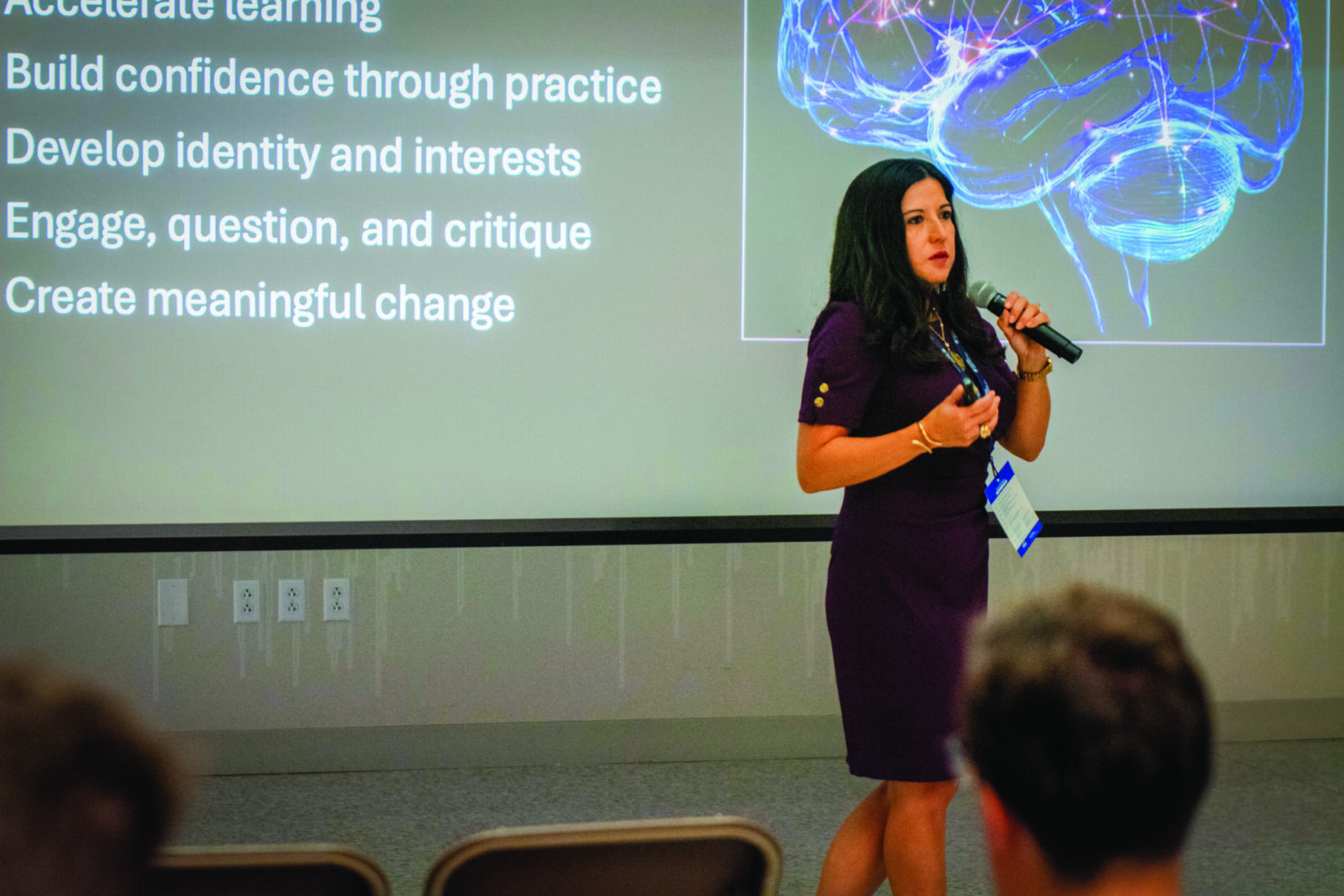
For many people, ChatGPT, Google Gemini, and Siri may come to mind at the mention of artificial intelligence (AI), but for Penn State students, AI means much more. That is because “Penn State students are engaged in the conversation about digital citizenship,” according to Stephanie Swindle Thomas, director of emerging technologies at Penn State. The next generation of Penn State students won’t just be tech-savvy but AI-literate. Thomas wants students to think critically about AI, whether or not they ultimately choose to use it.
“For me, I am trying to split the difference between students who are going to be using AI badly and helping students use it well, I want them to understand both sides. People choose not to use it at all, too. I don’t require my students to use it, but I require them to mentally engage with it,” she says.
Because AI is rapidly becoming part of nearly every field graduates will enter, everyone has a place in the conversation. “I might as well have my students engage in the classroom, in a safe space where we can experiment, rather than send them out into the world, and have them not know how to use AI well,” she explains.
This classroom preparation may also affect how quickly graduates advance professionally. “I have students who got degrees a couple years ago who didn’t get AI experience in the classroom, and now they’re having to upskill on their own and aren’t advancing at the same rate as my students who just graduated, getting full-time roles because they engaged with AI in a thoughtful way through classes or an independent study,” Thomas adds.
The kind of thoughtful engagement Thomas describes is reflected in the experience of Sai Anurag, one of her students and a Penn State senior in the College of Information Sciences and Technology (IST). Anurag, who also serves as a Student Technology Advisory Representative (STAR), says, “A memorable experience using AI was in IST 130 [Emerging Technologies in Popular Culture], where I learned how to discuss the prompts I used to generate music and art and how I improved [them] over time.”
Anurag says the course expanded his understanding of human-centered AI and emphasized using the technology responsibly, which he says is valuable to his future goals. “In the College of IST, it is a ‘use AI, and stay cautious type of idea,’” he says. “They recently introduced a new major called Information Technology Ethics and Compliance that focuses on the ethics part of technology and how safeguards can be put in place.”
Anurag’s experience illustrates how Penn State’s approach to responsible AI is reaching students in the classroom. That classroom-level work is part of a broader, university-wide effort. Penn State launched an expanded AI initiative, known as the AI Hub, in 2021 to bring together researchers and educators from disciplines including computer science, engineering, information sciences, and data sciences. It has now evolved into the AI Center of Excellence that is home to dozens of initiatives across 15 of the university’s 16 academic colleges.
The center promotes the responsible use of AI in its mission to equip every student, faculty member, and staff member with opportunities to achieve foundational and advanced AI fluency. The university’s AI teaching and learning initiatives are helping students go beyond simply using generative AI to write emails. Students are learning to analyze large amounts of data, write effective prompts, generate professional graphics and branding images, build apps, deploy AI agents to streamline tasks, create virtual and augmented reality art, use predictive analytics models, and understand AI ethics and compliance.
At the same time, AI raises concerns about environmental sustainability, credibility, and trust. “Let’s learn how to use it well,” says Thomas. “If we ignore the conversation, then we’re not preparing students for success when they get out into the world and are expected to use it in their jobs.”
Happy Valley’s AI Future Is Already Here
A large portion of Penn State University Park students’ professional development takes place in the surrounding community. Whether they are reporting for the local newspaper, taking minutes at a township or borough meeting, developing innovative marketing ideas for a business, or analyzing digital trends and analytics, students, staff, and faculty with Penn State’s specialized AI literacy are helping bring Happy Valley into the AI era in an ethical and responsible way.
Ezra Nanes, presiding officer of the Borough Council and mayor of State College, says, “AI is a technology that empowers humanity fundamentally, so having people who are literate in the technology is good for the community. However, there are also risks and negatives that come along with the technology, so it’s important having students and other people in our community who can confront the ethical dilemmas that arise using artificial intelligence and being transparent when it’s being used.”
The State College Borough, home to the Downtown Improvement District and Penn State University, sits at the center of the region’s economic activity and higher education. Local businesses have the opportunity to recruit students and graduates with the AI literacy and skills needed to help optimize operations and drive innovation.
That growing talent pipeline is also helping strengthen State College’s reputation as a center for AI innovation. Nanes says the university’s expanding role in artificial intelligence, combined with federal investment in AI research, reinforces the community’s position as a hub for expertise and innovation.
“With Penn State, State College is a center for excellence in artificial intelligence already, and the federal grant can reinforce that status,” Mayor Nanes says. “The fact that the state is going to become a federal center of artificial intelligence research, I think it is good for the community because it draws attention to the excellence, the expertise, the intellect, the research, and the knowledge that is already here at the university and in the community.”
Penn State also serves as a major driver of community engagement. As emerging technologies become part of more community events and initiatives, students, faculty, and local leaders have increasing opportunities to apply AI knowledge beyond the classroom. That impact extends to businesses, nonprofits, entrepreneurs, artists, and community organizations across Happy Valley.
For businesses seeking AI expertise, the Nittany AI Alliance connects industry, nonprofit, and government partners with Penn State through collaborative AI projects that generate fresh ideas and practical solutions.
In the arts, Penn State’s Center for Pedagogy in Arts and Design (CPAD) launched the Community AI Futures initiative, a public series developed with 3 Dots Downtown that invites residents to explore how AI is shaping their lives.
Student entrepreneurs are also putting AI to work. The Happy Valley LaunchBox helped students develop Saveware, a startup that uses AI to automate the sales tax refund process for businesses and tax firms.
Students are also introducing emerging technologies to the public, including a Penn State IST student who hosted the Centre Film Festival’s first virtual reality immersive experience. The annual festival returns Nov. 2, 2026, with new and innovative ways to engage with award winning films.
Artificial intelligence will continue to evolve, but Penn State’s approach emphasizes that technology alone is not enough. By teaching students to think critically, act ethically, and apply AI responsibly, the university is preparing graduates who will shape not only the future of their careers but also the future of Happy Valley and the communities they serve. T&G
Elana Laing is a recent Penn State graduate and townie who loves telling stories in her community.