
Breaking barriers while building pathways
“I wanted to [be in] medicine as long as I can remember,” Kasandra Botti, medical director of the department of EMS with Mount Nittany Health, describes. However, it was a ride-along with a local EMS service in her community, while she was still in high school, which convinced her that emergency medical services was the route her career path would take.
“Even at such a young age, I was … really overwhelmed by how impactful what [the rescuers] were doing in true emergencies [was], but also in the calls that weren’t so emergent,” she says. “You’re walking into someone’s home on these people’s worst days of their lives.”
Detective Lisa Larkin — Bellefonte’s first woman detective — tells a similar story.
“My dad was a police officer in Portland, Oregon, and my mom says that as soon as I could talk, I said I was going to be a police officer like my dad,” she recalls.
That feeling never went away. In high school, Larkin participated in the Oregon State Police Explorer program, which offers training and ride-alongs to youth interested in pursuing law enforcement careers. That, she says, “sealed it for me that that’s what I wanted to do.”
While other women in public safety throughout Centre County may have come upon their current career paths only in adulthood — as was the case for Jennifer Walters, who’s been a dispatcher for the Centre County Department of Public Safety since 1999, or Sergeant Macy Neideigh of the Bellefonte Police Department (the first woman that the department ever hired, period, over its near 150-year history) — all seem to share the same motivation: They want to be of service to their communities.
A Day in the Life
A day in the life of a public servant, though, is nothing short of demanding.
Robin de Koning is a Geisinger Life Flight flight nurse with 30 years of experience. She works three 12-hour shifts per week, traveling via helicopter to scene calls and transporting patients between medical facilities.
“I like the adrenaline. I like the idea of having to use critical thinking skills,” she describes. “You don’t know what it is you’re going to get into. … Is it going to be a trauma? What kind of medical issue is the patient going to undergo? You have to put your thinking cap on and [make] differential diagnoses in your head based on the symptoms, [patient] history, their medications, and try to figure out what’s wrong and guide the treatment path in the direction it needs to go.”
At the same time, though, often, the job is nothing like what many imagine based on the public’s glimpse into these sorts of careers via various drama-heavy television shows.
Walters notes that individuals on the other side of a 911 call might expect that a dispatcher already has all their information at the ready, as soon as they place the call. In other instances, they might not understand why emergency services take a while to respond to a call — particularly in rural parts of Centre County where getting an ambulance isn’t exactly quick.
Likewise, Larkin says that in real life, cases require much more time than is often portrayed, and sometimes even just hearing back from a lab processing evidence can take months.
“We spend a lot of time interviewing people, tracking down leads, looking through camera footage. On TV, things happen really quickly and cases are solved within an hour, but in real life, that’s just not how it works,” she says.
Paving the Way for Future Women
When talking to the women who have been in their public safety roles for, in some cases, decades, a recurring theme is mentorship. Others have helped them climb the ranks or guided them through troubling times, and now they get to do the same for the next generation of women.
Penn State University Police and Public Safety’s Executive Deputy Chief of Police Stephanie Delaney says, regarding her being the first woman in her role, “Being the first and being able to hold that position for others to come after me is important. I have to thank all the predecessors that supported me through my career … and saw that I was the person for the job. … Since I was hired over 23 years ago, I have had [many] women police officers beside me … and I also appreciate them paving the way for me, too. They were really the trailblazers 25 to 30 years ago, paving the way in this profession.”
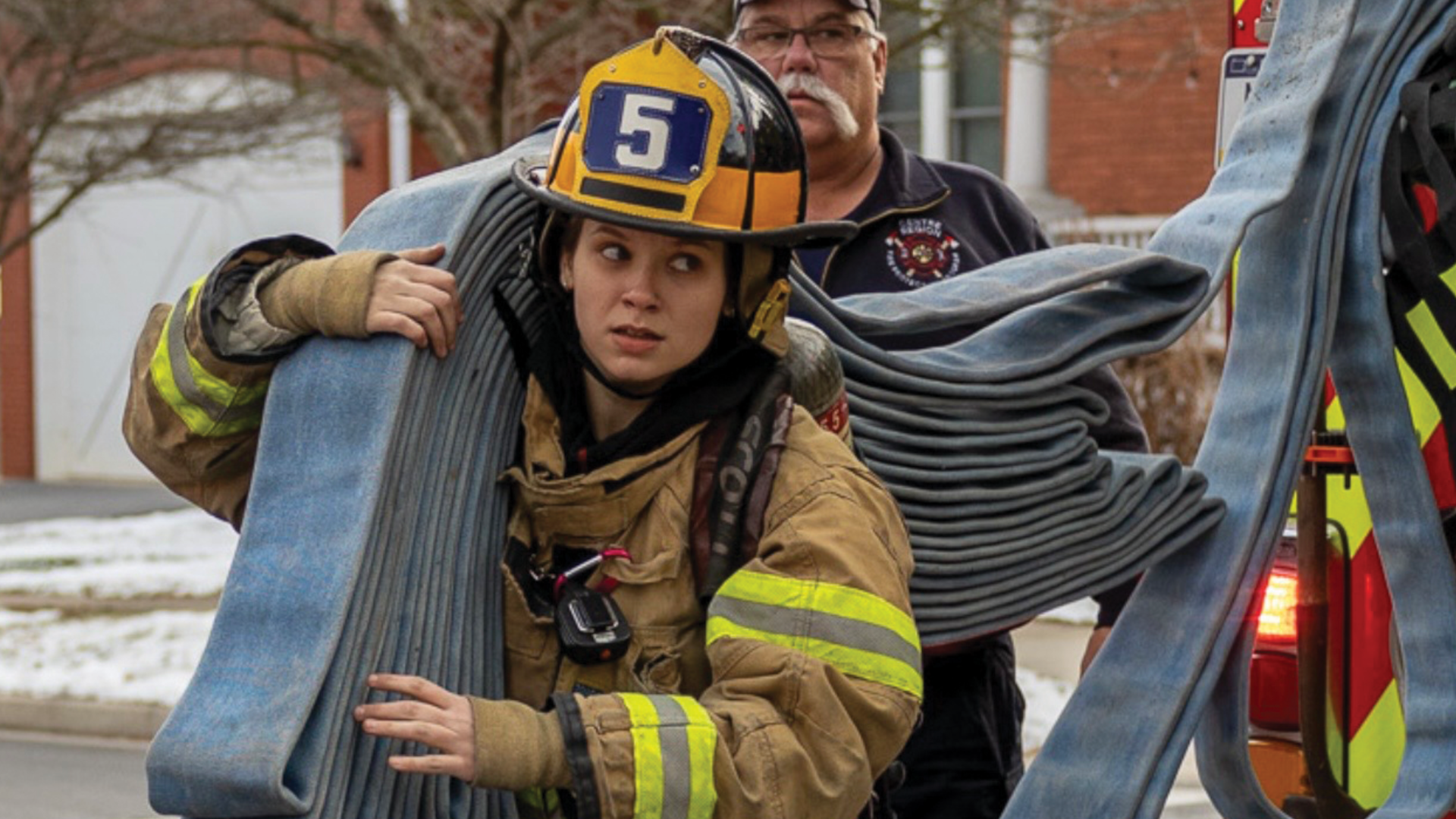
Twenty-one-year-old rescue lieutenant with Alpha Fire Company (and the first woman in her role as well) Kara Stover is one member of the next generation of Centre County’s women in public safety. In addition to being rescue lieutenant, she’s also a Penn State student pursuing a degree in psychology and criminology, with a goal of becoming a fire investigator post-graduation. Stover applied to volunteer with her hometown fire company at 16 and then applied at Alpha Fire Company once attending Penn State. Currently, Stover lives at the fire station and balances her course load with responding to fire calls, of which she and the rest of the volunteers often receive multiple per day.
Challenges and Advantages
Being a woman in public safety fields, and not just law enforcement, often requires working three times as hard to earn respect.
“A big hurdle for myself is knowing that I can absolutely do anything that a guy can. I have proved that to myself so many times already,” says Stover. “I don’t see myself as very different. … Yes, I’m a woman, but that doesn’t define who I am and what I can do. It almost feels like sometimes I have to prove myself more to other people, and as I’ve been in the company longer and longer, that has diminished.”
Larkin echoes the sentiment: “You really have to prove yourself, but also you have to walk this fine line of not coming off as aggressive. You can’t be weak, but you can’t be aggressive.”
That said, being a woman can also offer advantages. Under certain circumstances, patients and victims may feel more comfortable with a woman, or less intimidated than they might feel toward a man.
For example, Delaney notes, “Particularly working with students, I can bring a perspective to victims. I can sometimes bring that motherly perspective for folks that are transitioning from being in high school into the college environment. We all have strengths to bring to the table, and sometimes I feel like I have an advantage in that way.”
Likewise, Neideigh says, “There are some people … that don’t feel women should be in this career. They don’t want to take orders from women. I’ve only came across that a few times. Honestly, most people out in the field, when interacting with them, are actually more [open to] listening to me than a man.”
Taking the Leap
For women considering a role in public safety, “take the leap for sure,” Stover encourages. “The way I look at things, is if I were to try something new, I would much rather look back at it and say, well, maybe it didn’t work out, but at least I can say I tried.”
Botti advises others pursuing emergency medicine to focus on three things: self-care and wellness, competence, and essentially not becoming so absorbed in the seriousness of the role that the heaviness overtakes you.
“Keep self-care and wellness at the top of your list, because you and God are the only ones that are going to take care of you,” she says. “… Make sure that you put competence as your number one goal, because that will make you feel very comfortable in your own shoes, and it will exude professionalism. Then … always maintain a sense of humor. I think that’s really how I have gotten through my career, is with a great sense of humor. Life is short. You have to work hard but play even harder and last while you’re doing it.”
In a similar vein, many interviewees caution women to realize that, often, in public safety and service roles, a work-life balance is a lot harder to achieve than it might be in a typical 9-to-5 environment.
Larkin describes, “People don’t realize that our families sacrifice a lot. I’ve missed holidays, birthdays, and celebrations for promotions [or] retirements. … We don’t always get to tuck our kids into bed. We’re not always awake or there when they wake up in the morning. It’s a huge challenge for us to be present for our family, but also still really, really focus on the career at the same time.”
De Koning similarly shares, “Whether you run on an ambulance or you’re on the helicopter, it isn’t a 9-to-5 job. … You’re not guaranteed you’re going to get out at the end of your shift.” If a scene call comes in a few minutes before you’re slated to leave for the day, she says, you still have to answer it. The patient is the priority. “We all understand, when you go to work, don’t plan anything for after work. You’re not guaranteed you’re going to get out on time. Sometimes we’re out 14, 15, 16 hours later.
Wouldn’t Change a Thing
At the end of the day, despite the many challenges, those who’ve been in public safety for nearly the entirety of their careers say that they wouldn’t have chosen differently — not at all. They find immense satisfaction in serving the Happy Valley community. Certain moments and memories stand out, reminding them that what they’re doing matters immensely, even if those moments are quiet rather than dramatic.
Walters recounts one such instance, for which she received the honor of Non-Law Enforcement CIT (Crisis Intervention Team) Person of the Year.
“I took a call from someone who was having a bad day, and I was on the phone with that person for quite a while. We just talked about how they were feeling,” she says. “I was probably on the phone with that person a good 40 minutes, but … with my conversation and then sending first responders, that person was able to get the help they needed. Out of all the calls I’ve taken, that one stood out to me. It was nothing serious, but it was just talking to somebody that needed to talk to someone. It didn’t seem like a big deal at the time, but looking back at it, if I only helped that one person throughout my career, I feel like I made a big difference in their life that day.”
“That day, I felt like me being here was a good thing,” she sums up. T&G
Holly Riddle is a freelance writer for Town&Gown.



