
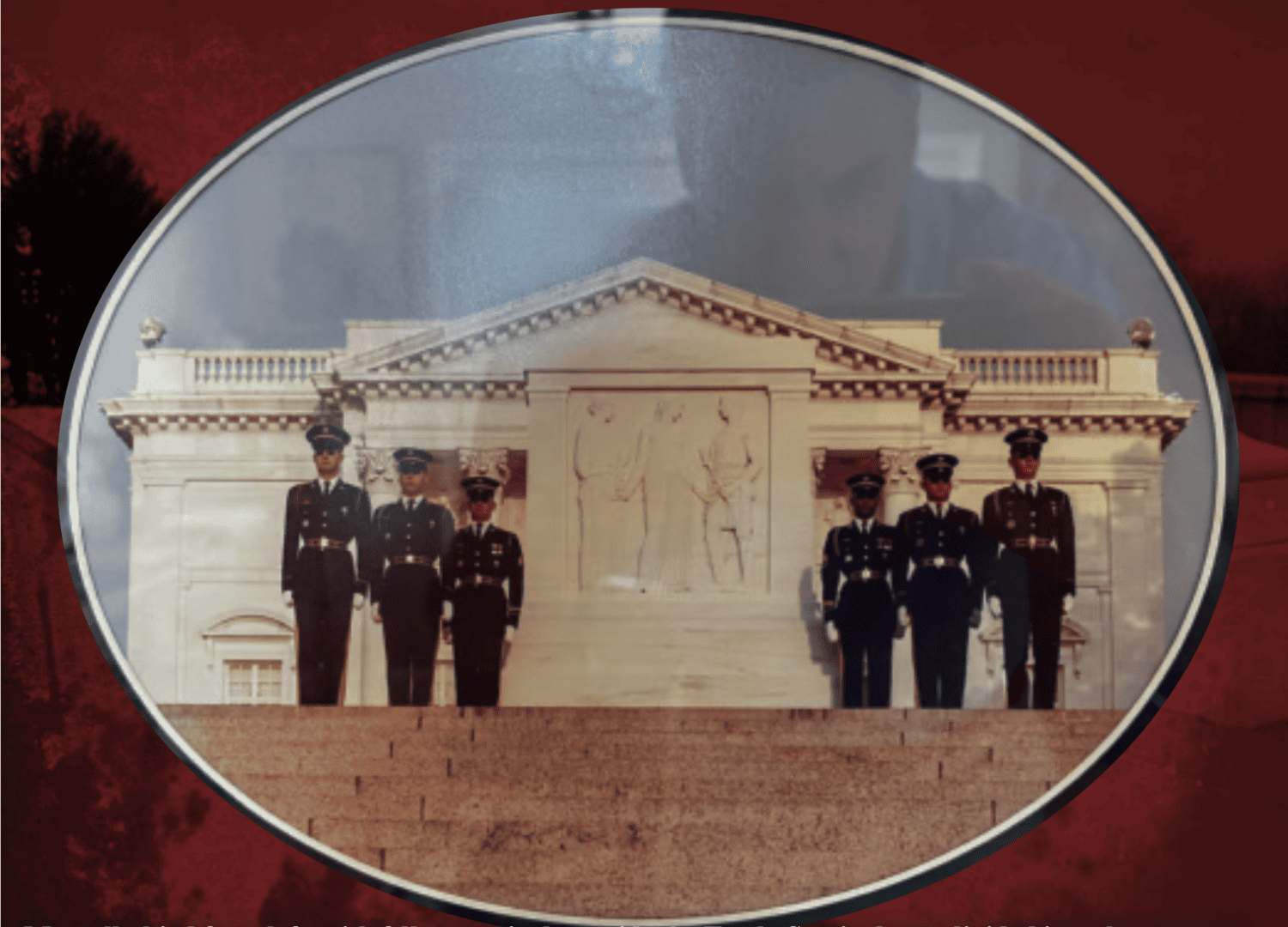
Decades after guarding the Tomb of the Unknown Soldier, Gerry Mansell continues to tell its story
One of Gerry Mansell’s earliest memories is of President John F. Kennedy’s funeral in 1963. As a 9-year-old, the “precision and respect” of the military honor guard “impressed me to no end,” he says.
That feeling intensified a few years later when his father, an accomplished musician, took him from State College to Arlington, Virginia, where his dad’s former teacher was commander of the U.S. Army Band “Pershing’s Own” at Fort Myer. The Mansells got to watch a military retirement ceremony and visited the Tomb of the Unknown Soldier.
“I was just completely floored,” Mansell says about the precision of the tomb guards.
Some 16 years after that visit as a sixth-grader, Mansell himself became a tomb sentinel.
“One of the proudest moments of my life was when my dad was there to watch me walk the mat at the tomb,” he says.
In the U.S. Army’s 3rd Infantry Regiment, the Old Guard, Mansell volunteered as a sentinel and then assistant relief commander from May 1982 to September 1983, earning Tomb Guard Identification Badge No. 259. With only about 730 issued since 1959, it is one of the least-awarded decorations in the military.
The majority of soldiers who begin tomb guard training are unable to meet the rigorous standards, according to the Society of the Honor Guard, Tomb of the Unknown Soldier. Those standards include maintaining uniforms with microscopic precision, mastering extensive knowledge of the tomb and Arlington National Cemetery, and demonstrating expertise in the weapon manual of arms — all while getting little sleep, with workdays for trainees that could last 30 hours.
“The uniform standards are incredibly exacting,” Mansell says. “There was no room for error, and we were very, very precise about positioning. The whole idea of that is, number one, we believe we represent the people of the United States in remembering the Unknowns’ sacrifice. But the other side of it, too, is that we don’t want pictures of tomb guards with things wrong on their uniform.”
Mansell says his biggest challenge was perfecting “the walk.” The sentinel walks 21 steps down a 63-foot black rubber mat at the tomb, then stops, turns, and faces the tomb for 21 seconds, then turns and faces north for 21 seconds before taking 21 steps back down the mat and repeating the process.
“The whole idea with the walk is you want it to look like you’re gliding. You don’t want to be bouncing and jumping with the weapon [an M14 rifle],” he says, demonstrating the process in his Bellefonte home. “To walk the mat at the tomb, it’s a push with your back foot, and then you lay the front foot down. It’s very quiet. The whole idea with the shoes, they have horseshoe cleats on the marble. The way you knew you were doing it right was you didn’t make any noise.”
While things have changed behind the scenes in the 40-plus years since Mansell was a sentinel, “I could go out there and do a guard change right now.”
Mansell enlisted in the Air Force in 1974, two years after graduating from State High. A member of the Air Force Honor Guard assigned to Bolling Air Force Base in Washington, D.C., he participated in ceremonies at the White House, the Pentagon, Andrews Air Force Base, and funerals at Arlington.
After attending junior college and working in real estate, Mansell realized he missed military service and enlisted in the Army in 1981. He retired from the Army in 1995 as a sergeant first class, going on to complete his degree in finance from Penn State’s Smeal College of Business.
Now retired from a career in the financial services industry, Mansell honors the Unknowns by sharing their story. He regularly teaches a class through the Osher Lifelong Learning Institute at Penn State and also volunteers to speak before community groups.
“It really is a way for me to continue to remember and give back,” he says. His genuine reverence comes with a sense of humor about military life. “Anything I can do to help remember the Unknowns and not have to shine my shoes, it’s all good.”
Here’s more from our conversation:
Is there a shift that stands out as particularly memorable for you?
Mansell: When Mom and Dad came down to see me, that was particularly incredible. [Mansell’s Tomb Guard Identification Badge is with his late father.]
It’s real life, and things happen out there. I think about the [shifts] where things happened that aren’t supposed to happen. When I was new, my relief commander would challenge me a lot. When I would come on post, he liked to stand as close as he could to me to do the weapons inspection. Because the catch is, if you drop the weapon, you’re done. You just take the weapon and you get downstairs, pack your stuff and go back to the company. If you drop the weapon on the plaza, no matter who it is, you’re done.
He would get really close to me. Well, one time he did this, and so I go up to inspection arms. He reaches up and grabs the weapon up toward the muzzle and takes it. When he did that, he hit the side of my face, knocked my sunglasses sideways, knocked my hat sideways. Normally he would have stopped and fixed it because we don’t want pictures like that. He couldn’t. He had the weapon.
Now, there weren’t a whole lot of people there, but this guy — we knew each other well enough, we could communicate without talking. And he was just like, “hmm, hmm, hmm, hmm” under his breath. He was laughing at me. So, when he gave the weapon back to me, when I went to order arms, I grab the weapon and I hit him. [He muttered], “You hit me.” Most of it is stuff like that.
You had incidents where you had to address somebody in the crowd of onlookers?
Mansell: We had one or two incidents a day. Eighty, 90% of the time, it’s either some little kid getting away from their parents under the chains, or generally, I found it was people who were foreign tourists who didn’t understand English. So, they didn’t understand necessarily what was going on, and they would, just out of not knowing, do things that [were disruptive]. Every once in a while, you’d have to challenge somebody. I had two incidents where I had to challenge.
One day it was very, very crowded. I’m walking the mat, and I see this little boy. He’s holding the rail. He’s probably four or five years old. And I can tell he’s coming. … So, I kind of held up my routine. And here he comes. I go to port arms and say, “Halt, it’s requested that parents keep their children on the outside of the rails.” The mom’s standing there, and she goes, “Jimmy!” And she snatches this kid up [and spanks him]. And I was like, “Oh, no.” So, when I came off post, I changed into my civilian clothes as quickly as I could and I ran out looking for this lady, just to say, “Please don’t beat your kid. Just keep him off the rails.”
The other time, I’m walking down the mat, and there were two young girls, probably 14 or 15. And when I would walk down, they would say things to me. “You’re cute. Why don’t you smile at us?” I listened to it one time, and when I came back and they said something else, I stopped and challenged them. I said, “Visitors must maintain a mature and reverent attitude while in the vicinity of the tomb.” Well, there was this collective gasp from the crowd. And these girls were like, “Oh my god, he can talk.”
What were you thinking about when walking the mat?
Mansell: It’s all counting in your head. Twenty-one steps, 21 seconds. When you’re doing your [arms] manual, it’s one, two, three, four. It’s almost like meditating because you do it so much. One day I was off duty. I was down at Springfield Mall walking around. And I’m walking down the mall, and all of a sudden I hear in my head, “71, 72.” I was counting my steps without even realizing.
Plus, you are keeping an eye on the crowd, and you’re being aware of what’s going on. It’s just that constant counting and keeping your cadence. You’re checking yourself all the time, (making sure) your weapon alignment is right. The sentinels who were off duty, we would go outside and we would watch each other and very quietly give corrections [with subtle hand signals to the sentinel on duty].
Are there any big myths about guarding the Tomb that you want to dispel?
Mansell: There’s this email that floated around about 10 years ago about tomb guards, and most of it was accurate. Our white gloves are cotton, and we would spray them with water. The cotton gloves are very slick. You wet them down to give you some grab on the weapon. That was true. But then there were things in there that a tomb guard can never swear for the rest of his life, can never drink alcohol for the rest of his life. Just ask the guys I play golf with, you know?
But your behavior while you’re a tomb guard is terribly important. A guy who trained me got a DUI, and he was gone. My roommate, when I first got there, bounced a check at the PX [Post Exchange]. Gone.
But even after [that service], the tomb guard badge can be revoked. And it has been revoked from 18 individuals that I’m aware of. So, there is a standard, but we don’t have to be saints. We’re not saints. We’re soldiers.
What does it mean to you to be one of about 700 who has the Tomb Guard Identification Badge?
Mansell: It’s very cool. There have been more human beings in space than have been awarded the Tomb Guard Identification Badge. You really feel like a member of a very exclusive organization.
When I was a drill sergeant, I had an Expert Infantry Badge and a Drill Sergeant Badge [on my uniform] — and I would tell my soldiers, “This is an Expert Infantry Badge. This means I am an expert at engaging with and destroying and neutralizing the enemy. This is a Drill Sergeant Badge. This means that I am an expert at training you how to engage with and destroy the enemy. This is a Tomb Guard Identification Badge. This says I look really sharp while I’m doing it.” They were afraid to laugh.
What would you like people to reflect on for Veterans Day?
Mansell: I think most people who’ve never been in the military really don’t have a sense of the sacrifice that active duty [service members] put in, [beyond] the dangerous working conditions and putting your life on the line. It’s long hours. It’s a long time away from family. It’s very taxing on families. My year in Korea, out of my platoon, I think there were 12 or 15 guys that were married. You couldn’t take your wife with you, so they were back in the states. Not one marriage made it. Everybody ended up getting divorced.
Remember the families and their sacrifice and what they did. … The separation is very, very hard on families. Just keep in mind that the families are also serving in their own respect. T&G
Gerry Mansell is scheduled to present his next OLLI class on the Tomb of the Unknown Soldier March 8. Visit olli.psu.edu for more information once spring semester signups are available.
For information on inviting Mansell to speak before a community group, contact the author at mbrackenbury@barashmedia.com.
Mark Brackenbury is a former editor of Town&Gown.


