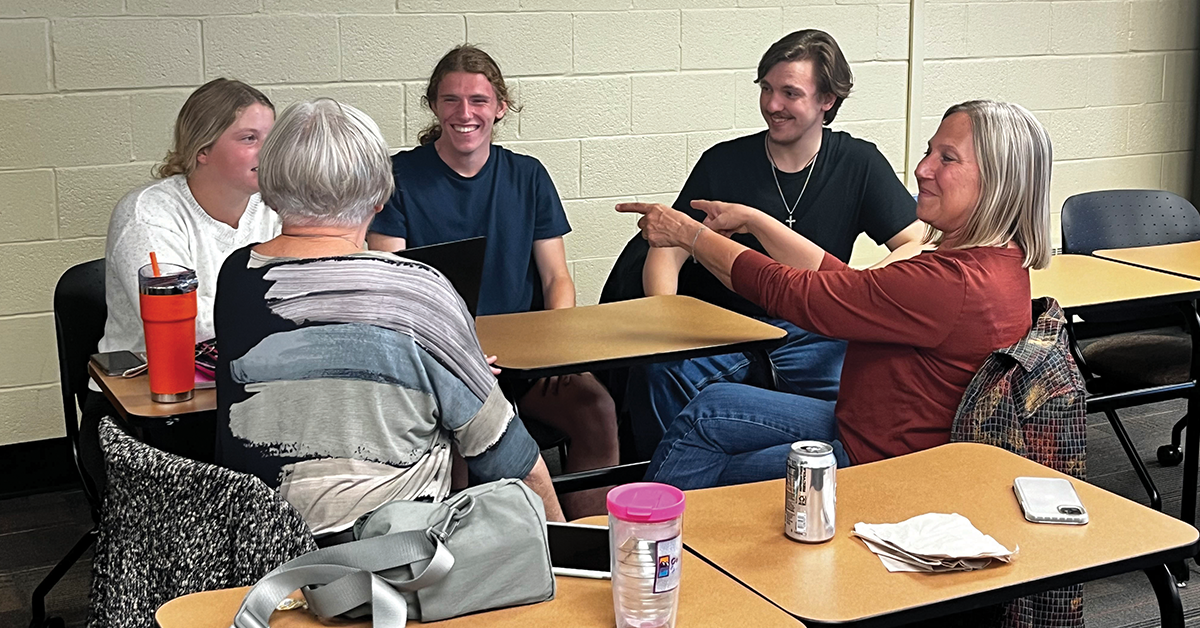
Efforts emphasize research, education, and intergenerational collaboration
Age is just a number. But Penn State and State College Borough aim to make it irrelevant in some ways and a bonus in others.
Since April 2024, Penn State has been part of the Age Friendly University Global Network, an international group of more than 110 higher education institutions committed to promoting positive and healthy aging and enhancing the lives of older members of the global community.
“This needed to be a designation for the entire university,” says Brynn Rousselin, executive director of the Osher Lifelong Learning Initiative (OLLI) at Penn State. She says although the program designation technically resides with Penn State Outreach, it was critical all colleges and most business units of the university be involved. “Being an Age Friendly University aligns very nicely with our commitment, being a land-grant university, to fulfill the needs of the residents of the Commonwealth of Pennsylvania,” Rousselin adds. The Age Friendly University (AFU) framework encourages members to provide access for older adults to participate in core university activities, including career development, the pursuit of master’s or doctoral qualifications, research, cultural events, and health and wellness activities. The Tressa Nese and Helen Diskevich Center of Geriatric Nursing Excellence in the Ross and Carol Nese College of Nursing and the Penn State Center for Healthy Aging, along with OLLI, led the effort to earn Penn State this designation. The head of the Center of Geriatric Nursing Excellence believes this designation aligns perfectly with her center’s goals, and those of the Center for Healthy Aging.
“All three of these units focus on the quality of life of older adults, and ways to include older adults in our essential mission of education, research, and service, so we all had a real passion to get this recognition at Penn State,” says Janice Whitaker, the Center of Geriatric Nursing Excellence’s director. Whitaker prepared a spreadsheet of the ten AFU principles, and identified four to be the focus of the effort at Penn State. These are:
1. Recognizing the range of educational needs of older adults, from those who didn’t finish high school to postdoctoral work;
2. Intergenerational learning to bring together different age groups to learn from each other;
3. Online educational opportunities to increase access;
4. Engaging with the university’s own retired community, including both retired employees and alumni.
The leaders of Penn State’s Age Friendly effort also identified two other principles as goals for the next five years. One of these is making sure the university’s research agenda meets the needs of an aging society.
“This means getting more older adults involved in the university’s research,” Whitaker emphasizes. She adds the Center for Healthy Aging already makes a point of including older adults in its research projects, but that’s not true of all of Penn State’s research units.
The other goal is to enhance the range of health and wellness programs, as well as arts and cultural activities for older adults. In other words, it’s more than academics.
“We aren’t focused on making sure that older adults are coming back to campus to attend classes,” says Kris Struckmeyer, Ph.D., the project director of the Age-Friendly University Initiative at the Center for Healthy Aging. “We are looking to make the university more age inclusive for every single aspect that we have, such as athletics, the theater, even parents and grandparents visiting students.”
Recruiting older adults to be part of research is one thing, but the findings of this research then need to be taken to the community. Programs are being presented in retirement communities throughout the area, with information gained from the research, to help improve the quality of life for older adults.
One way Penn State is implementing this idea is helping families dealing with dementia. This is a joint program through the Center of Geriatric Nursing Excellence and the College of Medicine.
“The program is called ‘Living with Dementia’,” Whitaker says. “We do community education for informal care partners of people living with dementia. We also offer a ‘memory café’, and in the memory café, our undergraduate nursing students partner with older adults living with dementia in creating artwork and other engagement activities.”
The nursing students also provide respite care for family members who can then attend the education programs.
The Center for Healthy Aging has created a program called Research PALS, standing for participation across the lifespan.
“This is a database of people, particularly older adults, who have volunteered to be part of an assessment of aging. These folks agree to answer surveys or otherwise participate in research on the effects of aging,” says Struckmeyer of the Center for Healthy Aging.
Penn State OLLI has partnered with an emeritus faculty member to create a program called Art Speaks.
“We will be bringing together OLLI members and undergraduate students to have conversation using arts as the vehicle,” Rousselin says. “We’ll be working with the Center for Performing Arts, the Palmer Museum, The Arboretum, and Shaver’s Creek to find ways to break down barriers and build relationships across generations.” Rousselin adds working with art can also help identify possible cognitive issues in older adults. But, she says, there’s a benefit for students, too. “We hope to provide our undergraduate students with skills to make them successful after they leave the university. Many of our students don’t have the ability to interact with older generations, and that’s needed as we now have up to five generations in the workforce,” Rousselin says.
Struckmeyer notes the older adults have been enthusiastic about being part of developing where Penn State is taking the Age Friendly University concept. He agrees the older folks often provide benefits for students.
“We brought in older adults to be co-instructors in classes, not just to talk about what it’s like to be older, but, for example, they can talk about what it’s like to be a manager.”
Struckmeyer notes another example of crossgenerational benefit is when older people helped students design an accessible art exhibit.
He adds older adults love intergenerational activities, and students get a greater understanding of aging and older adults, including how active many seniors are.
“A lot of undergrads think older adults are just sitting at home waiting for an email,” Struckmeyer says. “Students may offer Tuesday at 10 (a.m.) for an intergenerational activity, but the older adult will say, ‘I can’t do that, I have something. Here’s my schedule, I can fit you in Thursday.’ The students are amazed at how active many seniors are.”
While Penn State has already received a designation as an Age Friendly University, State College Borough is just beginning to explore the idea. “I have friends who live in some of our retirement communities, like Foxdale and The Villages,” says Mayor Ezra Nanes, emphasizing that while Penn State students make up a large part of the greater State College population, this area is increasingly a retirement destination. “In fact, my own mother, Alice, just moved from New York City to Village Heights.”
Nanes believes Penn State’s already being involved in this endeavor will help the borough as it considers whether to formally seek the Age Friendly City designation. He says because the populations of the university and town overlap so much, this could help town-gown relations.
The mayor hasn’t looked in depth at specific ideas yet, but hopes to get the idea on borough council’s agenda for initial consideration within the year. He believes this could include a presentation from Penn State.
Nanes thinks there are several ways becoming an Age Friendly City could benefit older residents.
“We have to make the community accessible for all people,” he says. “Having accessible sidewalks, areas where people can walk safely, making sure language on the borough website is easy to understand, having different ways for residents to access meetings, whether in person or on Zoom, allows everyone to participate in civic life.” Whitaker of Penn State also brought up the exact idea of how safe sidewalks cross generations. Her grandson, Cole, fell riding a scooter when he hit an uneven spot on a sidewalk, and only felt comfortable after that riding on flat sidewalks. “So if we make a sidewalk safer for older adults, we make it better for everyone,” she says. She believes the university and borough can integrate their efforts and looks forward to meeting with the mayor.
As Penn State moves deeper into its role as an Age Friendly University and State College Borough takes its first steps toward the Age Friendly City designation, leaders from both groups agree involving everyone is key.
“We must include older adults in determining what they need,” says Rousselin. “High school and college students can be a part of saying we are making this an age friendly community,” Nanes adds. “What a joy that would be.” After all, as they say, age is just a number.
For more on Penn State’s Age Friendly University designation, including an interest form to learn more or get involved, visit outreach.psu.edu/about/age-friendly university/?utm_source=pennstatenews&utm_medium=newsstory&utm_campaign=agefriendlyuniversity&utm_term=anouncement T&G
Ron Ruman is a freelance writer, Centre County native, and Penn State grad who lives in York.