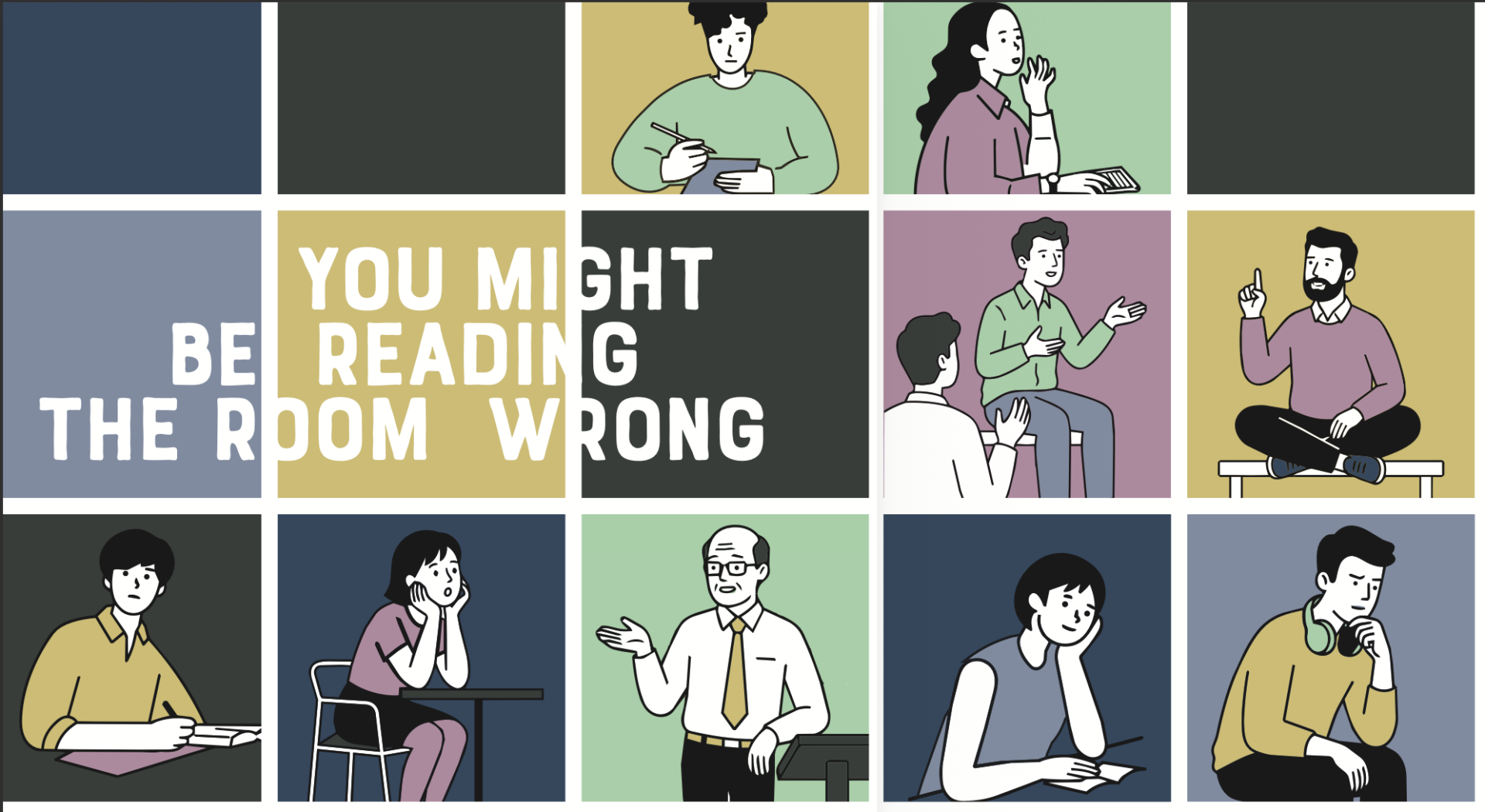
Researcher Laura Feibush explores how people communicate attention through gestures, body language and digital behavior.
By Matt Farley
According to Laura Feibush, Ph.D., listening is not simply hearing the words someone is speaking; it can also encompass a wide range of physical expressions that reveal how much — or how little — people are paying attention to each other. Feibush explores this idea through a concept she calls “gestural listening” in her new book, “Gestural Listening in and Beyond the Classroom.”
Feibush is an assistant professor of rhetoric and composition at Penn State Harrisburg, and her interest in how people listen began as a graduate student at the University of Pittsburgh, where she had an experience that challenged her expectations.
“I was teaching for the first time, and I started noticing that some students listened in a really responsive way; I could really see them listening,” says Feibush. “On the other hand, I noticed that some students’ body language was a lot more self-contained. I felt as though I didn’t necessarily know what was going on with them.”
She noticed one student in particular who was very quiet and still, demonstrating little body language to indicate he was paying attention to lectures.
“I decided that maybe this student didn’t really care about my class and was checked out. But then, some weeks later, when we had the opportunity to have a one-on-one conversation during my office hours, he really proved me wrong. The questions he was asking showed me that actually he had really been listening very closely in the classroom. I was surprised by that, and I noticed how I made this misjudgment about the student that was overturned later, but it was based on his gestural listening.”
“Gestural listening,” a term coined by Feibush, refers to the physical manifestations of the way people choose to demonstrate the act of listening.
In a classroom, this could include a variety of actions and decisions, such as whether or not a student makes eye contact, where in the room they choose to sit, what they may do with their hands, their posture, and a number of other behaviors, both big and small. Many of these actions may be subtle or lead to assumptions that are incorrect, as Feibush discovered during her early days of teaching.
“That moment really opened my eyes and made me want to think more about what’s going on with how different students show their listening differently and how teachers can become more aware of the range of listening behaviors in the classroom so that they can avoid the type of misjudgment that I made,” she says.
A component of Feibush’s research for her book involved a study where she used a few different data-gathering methods to learn more about the ways in which students exhibit gestural listening.
“I started with a survey that I gave to a certain number of students, and then I actually filmed classroom sessions, and I was able to look back on that footage and really observe closely what the students and the instructor were doing and how their interactions played out. I followed up with some interviews, and this really allowed me to get a lot of depth and insight because I was able to hear from them what was going through their heads in the moment,” she says.
This study and subsequent research led to findings that Feibush hopes will change how readers think about listening, both in and out of the classroom.
“Listening doesn’t always look like what we expect it to look like,” explains Feibush. “And listening can look different when it’s done by different people. Oftentimes, when a teacher or other authority figure says, ‘Hey, listen,’ what that really means is, ‘I want you to do what I’m telling you to do.’ Because of this, we kind of expect listening to look like obedience or cooperativeness, but sometimes listening doesn’t look that way.”
As for examples of what good listening actually looks like, there is not a single fixed answer. In fact, how one person chooses to actively listen may be completely different from someone else.
Feibush says, “For some people, good listening can look like nodding and giving a lot of nonverbal responsiveness. For other people, good listening can look like taking really detailed notes and trying to record as much information as possible in order to do something with it later. And for other people, good listening looks like taking action after the conversation based on what was said. So they might not do a lot of nodding or give nonverbal feedback in the moment, but for them, the actions they take afterward show they were listening.”
Given the way modern tools such as smartphones and video conferencing have transformed how people communicate, Feibush focused part of her research in the book on the impact of technology in the classroom as it relates to listening.
“When every student has a phone or a laptop, there are some interesting things that happen. Oftentimes, when someone is looking at a device, it creates some uncertainty in the people around them because it’s not clear how much that person is mentally present in the situation.”
Feibush notes that while a person looking at a device may not be listening to what’s happening around them, they could be intently engaged in a conversation that’s happening halfway around the world. This adds an extra layer of uncertainty in classroom environments, where teachers may be unsure if a student is simply using a device to aid in listening by taking notes, or if they are tuned into a completely unrelated corner of the internet.
“There’s a need to kind of suspend judgment. We don’t know if people around us who have a device may be mentally present, whether they may be doing something else entirely, or they may be doing a mix. It even creates a little bit of mystique because if you are on your phone, one of the implications is that you have people who want your attention elsewhere.”
Some people who feel anxious in social situations may even use devices as a defense mechanism to add a layer of protection around them, and Feibush found that some younger students feel like they’re actually being polite by looking at their phones because they’re lessening the pressure on other people around them to strike up a conversation.
The book also looks at how listening changes in digital environments.
“Being physically present in a situation where communication is happening really adds so much nuance and so many dimensions to that communication. There are subtle but powerful things like body language, eye contact, and the volume of somebody’s voice, which really change and sometimes go away completely when we communicate through a screen.”
This may contribute to Zoom fatigue, the mental exhaustion that many people experience after spending hours of their day in virtual classrooms or meeting spaces.
“What I see emerging is that people need to work harder to read the cues that would be given by in-person dimensions like aspects of gestural listening,” explains Feibush. “When we’re on Zoom, we have to fill in so many of the subtleties of body language that get lost over a video call, which can actually create a more tiring experience. We also tend to amplify our gestural listening behaviors when we’re using video conferencing software to communicate. We’ll nod or try to make eye contact a little bit more, or we’ll put special effort into really staying centered in the camera frame so that people we’re Zooming with know that we’re there and paying attention. All of that is actually extra gestural listening effort and energy, and that’s fatiguing.”
If you’re interested in the concept of gestural listening but you don’t plan to spend any more time in a classroom, the book might still be relevant to you. As Feibush explains in the book, gestural listening dynamics can be present in many different scenarios and environments, including meetings, protests, and congregational settings, with one of the specific examples in the book discussing how gestural listening shows up in community singing.
In terms of putting all of these ideas together in a book, Feibush has some advice for anyone who may be interested in doing their own research about a specific topic.
“It’s a good idea to start taking a look at what else has been published about your area of interest so that you can have a better sense of the conversation that’s already going on. If you’re able to get a really good sense of the field and what has already been said by other people, that may clarify what your own personal contribution could be. You want to be able to offer a little slice of something that adds to and enhances the ongoing public conversation about the topic. I found that very clarifying because it helped me see where exactly I could contribute more specifically.”
“Gestural Listening in and Beyond the Classroom” is available now from the publisher and major booksellers. Learn more at upcolorado.com/utah-state-university-press/gestural-listening-in-and-beyond-the-classroom. T&G
Matt Farley is a freelance writer in State College.