
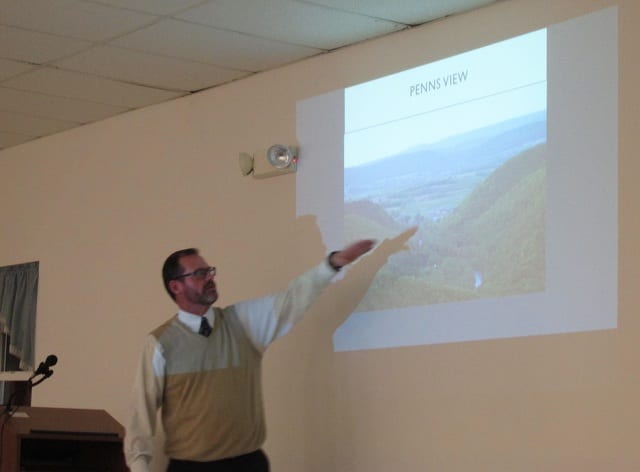
DSPRING MILLS — The Penns Valley Historical Museum held a history dinner meeting Jan. 11 at New Hope Lutheran Church featuring speaker Martin Tobias, a Penns Valley High School teacher who presented an overview of the history and development of Penns Valley.
Tobias, who teaches a course on the area’s history at the high school, said water was very important to the early settlers in the valley. Elk, Sinking, Pine and Penns creeks all run through the valley, and were necessary sources of power to run mills.
The valley’s first occupants in the late 1700s were farmers, taking advantage of the availability of water and the fertile farm land, most of which had been cleared of trees, possibly by Native Americans. The first buildings erected by farmers were houses, with the earliest examples being single story dwellings.
“The earliest farmers would not have had help to make two-story buildings,” he said. “They (the houses) were made of small logs that a man and his wife could stack up to build themselves a home.”
Later, two-story homes were made with help from neighbors after communities were established in the valley.
According to Tobias, the next structures to appear were mills for processing grain and sawmills for making boards for home and furniture construction. He showed photos of many mills still standing in Penns Valley, and said the last water-powered mill in Pennsylvania was Rote’s Mill, near Coburn. Water-powered sawmills included some in Poe Valley, which contained a nearly endless supply of trees for a logging industry.
Once the mills and small towns were established, roads were built to connect them. Tobias mentioned that several tollhouses were built to recoup some of the expense of building the roads.
According to Tobias, Aaronsburg was the first community established in Penns Valley, and others soon followed.
Tobias also pointed out the importance of the railroad in helping Penns Valley grow.
“The railroad opened up Penns Valley to the rest of the country,” he said.
The Lewisburg and Tyrone branch of the Pennsylvania Railroad laid tracks through the valley in the mid- and late 1800s. Tobias said the original plans called for the tracks to follow Brush Valley, but were altered to go through Penns Valley because there were more communities and water sources there. Train stations were erected in Coburn, Spring Mills (called Rising Springs) and Centre Hall, and there was a small station used only 10 days a year for the Grange Fair.
The Civil War interrupted construction of the railroad, and it was finally finished in the mid-1880s. The railroad fostered many industries in the valley by providing a convenient means of shipping raw materials and finished products. Tobias said the railroad made Coburn the most important town in the valley in the 1800s. It was also a port where farmers’ produce was loaded on rafts and floated down Penns Creek to reach large markets near the Susquehanna River.
Tobias spoke of the many hotels and taverns in the valley, noting that the Millheim Hotel is the oldest existing business in Penns Valley, having been operating since 1794. He said the Woodward Inn, built in 1814, had many famous guests throughout its history, including Thomas Edison, Fred Waring and actors Cornell Wilde and Ronald Reagan.
More Arts & Entertainment
View all Arts & Entertainment
‘Rock the ’80s’ Benefit Concert Set to Return to State Theatre
2023's "Rock the '80s" concert will mark the annual fundraiser's first in-person event since 2019.

Your Vote Could Help Bring a Free Outdoor Concert Series to State College
You can vote by visiting levitt.org/vote or by texting 866-267-2023 and using the keyword "STATECOLLEGE".

Happy Valley Cornhole tourney returns
STATE COLLEGE — The second Happy Valley Cornhole Tournament will take place on Sunday, April 5 at the American Legion’s Post 245 location at 1950 Pine Hall Road in […]


