
“In like a lion, out like a lamb” is a familiar proverb used to describe weather during the month of March. As the transitional month between winter and spring, the use of lion (for winter) and lamb (for spring) seems appropriate.
Some believe the phrase was created by Pennsylvania farmers sitting around the fire, talking about the weather and planning for the spring planting. In an agricultural state, it would be no surprise to learn that these words could be attributed to Pennsylvania’s early farmers and herders.
NITTANY LION COLLECTIBLES
Using this proverb as inspiration, let’s look at one of Pennsylvania’s most famous lions, the Nittany Lion, and Nittany Lion collectibles.
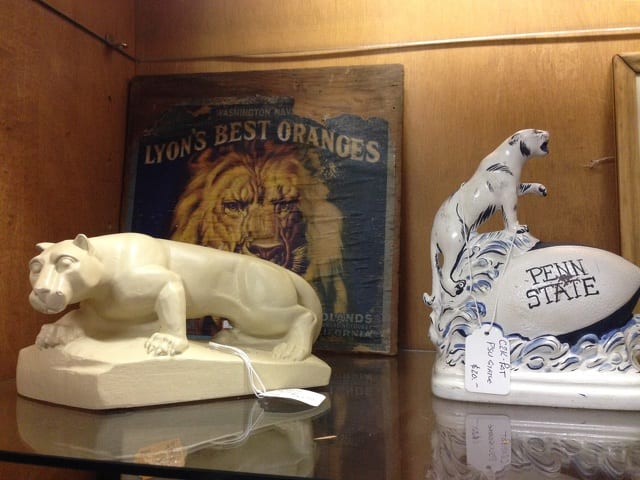
Antique shops in the central Pennsylvania region receive many visits during football season from Penn State alumni and others who are avid collectors of Penn State sports items, with Nittany Lion images among the most sought-after.
Many collectors know that the Penn State lion image has changed significantly over the years, and they have their personal favorites. While the first image was conceived in 1907 by Penn State alumni and then adopted by Penn State, one of the most familiar and iconic images is that of the mountain lion on the stone mound created by renowned sculptor Heinz Warneke in 1942 and seen near the Nittany Lion Inn.
Several graphic depictions have been created over the years for Penn State, Penn State sports and other purposes. Penn State introduced a new lion image recently that is visible throughout the Penn State system and the commonwealth. These images, and their availability once each new logo is introduced, affect scarcity and collectability.
The Nittany Lion, whether as a sculpture on a clay or stone statue for a desk, or a graphic image on a poster or athletic program, sports jersey, jewelry or football buttons avidly collected by Penn State’s football fans, remain popular with collectors.
One useful guide for those collecting Penn State football game day buttons is the “Penn State Football Button Book” by Martin Ford and Russell Ford, published in 2004. A quick Google search will provide a number of websites on Penn State collectibles.
LAMB COLLECTIBLES
Still in Pennsylvania, and anticipating spring, takes us to lamb collectibles.
Lambs are a well-known spring and Easter image. These youthful creatures are often found on children’s tea sets, hankies and dinnerware. Stangl offered a particularly collectible line of children’s plates and mugs and nursery rhyme ware (“Little Bo Peep”) that are popular with collectors of both children’s items and mid-century dinnerware.
The “Little Bo Peep” pattern was produced specifically to appeal to children and discontinued in 1953. It features sketches of this storybook character in a pink dress on a white background, with pink and yellow bands painted on redware plates.
Lambs are also found on the “barnyard” patterns in what Stangl called “kiddieware.”
Toymakers Steiff, Dakin and others have created a number of stuffed mohair lambs that also are popular with collectors.
Collectors of antique and vintage porcelain are familiar with the British and American potteries that have manufactured porcelain and china lamb figurines, with the Staffordshire lambs among the best known and sought-after by collectors of antique porcelain. Figurines have been manufactured by many familiar firms, including Royal Doulton, Beswick, Eschenbach, Schaubach, Bing & Grondahl and Boehm. These vary in price depending on scarcity and condition. Consult any of a number of collectors guides on vintage and antique porcelain for price ranges and condition information.
Also popular are putz sheep and lambs often collected for inclusion in Christmas creches or other holiday scenes. Originating in Germany, a putz was a Pennsylvania Dutch miniature landscape that included handmade structures, figures and animals made from a combination of materials including paper, wood, fabrics and wool, among others.
EASTER COLLECTIBLES
And, of course, lambs are a major Easter collectible, whether on postcards and greeting cards, candles, period honeycomb Easter decorations, candy containers or metal candy and butter molds.
Many collectors seek the tin candy molds, which were made in a range of sizes and are available in most antique co-ops. The larger molds are among the most popular for both Easter and country/farmhouse collectors. Cast-iron molds made for clear barley candy are sought after and difficult to find. Some of the tin lamb molds were also used to create lamb-shaped cakes and lamb butter molds for the Easter table.
Whether a lion or lamb collector, enjoy the month of March. Happy spring!
Lee Carpenter is a dealer at Apple Hill Antiques in State College.
More Business
View all Business
New Multi-Roaster Coffee Shop Third Planet Opening in State College This Fall
A longtime State College resident and coffee expert is preparing to open a new downtown shop centered on a rotating selection of light-roast, single-origin coffees from roasters across the country. […]

Bottle Shop Expands With New Blue & White Pub in Downtown State College
What began as a plan to purchase and renovate a longtime West Beaver Avenue bottle shop has grown into a new pub six years later. The Blue & White Bottle […]
State College Teen Turns Passion for Card Games Into New Downtown State College Business
Just over a year after graduating from State College Area High School, a 19-year-old entrepreneur is preparing to open a new trading card, tabletop and retro gaming store in downtown […]


