
In just over a week, Penn State will take the football field with a new head football coach when Matt Campbell starts his first season on the Nittany Lion sideline. It is a time of renewed hope and optimism in an era of massive uncertainty in college football.
Sixty years ago, the new head football coach took over at a time that was very different. In a file for the 1966 preseason camp, there were things outlined that needed to be done. There were coaches assigned to do room check every night. Penn State was on the quarters system back then, so they were in preseason camp a lot longer.
Two of the assistant coaches were assigned to paint the practice field lines. The coaches’ offices were still in Rec Hall, and the assistant coaches all had desks in a common room. That room was generally filled with cigarette smoke. Cigarettes and coffee fueled long hours of film study and meetings.
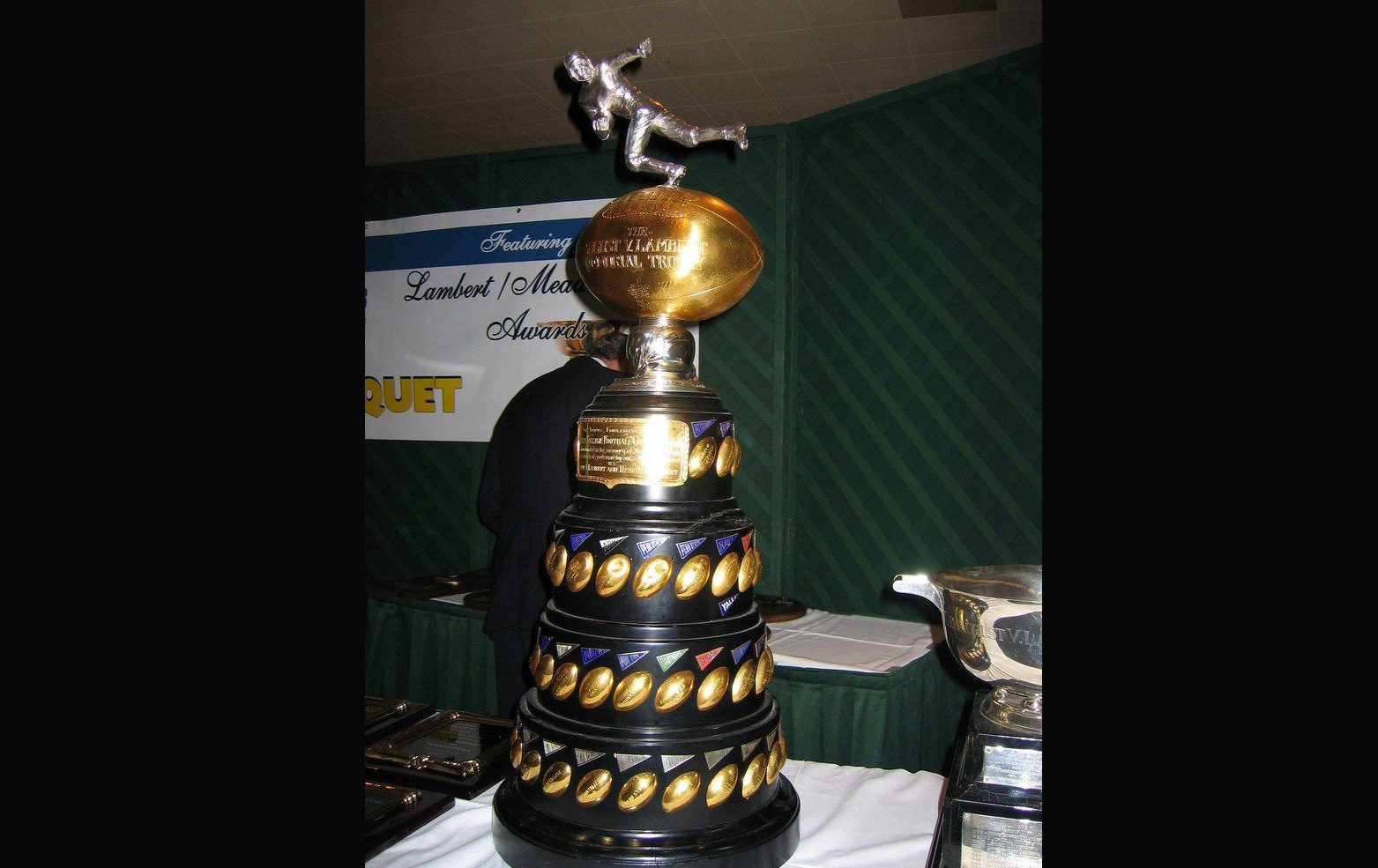
In the staff room a blue felt banner hung recognizing Penn State’s Eastern Championships. With Penn State and many other eastern schools being independent, the Lambert Trophy was the equivalent of a conference championship. Much like the Stanley Cup, the Lambert Trophy only resides with the winning team for one year. And like the Stanley Cup the trophy had rings where a football and small metallic pennant with the champion’s name would be added each year.
In 1966, there were eight assistant coaches, a receptionist, a film guy, an equipment manager, some student managers, a couple of graduate assistants and not much else in the organization. Freshmen were ineligible so there was a freshmen team, which was coached by Earle Bruce.
When that new head coach was given the job in the winter of 1966, there were no agents in the room, no contracts. The university president offered the new head coach about $20,000 per year on a handshake deal that seems both quaint and naïve in the cutthroat world of college sports now.
The first game of a 10-game season wasn’t until mid-September when the students had returned for classes. There were still Saturday morning classes, and some players attended classes before walking to the game.
The athletic department was part of the physical education department, and many of the coaches, including the new head coach, were tenured faculty members who had taught physical education classes.
In 1980, after three undefeated seasons and 10 Eastern Championships in 14 years, a building for football offices,the Greenberg Indoor Sports Complex, was completed next to the practice fields. That building included an indoor practice field, indoor track and a new ice rink.
The money for the new facilities was raised privately, which was a dramatic change for Penn State. Before that, campus buildings were built with state funding, which created a lag between the design and completion of projects. Six years later, more fundraising enabled the completion of Holuba Hall, another indoor practice facility.
From 1966 through the late 1980s, change came pretty slowly to the college game. But the decade of the 1980s changed things in rapid succession. The Supreme Court decentralized control of television rights. The January 2, 1987 Fiesta Bowl between Penn State and Miami was a made-for-TV matchup made possible by a jump in rights fees to create a de facto national title game. Memories of that massive game hung over the sport until the creation of the BCS Championship Game, which yielded to a true playoff.
By the end of the decade, Penn State broke years of precedent as an independent and announced they were accepting membership in the Big Ten. That triggered the first wave of what has seemed to be an unending 3+ decades of conference realignment.
Penn State played three more seasons of football before joining the conference in 1993. And it only happened that “soon” because Penn State started scheduling Big Ten teams like Iowa and Michigan State on their own for the 1993 season.
Fast forward to 2021 and the passage of the California law allowing Name, Image and Likeness (NIL) changed college sports forever. As rapidly as AI has changed technology, it’s got nothing on the pace of change in college sports these past five years.
In just a few years we’ve gone from laws allowing more modest NIL deals to revenue sharing. Some football teams’ payrolls now top $40 million or more. Where we once had a staff of 20 or 25 people, go to a practice or look at a team photo and you may see as many as 80-90 staffers for the team.
College teams have general managers evaluating the value of current players, recruits and possible transfers while balancing a payroll. And they must get donors to fund that payroll, while also searching for NIL dollars.
There are scouting departments to evaluate both high school players and possible transfers from other college teams. AND if a current ruling is left standing that allows NFL players who get cut to return to college, they may have to start scouting NFL rookies in preseason games.
All change is not bad, and all change is not good. But it’s no secret that much of this light-speed lawless change needs to be legislated from Washington. The game and, indeed, all college sports need the legal protection that only the Protect College Sports Act can provide.
Why? College sports does not have a revenue problem, we have a spending problem.
Despite a dramatic increase in revenue, college sports operate on razor thin margins or large losses. In many cases schools are taking tuition dollars, tax dollars, student activity fees and donor dollars to simply meet each year’s annual payroll.
It has put schools in an awkward position where the athletic department’s fundraising operation is competing to get donors to pay millions to players; money that might otherwise go to the academic mission of the campus.
Senators Maria Cantwell and Ted Cruz have both expressed concern about how the runaway spending might start to negatively impact the academic mission of our universities.
That is the current reality.
One would be willing to bet that, given a dose of truth serum, even the youngest, most aggressive coaches in the game would admit that the days of eight assistant coaches and being assigned to line the fields might be a lot more fun than negotiating with agents over vast sums of money.
But for now, as the days grow shorter and the evenings grow a tad cooler, the joy of games and competition is nearing. No matter how much we may not like the current chaotic system, perhaps the stories we read this fall will be mostly the epic tales of noble efforts of players competing on the field. Here’s to reading the stories of not only those who won, but those who were valiant even in defeat and left it all on the field, exhausted from the effort.
College football is, after all, the most American of American sports. And time after time it has been a true reflection of each era’s society and values. This era is no different.
Starting this weekend, for 60 minutes of football each week, let’s look at our favorite team and simply relish the competition. Let’s get lost in the spectacle of the sport, the bands, the pageantry and the back and forth of young men in the unscripted drama that is revealed play after play.
As much as the fans want to get lost in the games themselves, no doubt the coaches and players want to allow the adrenaline rush of elite competition to take over their minds, bodies and spirits as well.
That new head coach in 1966 used to say “On Saturday afternoon, we stand on the sideline awaiting the kickoff and look across the field at a worthy opponent. They look back at us and we say “Let’s go, let’s see what you’re made of and see what we’re made of.”
In just over a week the journey begins.
More Columns
View all Columns
Frank: To My Sister, on Her Birthday
Today is my sister Meryl’s 80th birthday. I could wrack my brains for the perfect gift idea, but when you get to be as old as Meryl is, and you’ve […]

Paterno: Upcoming Impact Award Honorees Represent ‘the Very Best of Penn State’
Penn State is the nation’s leading service-oriented university, a school where philanthropy and helping others is part of our DNA. That commitment is university-wide, including a long history of service […]
Penn State Coach Matt Campbell: ‘We Still Have a Lot to Prove’
Most of the 2026 Penn State football roster has been here before. “Here” is not a good place to be. “Here” is a three-game losing streak, as the Nittany Lions […]


