
When I arrived at Penn State in the fall of 1977 as a 17-year-old – what is now referred to as a “first-year student” – I moved into Beam Hall in the North Halls dorm area. North Halls was, and is, the smallest dorm area on campus, and at the time it was the primary location for Penn State’s “Interest House” living option, which was how I got placed there.
Interest Houses were offered as an option ostensibly for academic purposes, but to many of us students it was “interesting” mostly because it was the only coed housing on campus – where women and men shared a dorm floor. Most dorms at that time were single-sex buildings, so women and men in the same building, let alone the same floor – albeit separate wings – was a unique situation.
At the time, North Halls had only four dorms, each only four stories tall, and was a world apart from the rest of campus. It was bordered by parking lot 80 to the east; Hort Woods to the west; tennis and basketball courts and all of campus to the south; and quiet Park Avenue and single-family neighborhoods to the north. Including the home of the head football coach.
In those days Park Avenue did not go straight through to the far east side of campus, and outside of home football games was mostly a calm street. Instead, as Park Ave. went east from Atherton Street and passed East Halls, it curved to the south and became University Drive. The remnants of that road are still visible at the end of the east side of the softball field’s parking lot.
The point is, if you lived in North Halls you were a part of the smallest dorm area “clique” on campus. And it, and its residents, had a reputation among some other students on campus as being just a little “different.”
Many of us North Hallers were aware of this designation, and didn’t necessarily try to dispel it. What it may have done though, was allowed us to be a little freer in our thinking and how we approached life on campus. And campus at that time was a treasure-trove of odd places and tunnels and water towers and locked doors with who-knows-what behind them just waiting to be investigated. The mindset of some of us in North Halls was often similar to Calvin’s last ever comic strip line: “Let’s go exploring!”
But there was one place on campus where even our most diligent efforts to explore were completely thwarted at every turn. There was no steam tunnel access that we could find, it was surrounded by fencing we couldn’t climb, we knew no one with the ability to get in who might supply—unwittingly – a key, and it was guarded. It was impenetrable.
And that place was Penn State’s Breazeale Nuclear Reactor.
For a bit of context, many of the kids who showed up at Penn State in the late ‘70s grew up doing nuclear fallout drills in public school. Once a year or so we would line up in our public school classrooms and walk to the basement of the school – which was the nuclear fallout shelter and supposedly safe from harm – so the word “nuclear” had pretty strong associations for us.
When we arrived at Penn State in 1977 the Cold War was very much still on, and some of us used to joke about Happy Valley being a safe place to be if the bombs started falling. A rural mountainous region distant from any populated cities, it seemed like the last place to be a strategic target.
In any case, as I said, in our efforts to explore every nook and cranny of campus, we knew next-to-nothing about this nuclear reactor, and were pretty impressed that it even existed. Little old Penn State had a nuclear reactor.
And then, as most college students do, in a few years we left Penn State, went out into the world and lived our lives. And forgot about this nuclear reactor. Not the least of which was because Harrisburg became the focal point of nuclear reactors in the United States when the Three Mile Island accident occurred on March 28, 1979.
In any case, even after moving back to Happy Valley over two decades ago I hadn’t thought about the Penn State nuclear reactor at all until a few weeks ago when a couple old friends came back to town. The plan was for us to spend a few days reliving our youth, and two members of the group suggested we take a tour of the reactor. Something they had done years ago and wanted to try again. Given what little I knew about the facility, I was surprised that this was even possible, but it turns out that yes, you can tour Penn State’s nuclear reactor!
And so we did. We set up a time and date with Zach Van Horn, the outreach coordinator for Penn State’s Radiation Science and Engineering Center, and showed up at the gate at the appointed time with our IDs. After confirming our identities, the gate was opened and we were granted access to the building.
Zach was there to cheerfully greet us as we entered the building, and provided us with a synopsis of the facility and what we were going to see, which is the nation’s longest continuously operating university research reactor. The reactor first went critical in 1955, and celebrated 70 years in use last year. More details are available on its website.
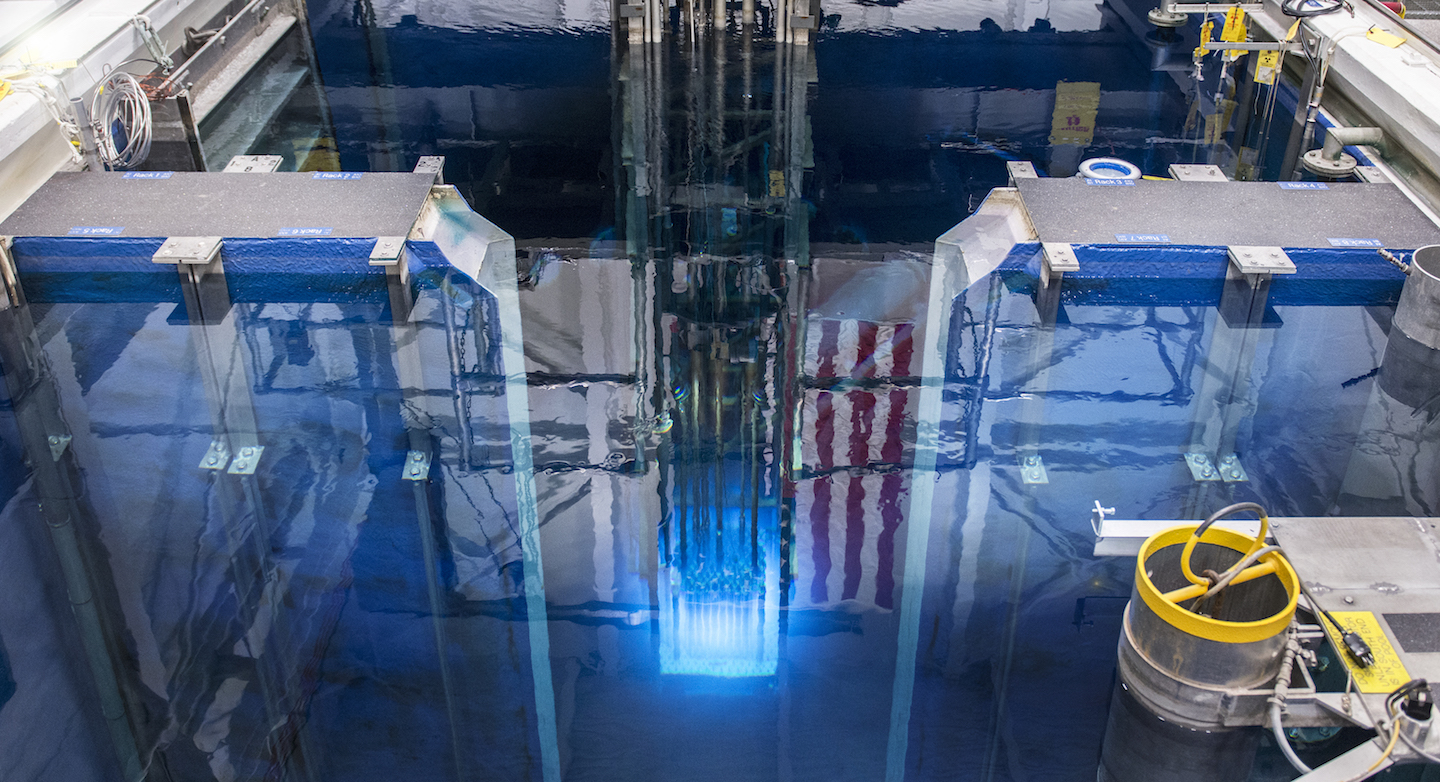
After the briefing we all entered the reactor room where the core is located in a 24-foot-deep pool with approximately 71,000 gallons of demineralized water. Zach explained a few more details about the fuel rods and how the reactor works, and let us peer over the side into the pool to see the reactor core at the bottom.
Then the real fun started. Zach took us into the control room and they fired it up! OK, I’m sure they have a technical term for that process, but that’s the best way I can describe the excitement of watching a nuclear reaction start to take place.
After a few minutes of the reactor “warming” up to full power, Zach took us back out into the reactor room where we could peer down into the pool at a very glowing reactor core. Now, we had to leave our phones and all personal effects out in a separate room before we started the tour, so I have no pictures I can show you, but the photos of the glowing core on the website link above, and on their visitor information page, are what it looks like.
I should point out that Penn State’s Breazeale Nuclear Reactor – which was named in 1971 to honor Professor William M. Breazeale, the reactor’s first director and its first licensed operator – does not produce electricity. It is for research and education purposes. In fact, Zach will tell you the type of reactor it is, is extremely inefficient at creating electricity, but very good for research needs.
What it is also good at is providing a safe, real-life look into the nuclear reaction world for anyone who is interested. And given the ever-changing energy landscape in our country, being able to safely use nuclear power looks like a tremendously viable option for we humans to navigate our way through history.
Which is why it’s wonderful that we have this resource right here in Happy Valley for anyone who wants to check it out. It’s not the secret installation I thought it was when I started as a Penn State student back in the day. These days Penn State is amazingly welcoming with this facility, and very much wants us to become educated about it and the entire Radiation Science & Engineering Center.
So, if you’re a teacher with a class of students, or a local business group, or just a bunch of friends who would like to see something pretty darn interesting, go to the visitor information page on the center’s website, and contact them to set up a tour. And watch them create a nuclear reaction right in front of your eyes!
More Columns
View all Columns
Penn State’s Matt Campbell on AD Pat Kraft: ‘My Focus Has Been Completely on This Building’
Penn State coach Matt Campbell, whose 3-3 Nittany Lions last won nearly a month ago, is focused on his team, his staff and the preparations for their game on Saturday […]
Frank: To My Sister, on Her Birthday
Today is my sister Meryl’s 80th birthday. I could wrack my brains for the perfect gift idea, but when you get to be as old as Meryl is, and you’ve […]

Paterno: Upcoming Impact Award Honorees Represent ‘the Very Best of Penn State’
Penn State is the nation’s leading service-oriented university, a school where philanthropy and helping others is part of our DNA. That commitment is university-wide, including a long history of service […]


