Words of wisdom: As far as your body goes, take the little things seriously. Why? I’ll tell you a story. But first I’m going to break every normal column-writing convention and tell you how the story ends before I even begin. Here goes…
I had tonsil cancer and now it’s gone.
Granted, I will have PET scans every so often to make sure the cancer doesn’t return, but that is, according to the medical professionals, a 1% or less chance. And I’m still healing from the surgery that removed the cancer, but the outward signs of that healing – the scars, swelling and speech issues – are diminishing every day.
In other words, I’m in pretty good shape, all things considered!
Now, if you are still interested and want to read my story about why you should pay attention to the little things, here’s what happened…
On Thursday, July 17 I went to our family dentist to have a crown replaced. While he was working on the crown he asked me something slightly odd — when was the last time I looked in my mouth? I replied that I had no idea but probably years. I brush my teeth and gargle twice a day, and floss all the time, but opening my mouth and going, “ahhh” in the mirror is not something I do very often.
He said, “Let me show you something.” He inserted a small camera in my mouth and put the picture up on a screen. There was a big lump in the back of my mouth where my right tonsil would be and it was covering up half of the opening to my throat. Now, it didn’t affect my breathing or swallowing, and didn’t hurt, so I had no idea it was there. The dentist said, “You need to get that checked out.”
That weekend our daughter was bringing her boyfriend home for us to meet for the first time (and we really liked him), so my wife, Jackie, and I were busy preparing and I sat on this piece of information. Since the lump didn’t hurt, wasn’t causing any issues, and no one knew how long it had been there, it seemed like it might be important, but not emergency-level urgent, so I would deal with it first thing next week.
After the weekend was over I got involved in work and didn’t do anything about it until Tuesday when my wife said I really needed to see someone about this. Rather than try to get in to see our family doctor I went to one of the local express facilities in town. The provider there looked at it, couldn’t figure out what it was, said I should see an ENT and put me on antibiotics on the chance that it was an infection.
After I got home I tried to get an ENT appointment but the soonest they could see me was a month later. Jackie then called another office and was able to get me an appointment in two weeks in another town.
Later that week our dentist followed up with me to see how things were going. I told him what had happened and that although I was on antibiotics the lump didn’t seem to be getting any smaller. He took it upon himself – fantastic dentist this one! – and was able to get me an appointment the following Monday, July 28.
That Monday, Jackie and I drove to Altoona and saw the doctor there. He examined the lump for a minute or two and then sat down and said, “You have cancer.” Keep in mind, I thought it was, at worst, a very screwed-up tonsil.
Jackie and I were shocked. Talk about a good start to your week.
During the rest of the visit the doctor explained it was likely a treatable cancer caused by the HPV virus that many of us carry. The virus lies dormant most of our lives and then pops up for unknown reasons in the form of tonsil cancer.
While this was encouraging news, I’m old enough that the “c” word still holds a considerable amount of fear for me, and the gap between the initial information and the hopeful news may have been just a minute or two, but seemed like an eternity as my brain processed the information.
Of course, our immediate desire was to know what to do next and how soon we could do it. First would be a CT scan, and then based on those results, most likely a biopsy, possibly followed by the ability to remove the mass and do radiation treatments.
Gratefully, the doctor quickly scheduled the CT scan for that Thursday, July 31. The results confirmed what he thought – it was a mass – but it involved the surrounding tissue and blood supply as well, which meant removing it would not be possible for him and that radiation was the probable treatment. But a biopsy was needed.
The biopsy surgery took place the following Wednesday, Aug. 6. It was outpatient surgery, only took about an hour, and the pathology results came back pretty quickly. It was cancer – luckily the very treatable version of the HPV virus – and radiation would work very well. So, the “I’m not going to die right away” specter was lifted for a bit!
During this time my wife told our kids what was going on with me. Our son, James, works for a nonprofit organization called Uplifting Athletes, which was founded in 2003 by Penn State football player Scott Shirley with the purpose of harnessing “the power of sport to build a community that invests in the lives of people impacted by rare diseases.” Their vision is that “no person impacted by a rare disease feels alone and everyone is inspired with hope for the future.”
It turns out that tonsil cancer is a rare disease, and true to their mission, one of Uplifting Athletes’ contacts strongly suggested we should check in with the University of Pennsylvania’s ENT program, and gave us a doctor to get in touch with. They were able to see us right away, so we sent them all my medical information, and the day after my biopsy Jackie and I were in Philadelphia meeting with Dr. Gregory S. Weinstein and his team.
After an initial briefing with his nurse, Dr. Weinstein came in and the first words out of his mouth were, “You’re gonna be OK.” He talked a bit about the virus, did an examination of my throat, mouth and nose, and then explained what he anticipated would be the treatment plan – the primary part of which was transoral robotic surgery, or TORS for short.
TORS is a robotic surgical technique to treat mouth and throat tumors and conditions that allows surgeons to access hard-to-reach areas through the mouth. It turns out that Penn Medicine was the first medical center worldwide to develop and perfect TORS surgery, and the team there has performed more TORS procedures than any other team in the world.
Dr. Weinstein said their cure rates for this cancer were 90% and above. It was great if you needed surgery, radiation and chemo, even better if you just received surgery and radiation, and was almost perfect if you just needed surgery. Based on the information we provided and his exam, he felt I would likely need both the surgery and radiation, but he was confident I would be fine.
They did need to do their own biopsy to make sure, so we went back down to Philly on the following Tuesday, Aug. 12 for more surgery. We stayed in Philly until Thursday, Aug. 14, when we again met with the doctor and other members of their team – especially plastic surgery folks and speech pathology folks.
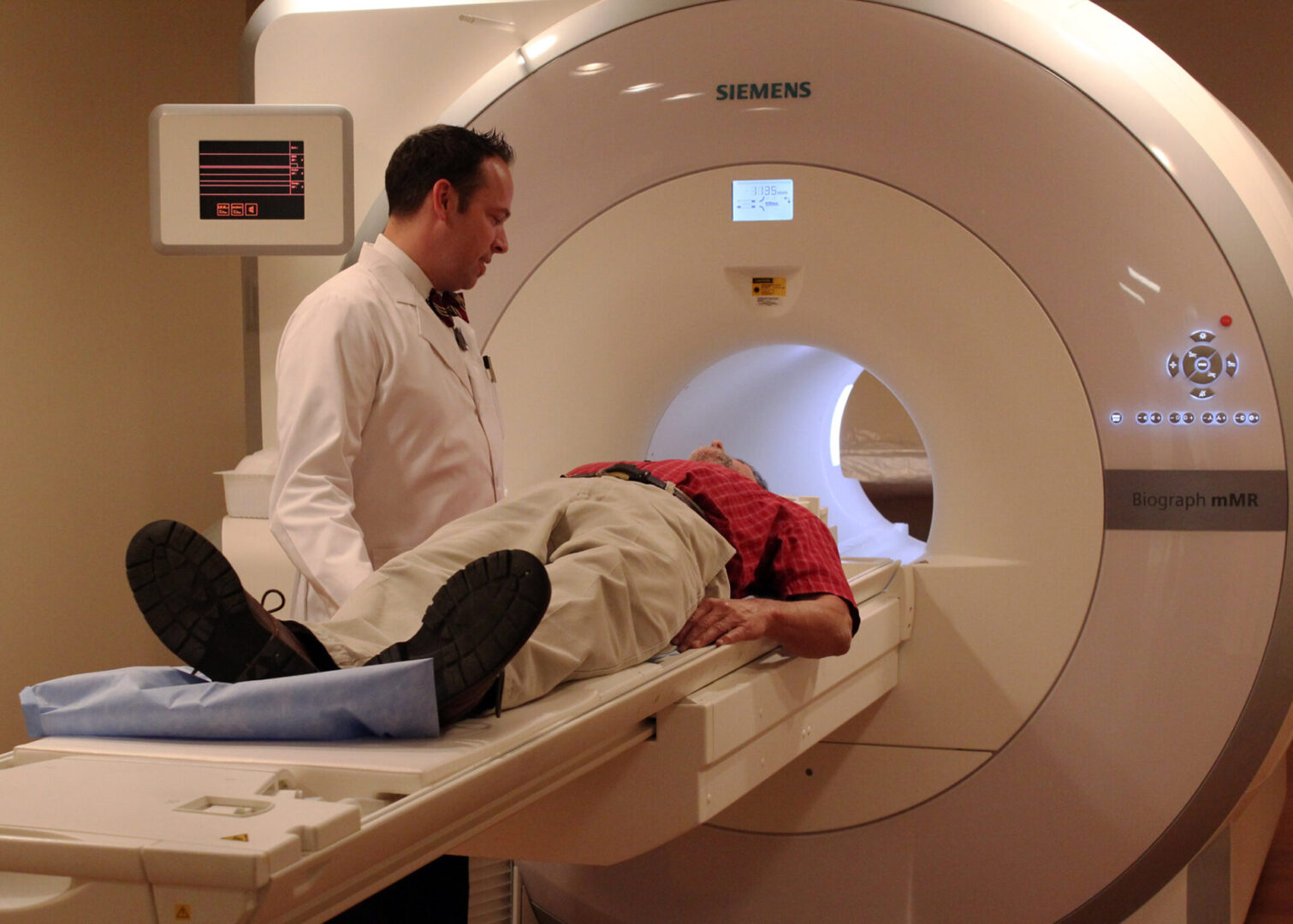
On that day, Dr. Weinstein confirmed what we had known – it was a curable HPV cancer — and that TORS was a great solution to take care of it. We scheduled the surgery for Tuesday, Sept. 2, and in the meantime had a PET scan done just to finalize that everything was what they thought it was.
We reported for surgery at 6 a.m. on Sept. 2, they wheeled me back to the operating room at 8:30 a.m., and my family was able to see me in recovery at 7:30 PM that evening (a long day for Jackie, our two kids and our daughter’s boyfriend, who were all there for support). I had a trach tube, three drainage tubes – one behind my right ear, one under the left side of my chin, and one in my left arm – and a feeding tube in my nose.
What Dr. Weinstein had done was to cut out the lump in my mouth, remove the surrounding tissue, and take out over 40 lymph nodes. Then Dr. Ara A. Chalian, the plastic surgeon, cut a 2” x 2” piece of skin off my left arm – down to the muscle – as well as a vein/artery. They sewed that in place where the lump was in my mouth and connected it to a blood supply in my neck. Then they cut a 2” x 2” patch of skin off my upper left thigh and sewed that where they took the skin from my arm. They also implanted a Doppler wire to make sure the graft in my mouth was getting blood supply.
I spent the next week in the hospital and they released me the following Tuesday, Sept. 9, sending us home with the three drainage tubes, the feeding tube, the trach and a ton of supplies. Each drainage tube was emptied and measured three times a day. The trach tube was also cleaned and changed three times a day minimum. This involved squirting saline into the opening, suctioning it out and removing and replacing the inner cannula. This is not a job for the faint of heart. We had home health help, but Jackie had to do a lot of this on her own – a brave woman!
We drove back to Philly for our first follow-up visit on Thursday, Sept. 18, when, if things were going well, they would remove some or all of the tubes. Happily, the drainage amounts were good, so all three of those tubes came out. I was able to swallow a little, so the feeding tube – which had come out on its own the night before while I was sleeping – was not replaced. And they felt good about my breathing so the trach came out as well. I was operating under my own power!
Then, the moment we had been waiting for: the pathology results. Dr. Weinstein told us there was no cancer in the surrounding tissue and the lymph nodes, so I didn’t need radiation. He said I was doing great, things looked wonderful, and we could go home and continue recuperating.
We had a follow-up appointment this past Thursday, Nov. 6 to meet with the plastic surgeon and the speech pathologist, and they are happy with the recovery. We go back in mid-December for a follow-up PET scan and if everything is fine there – as they expect it will be – I will be good and likely put on an annual visit basis.
The end of the story – which you already know – is that I went from “you have cancer” to “you don’t have cancer” in less than two months. What an adventure.
And… I’m acutely aware of what a lucky adventure it is. Having a sister who passed away from colon cancer, my wife having had skin cancer, and many other friends having dealt with, or died from, various cancers, it is a very defining diagnosis. It makes you rather quickly take stock of your life and think about who you are and who you want to be.
Here’s a reality: According to the American Cancer Society, in this country an estimated 40 out of 100 men and 39 out of 100 women will develop cancer during their lifetime. That is a lot of people. That essentially means that if you are in a group of five people, two of you will get cancer sometime in your life.
However, it doesn’t have to be a mortality issue. Because of advances in treatment and earlier diagnosis, survival rates for some cancers have increased. On a daily basis, most of us are not working on the advances in treatment side of things, but we can all play a part in the early diagnosis side of things.
As I said at the beginning, the takeaway is this: As far as your body goes, pay attention to the little things, especially if you don’t know anything about them, because you do not know when that little thing could become a big thing. Life is about living and you have to be alive to live it.