
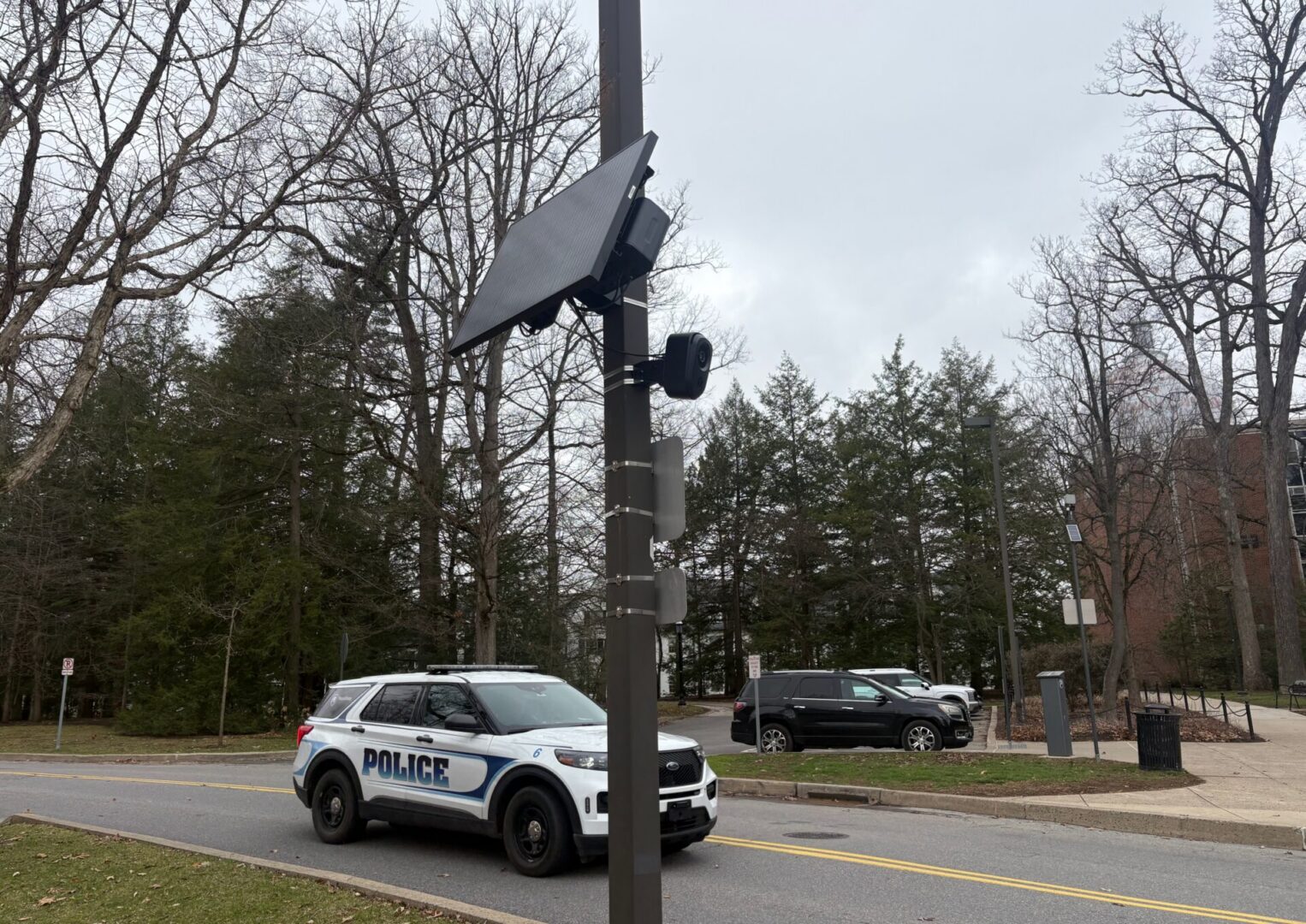
Penn State is ending its use of Flock Safety cameras following the expiration of a one-year contract for the controversial automated license plate readers.
University Police and Public Safety installed the cameras at perimeter locations around the University Park campus after entering a contract with Flock in 2025. A department spokesperson previously described the initiative as a “pilot program” supporting law enforcement efforts including stolen‑vehicle recovery, missing‑person cases and investigative leads.
Now the university is removing what a Flock watchdog website reported were more than 20 of the cameras around the campus.
“After reviewing the system’s cost, return on investment and operational value, the department determined that it would not renew its now expired initial one-year contract with Flock Safety for stationary automatic license plate reader cameras at select campus perimeter locations,” Penn State police public information officer Jacqueline Sheader told StateCollege.com in an email on Wednesday.
Sheader added that Penn State police “regularly evaluates the tools and technologies it uses to support campus safety and operational needs.”
“UPPS remains committed to using public safety technology responsibly and in alignment with University policies and applicable laws,” Sheader wrote. “The department will continue to research and assess tools that may provide similar operational capabilities in a more cost-effective manner and no decisions for a replacement system have been made.”
Automated license plate readers — made most notably by Flock Safety but also other manufacturers like Motorola and Axon — capture images of passing vehicles and use AI assistance to log license plate numbers and vehicle characteristics that are then stored in a database for a set amount of time unless otherwise preserved. (Flock recently lowered its default retention time from 30 to seven days.)
They have come under intense scrutiny amid increased use by law enforcement, who say they are a useful and important crime-solving tool, and heightened privacy concerns.
Pennsylvania lawmakers from from both major parties have introduced legislation in the General Assembly to limit or ban ALPRs, according to Spotlight PA, while both Democratic Gov. Josh Shapiro and his Republican opponent in the Nov. 3 election, Stacy Garrity, have voiced opposition to the cameras.
Privacy advocates, politicians and ordinary citizens have raised concerns about their use for mass surveillance, pointed to instances where police have misused the cameras to track individuals for personal reasons and cited cases where they have misidentified suspects.
At least one Centre County municipality has explored whether it can ban or tightly restrict use of the cameras.
Ferguson Township’s Board of Supervisors discussed the issue in September. Supervisor Trevor White said that in part his concerns were tied to Penn State’s use of Flock cameras and whether the university could expand the program to its properties in the township, such as in the Science Park Road corridor where the university has multiple research facilities.
“These Flock cameras have been placed in such a density that you cannot get onto campus without getting tagged by them,” White said at the time. “You cannot opt out, and that is not something we want for people just passing through our municipality, or people that live in our municipality that have to commute to campus. You are getting put in a database. You do not have an option to opt out. It’s that simple. I think that we in Ferguson have a duty to ban these.”
Township Manager Warren Obenski said preliminary research indicates the township does not have the authority to enact an ordinance banning ALPRs on private property. White suggested the possibility of filing a lawsuit against any entity that installs ALPRs on property in the township for violating the Fourth Amendment rights of residents, and supervisors also discussed a resolution that “captures the sentiment of our community and where the board stands” so that that the township could add its voice to potential legislation addressing ALPRs.
DeFlock, which maps ALPRs throughout the United States, showed Flock cameras along roadways and entry points around the University Park campus including:
- University Drive
- Porter Road
- Pollock Road
- Curtin Road
- White Course Drive
- East Park Avenue
- Bigler Road
- Shortlidge Road
- West Big Hollow Road
- Allen Road
- West Park Avenue
- Innovation Park
More Local News
View all Local News
High Court Rejects Challenge to How Pa. Treats Users Accused of Supplying Drugs in Fatal Overdoses
In a concurring opinion, one Pennsylvania Supreme Court justice said “the spirit of the law is in considerable tension with its text” and “it is the latter that binds us.”
State College Borough Council OKs Free Holiday Season Parking Downtown
State College Borough Council on Monday approved a program that will once again offer free downtown parking options for the holiday season, starting before Thanksgiving and continuing until after New […]

Harlem Globetrotters Bringing New Rivalry Tour, Free Pregame Party to Bryce Jordan Center
The Harlem Globetrotters are bringing a new lineup of rivals and interactive basketball challenges to Penn State in March as part of the team’s 2027 world tour. The exhibition basketball […]


