

In 2026, college football and college sports face a most uncertain future. Athletic departments are having financial difficulties, and even the largest schools are not immune.
Nationally it is common to be operating business models that require “donors” to cover their “revenue sharing/labor costs” each year. Involuntary student activity fees, general funds (tuition and tax dollars) and direct state appropriations have now become part of the ways some schools are covering costs.
Even the participation agreement that is supposed to govern college sports is in trouble as major conferences resist signing on.
The status quo is not sustainable.
A range of issues must be addressed to secure a viable and realistic future for college football and by extension college sports. This column is not advocating for any side of the issues. It is simply a scorecard of things that will have to be addressed sooner than later, or we will have ongoing long-range structural problems.
Because it repeats itself, history is instructive here.
In the late 1920s, coach Amos Alonzo Stagg at football power the University of Chicago wrote about an issue that sounds familiar now.
“Playing ringers fell into three types: first those who did not even take the pains to register for courses; second, those who registered for courses which they seldom attended; and those who registered for snap courses in some department where the work was easy and little or no work was required.
“There are still quite a number of colleges and universities where the first and second case still happen. There are still quite a number of colleges and universities where the third case can and does happen.”
The key message from these notes from Stagg goes back to this: ”the formation of conferences where free and frank discussions take place along with passage of the one year residence and satisfactory scholarship rule, has tended to do away with this and all other unfair practices.”
In the 1920s, conferences were able to get together and solve problems. To be fair, over a century later, repeated attempts to solve the problems have continually been met with litigation. The settlements and outcomes of litigation have repeatedly set and reset the college sports model.
College sports needs protection under the law; legislation to prevent litigation.
To that end, the identification of many of the issues below reflects the input and concerns of coaches, ADs, athletes, former athletes, lawyers, U.S. senators and fans.
Even after a White House executive order and amid a flurry of current activity in Congress, not all of the issues below will be covered or addressed. But they will have to be at some point in time.
The issues facing football:
- Employee status must be addressed. There is huge resistance to this, but when a football player is making two or three times as much as a university president it may be time to rethink the current “non-employee” status.
- Enforceable player contracts that preclude tampering with other teams’ players and coaches. Contracts should be transparent in terms of length, so that schools know who is and who is not under contract.
- Player injuries: How do we cover them both in the short term and if there is potentially long-term disability?
- Collective bargaining for players. This could protect both the players and schools from a chaotic and unregulated transfer portal era. Given the size of contracts and the lack of an overarching apparatus to enforce contracts both from an athlete’s standpoint and the school’s standpoint, this may be long overdue.
- Collective bargaining for coaches that mimics the NFL’s model. A coach currently under contract with one school could not leave to go to another school. That prevents coaches from leveraging their school every two years with demands for more money, or more spending on facilities. As with the NFL, this would essentially eliminate the eight- and 10-year contracts that create massive buyout liabilities for schools. It also would help get control of the spiraling costs of assistant coaches’ contracts.
- A certification process for player agents. The NFL has a process by which agents are regulated to protect the players. Currently, anyone can act as a player’s agent in college. There are no protections.
- A two-track system for player contracts/national letters of intent could be in order.
A. The first would be an academic track contract. The player and the school would sign a four-year contract that would include a four-year guarantee that the player won’t be cut (except for disciplinary/legal issues). It also protects the school from athletes transferring (unless they go through a more robust, mutually agreed upon process). This contract would include the traditional full scholarship, room, board and books. It would also include revenue sharing and potential NIL money as a separate income stream.
B. The second would be a more professional contract. These could be one-year or multi-year deals. This would give the athlete the option to take an academic track or an apprenticeship track. (More on that in the next point). But at the end of the contract term the obligation between the player and the school concludes. The school is free to let them go at will and the player is free to go at will.
- An NFL apprenticeship program. Many of the one- or two-year transfers are merely going through the motions academically, which wastes time for professors, wastes tuition money and takes up seats in classes that may have limited enrollment. Like programs for associate degrees, it would offer coursework relevant to the athlete’s stated professional goals. This would include courses in financial literacy, agent awareness, contracts, nutrition, training, public relations and community engagement. If a player chooses this option, it is buyer beware if they fail to make the NFL.
- A return to real Name, Image, Likeness (NIL) is needed. Collectives and other NIL programs are essentially pay-to-play schemes set up to skirt the revenue sharing cap. True NIL is supposed to be the use of a player in an ad or representing a company or organization based on a perceived return on investment.
- A limit on eligibility. Five years seems to be a number that is acceptable to most people. It is an extension beyond the previous four years of eligibility. The cap has benefits as a risk analysis — we do not want 25-year-old men competing in football against 17- or 18-year-old freshmen. The creeping extension of eligibility and the transfer portal also impacts high school recruitment as schools will opt to keep players longer or seek older players in the transfer portal.
- Gambling: As part of the collective bargaining for coaches and players, we need enhanced monitoring and enforcement of gambling activities. Legislation eliminating prop bets on college athletes should also be discussed.
- A playoff format and schedule that is based both on competitive realities and player safety. The proposed extension of the playoff requires more players to play more games and endure more hits and potential for injuries. The current playoff expansion conversation is devoid of player input. Note: Future player contracts may have to mirror coaches’ contracts with bowl or playoff bonuses.
- If the bill being crafted by Senators Cruz (R-TX), Schmitt (R-MO) and Cantwell (D-WA) passes the Senate, the consolidation of TV media rights allowing conferences to combine rights now becomes an option. The total pot of network/cable media rights is finite. With the NFL re-doing their deals, they will soak up a huge portion of that pool. Is there more leverage with college football as one entity, or do the networks benefit by working conference by conference?
- A realistic calendar for football. The current calendar is a piecemeal addition or subtraction of elements creating a mishmash calendar where coaches and players are leaving while teams are still playing. The entire calendar needs to be reconstructed from the ground up. The early signing day, the transfer portal, the length of the season, coaching changes, bowl schedules, conference championship games, the academic calendar; all these things overlap and/or conflict with one another.
- Limits on staff sizes, which will then curb expenses. Given the expansion of technology like AI and analytics being used in the game now, much more of the basic ground level work can now be done using fewer people. We recognize that there need to be new departments set up, like a GM office, and recruiting/evaluation of high school and college players. But the creep of oversized staffing has to turn back.
- Academic eligibility and performance monitoring combined with initial eligibility requirements.
There are other issues, but these form the major issues that need to be resolved once and for all. We either define and resolve the issues, or future litigation decisions will continue to jolt the system over and over.
More Columns
View all Columns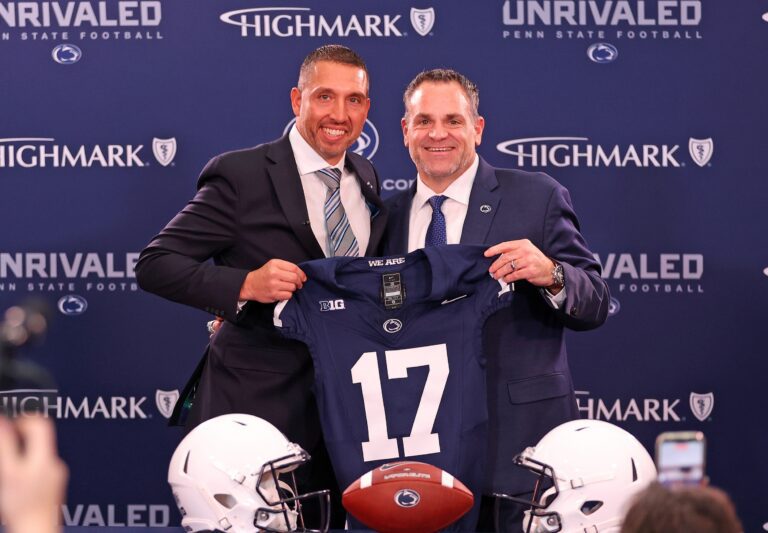
Penn State’s Matt Campbell on AD Pat Kraft: ‘My Focus Has Been Completely on This Building’
Penn State coach Matt Campbell, whose 3-3 Nittany Lions last won nearly a month ago, is focused on his team, his staff and the preparations for their game on Saturday […]

Frank: To My Sister, on Her Birthday
Today is my sister Meryl’s 80th birthday. I could wrack my brains for the perfect gift idea, but when you get to be as old as Meryl is, and you’ve […]
Paterno: Upcoming Impact Award Honorees Represent ‘the Very Best of Penn State’
Penn State is the nation’s leading service-oriented university, a school where philanthropy and helping others is part of our DNA. That commitment is university-wide, including a long history of service […]


