
This story originally appeared in the May 2026 issue of Town&Gown magazine.
C-NET (Centre Network), with four full-time and three part-time employees plus interns from Penn State’s Bellisario College of Communications, produces and broadcasts about 520 government and educational programs annually in Centre County. From gavel-to-gavel coverage of local government meetings to interviews with political candidates, educational programming and high school games, C-NET highlights public officials’ work and community life. Its importance is heightened in today’s charged political climate as newsrooms nationwide shrink.
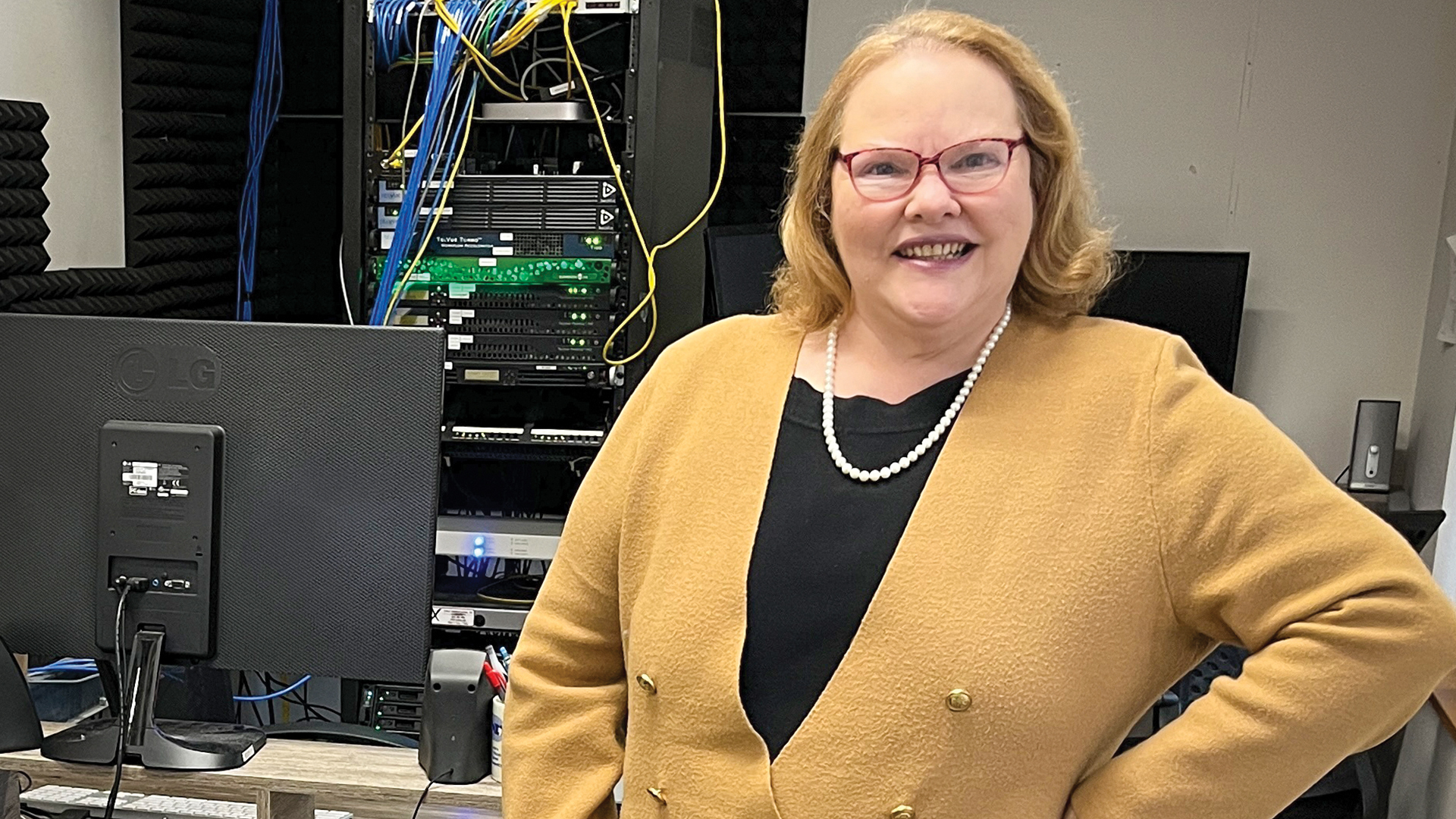
“Now more than ever, transparency and the ability to know what is going on at all levels of government is really essential,” says Cynthia Hahn, who plans to retire May 31 after leading C-NET as its executive director for 20 years. (The C-NET board on April 14 approved operations manager Stephanie Yager as the next executive director.)
“It takes a lot of time to really know what is going on,” Hahn says of keeping abreast of local government. “But I think that we make it easier for people, so that they are able to participate and perhaps serve even.”
Hahn is part of a local public service power couple. She joined the State College Borough C-NET board in 2001 and became executive director in 2006. Her husband, Donald, a former State College mayor and council member, is a magisterial district judge.
C-NET was born from a task force established after a 1984 survey by Penn State graduate students found a strong interest in the community to develop a local programming channel. Powered by 10 charter members, C-NET began broadcasting in 1988. That November, C-NET broadcast live for the first time, with election coverage from the Centre County Courthouse.
Nearly four decades later, C-NET has grown to 17-member-organizations with regular live streams of meetings and events. It operates with Hahn’s six-producer crew and Penn State interns. A producer covers each meeting, with larger crews at major events like football games.
“If we really had to, we could do six meetings at one time,” Hahn says.
C-NET operates on a roughly $400,000 budget, she says. Cable subscribers pay about 32 cents monthly in PEG (Public, Education, Government) fees for equipment like cameras, microphones and servers. Operating costs are funded by member dues ranging from about $67,000 to over a five-year period, she says.
“We really have a small budget and a tight belt when it comes to finances,” Hahn says.
“I am so proud and impressed by the amount of content we do.”
Here’s more from our conversation:
How has C-NET evolved over your tenure, during an era of big technological change?
Hahn: When I arrived, we were recording on huge cassette tapes and then reusing the tapes, taping over them for meetings. We really only had a record of a meeting for about two months before it would be used again. Then we graduated to our first server that allowed us to have files that played, and we graduated from VHS to DVD. And then finally, in 2015, we did away with DVDs and we’re totally file-based. Now, with storage being so inexpensive, we’re able to keep meetings forever. We store them online for two full years. And that’s the other thing: The online presence is amazing. We would record meetings, and some of them were live, but the idea of live streaming, the YouTube (channel) that has emerged, and all of our programs and our online content being available, is just remarkable.
How has C-NET grown over that time?
Hahn: When I started, there were three or four municipalities that were members, along with two school districts and the county. We’ve now grown to seven municipal members, the same school districts, the (Centre Region Council of Governments), the county government and four regional authorities. We’ve added something like eight members since I’ve been here. The number of programs we produce is far and above what you’ll find at other stations like C-NET. We are what is known as a PEG station, which stands for Public, Educational and Government. Now, coverage from the Centre County Courthouse. Nearly four decades later, C-NET has grown to 17-member-organizations with regular live streams of meetings and events. It operates with Hahn’s six-producer crew and Penn State interns. A producer covers each meeting, with larger crews at major events like football games.
“If we really had to, we could do six meetings at one time,” Hahn says.
C-NET operates on a roughly $400,000 budget, she says. Cable subscribers pay about 32 cents monthly in PEG (Public, Education, Government) fees for equipment like cameras, microphones and servers. Operating costs are funded by member dues ranging from about $67,000 to we do not have the public access component, so we’re really an “egg” (EG).
(Hahn later explains): In the beginning, there was a lot of trepidation about the stereotype of (Saturday Night Live’s) “Wayne’s World” — would C-NET become a vehicle for racist, extremist groups to have a platform? And so, Centre County decided at that point to not embrace the “P” in PEG, to simply be education and government. And if an outside group wants C-NET to come and record their event, what they need to do is find sponsorship from a member organization. So, the county sponsors (broadcasts like) the League of Women Voters candidate nights and the Literacy Council spelling bee. You’ll have different programs sponsored by member organizations who agree to essentially pay for it.
But the fact that one PEG organization serves so many municipalities and school districts and local governments and authorities is really unheard of. Most of the time, you’ll find a station serving one municipality or one school district. That is a tribute to our members who support us and fund us, that they are so cooperative with each other. Centre County really is very fortunate to have this organization so that every little township and borough doesn’t have to have its own station.
For those government entities that aren’t on board, is it a financial thing, a philosophical thing where they don’t want to be on television, or a bit of both?
Hahn: I think for some, it is financial. Others simply feel that if people are interested, they will come to the meetings, and they don’t feel that motivation to reach out to their constituents. Each entity will have its own reasons. And often, they sort of have to warm up to it. Ferguson Township was not a member until 2009. Everyone thought that Ferguson should be a member. And finally, they were. And now they do the Planning Commission as well. So, sometimes it takes multiple years, but eventually it happens.
What would you say to municipalities or other government entities that are reluctant to join?
Hahn: I cannot see any downside to public engagement. I don’t think there is a reason to keep the public out of the decision-making process. It can only be better with more of the public involved. Life these days is very complicated and very busy. And often, people simply do not have the time to necessarily go to all the government meetings that perhaps they would like to.
There’s an article on your website from the Centre Daily Times back in 1988 in which some people expressed concern that meeting participants would “grandstand” for the TV camera. Has it played out that way?
Hahn: The truth is that we have seen the opposite to be true. People watch what they say and do because the community is watching, and they are accountable for their actions and for what they say.
On the flip side, one of the arguments was that the camera would inhibit discussion. Have you seen that?
Hahn: I do not believe it has, but I’m sure you could find someone who could give you an example of that. But not that we have noticed.
All you have to do is watch a four-and-a-half-hour College Township meeting to know that discussion is not inhibited. When the public cares about something, they show up and they voice their concerns.
Are meeting broadcasts edited?
Hahn: I can count on one hand, if that, the number of times that I have been asked to edit something out by a member of a meeting. It just doesn’t happen. The members are embracing transparency, but there’s also a certain integrity to covering it gavel to gavel. It’s all there. It isn’t edited.
I think one time there was a gentleman who had a health episode in the middle of a meeting. They called me the next day and said, “Is there any way that that can be cut out?” I mean, it’s really not of any probative value. And sure, we did. But it just isn’t really an issue.
Do you measure your audience, how many views you get on a particular meeting?
Hahn: Comcast considers viewing data to be proprietary. I cannot ever tell anyone how many people watch on cable. What I do have access to are the number of views online.
(Online, we see) anywhere from 25 views to several hundred — three, four hundred — for a meeting of great interest. Things sort of ebb and flow. Municipalities have a hot-button issue or a very controversial discussion and you’ll see a lot of people watching. The next meeting, you’re back to 20 or 25.
What are you most proud of in your 20 years at the helm?
Hahn: I am the most proud of the way the organization has grown over the past 20 years, while still remaining true to our mission of providing residents with a way to connect with local government. C-NET provides a level of transparency that keeps residents informed and engaged.
As you retire, what will you miss the most?
Hahn: I will miss the day-to-day work most of all — the opportunity to play a part in the mission of C-NET. And, of course, the people — the staff and board of directors of C-NET, and the staff and elected officials of our member organizations, all of whom have provided the support to make C-NET’s growth possible. T&G
Mark Brackenbury is a former editor of Town&Gown.
More Community
View all Community
Centre Film Festival Unveils Lineup for 8th Annual Event
The Centre Film Festival will return Nov. 2-8 with films from around the world, Pennsylvania-made productions, special guests and screenings in State College and Philipsburg. Organizers announced the lineup for […]
Farm-to-Table Dinner in Millheim to Feature Sustainable Agricultural Leader, Showcase Local Food
The Penns Valley Conservation Association is partnering with Elk Creek Cafe & Aleworks in Millheim to host a Farm-to-Table Dinner showcasing and celebrating the fresh and nutritious foods that local […]

Fellowship of Churches to Hold ‘Light the Night’ Event in Walker Township
The Nittany Valley Fellowship of Churches will hold its annual Light the Night event from 6 to 7:30 p.m. Wednesday, Oct. 28 at Walker Township Park. The free family event […]


