
JULIAN — The Tom Ridge Wetlands is the site for the Autumn in the Wetlands photography contest sponsored by Wildlife For Everyone and The Centre County Gazette.
The wetlands host a number of species, from mammals to reptiles to amphibians; but this time of year is especially good for taking pictures of migratory birds. The birds are drawn to the Tom Ridge and Julian wetlands because the area is like a one-stop-shop for traveling birds, according to Ron Rohrbaugh, director of conservation and forest science with Audubon Pennsylvania.
“The wetlands is good habitat, but by itself, it’s not that big. It’s the combination of the wetlands and the adjacent forested corridor and ridge that give it value as a good stop over for migrating birds,” said Rohrbaugh. “The ridge will funnel migration. Raptors migrate by day and use thermals to fly. Songbirds migrate by night and drop down into the wetlands at daylight looking for food and cover to rest.”
The Tom Ridge and Julian Wetlands are part of the Atlantic Flyway. There are four flyways for migrating birds in the United States: Atlantic, Mississippi, Central and Pacific flyways, and each flyway is like a highway for migrating birds to follow to get from their breeding grounds to warmer climates for the winter, then back again.
“Many birds follow the ridges and valleys of Pennsylvania south and the Bald Eagle Ridge and valley are major flyways. The Tom Ridge and Julian wetlands are regular stopping points for migrating waterfowl, particularly the Julian site because it usually has more open water,” said Mark Nale, local naturalist.
As the seasons change, so does the variety of birds at the wetlands, according to Nick Kerlin, local birder and former Pennsylvania state park education specialist and park manager.
“Different seasons will attract waterfowl, shorebirds and songbirds, all wetland species unique to that habitat. Wetlands in the Centre region are not common, so the Tom Ridge Wetlands is a unique place to observe and learn about the bird species that frequent it during migration and those species that stay to breed,” said Kerlin. “More than 180 species have been observed at the Tom Ridge Wetlands and the adjacent Julian Wetlands. Information can be found on the eBird website provided by the Cornell Lab of Ornithology.”
Margaret Brittingham, Penn State professor of wildlife resources, said there is a variety of migrating birds to see right now at the Tom Ridge Wetlands.
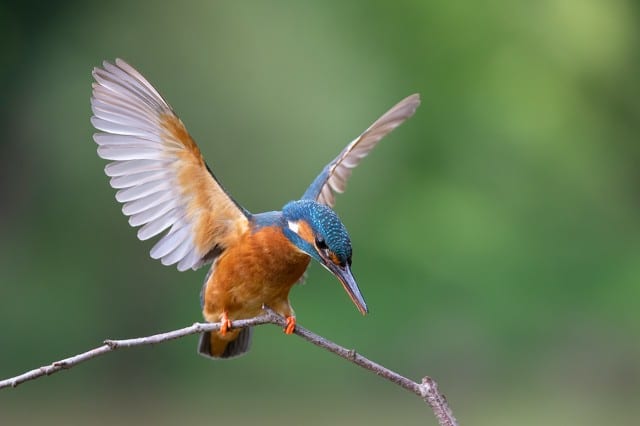
“The wetland is alive with the sound of goldfinches and song sparrows feeding in the fields along the wetland edge. Great-blue herons stalk fish along Bald Eagle Creek while kingfishers patrol the stream,” said Brittingham. “At this time of year, you may also see migrating flocks of songbirds including red-eyed vireos, common yellowthroats and palm warblers. These flocks migrate at night and stop at the wetland to refuel before continuing on their journey south. If you are lucky, you may also see a migrating osprey flying over.”
Visitors will find other animals at the Tom Ridge Wetlands in addition to the birds, and the plants and vegetation also make good subjects for the Autumn in the Wetlands photography contest. There are two categories for submission: youth 17 and under and adults 18 and older. The photographer must be amateur, and by that, never has been published or received payment for a photograph. The Autumn in the Wetlands photography contest is underway right now. Pictures submitted must be taken between Sept. 23 and Oct. 14. A complete list of the rules and regulations can be found at Wildlife For Everyone’s website at www.wildlifeforeveryone.org, by calling the office at (814) 238-8138 or by emailing info@wildlifeforeveryone.org.
Susan Hawthorne is the executive director of Wildlife For Everyone Foundation.
More Community
View all Community
Alpha Fire Company Receives $10K Donation From Bloom Energy During ESPN Radio Tour Stop
ESPN Radio’s College Football Campus Tour made its first stop at Penn State, bringing a $10,000 donation from Bloom Energy to Alpha Fire Company ahead of Saturday’s Homecoming matchup between […]

Curtin Village Set to Host Final Tour of 2026
Visitors are invited to journey into Pennsylvania’s ironmaking past on Sunday during the 2026 season’s final guided tour of Eagle Iron Works and Curtin Village

Kitty Yoga at Axemann Brewery Brings Community Together for Centre County PAWS
Axemann Brewery in Bellefonte looked a little different on Wednesday night depending on which floor you were on. Downstairs, people played cornhole, sat around the bar and gathered for trivia. […]


